
David Benavidez–Andy Ruiz Heavyweight Matchup Discussed — But Ruiz Would Be a Test, Not a Shortcut

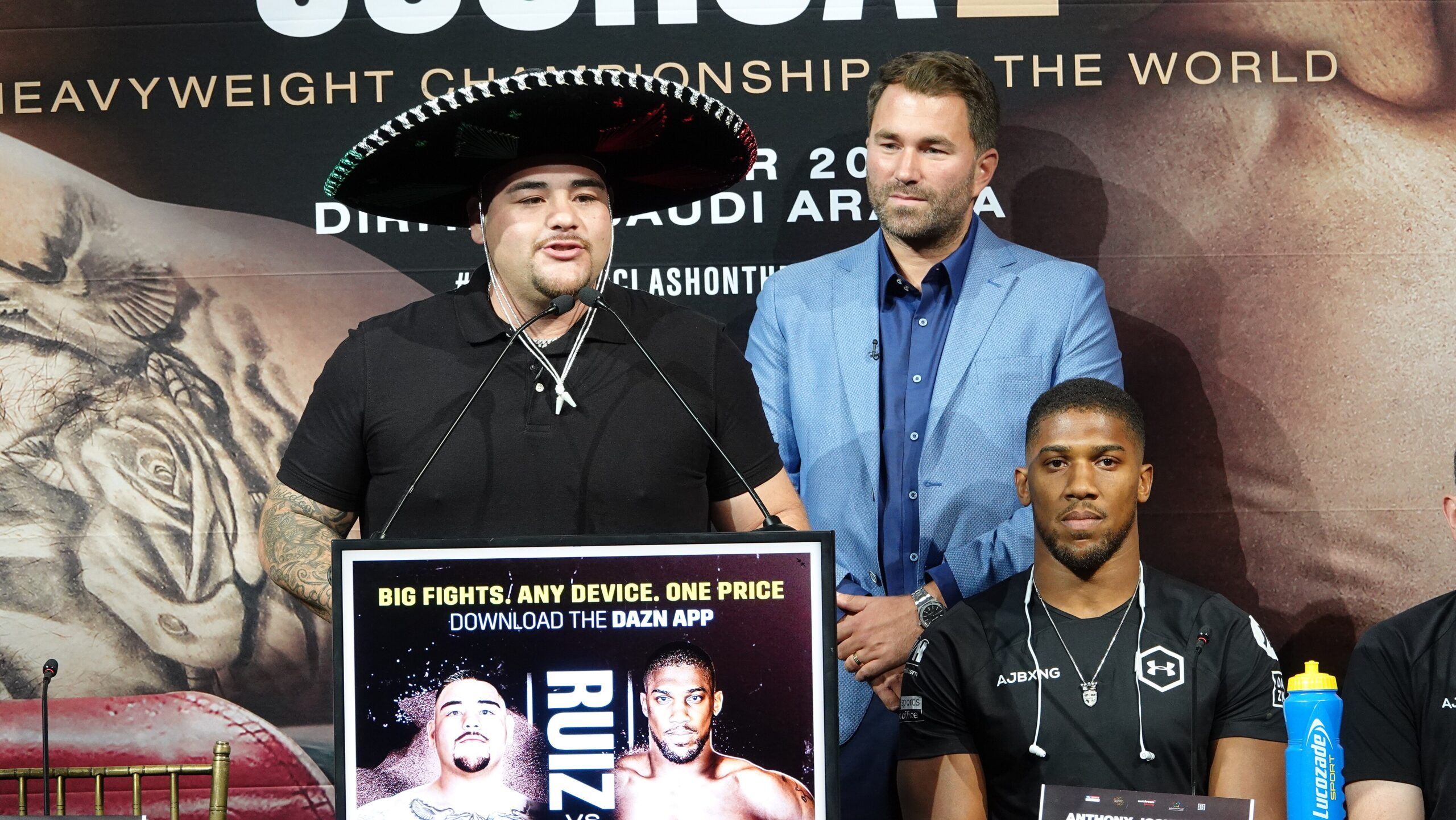
David Benavidez has conquered another division, and his camp is already discussing an even bigger challenge.
After becoming the WBA Super and WBO cruiserweight champion, the unbeaten Benavidez is being linked with a possible future move to heavyweight and a fight against former unified heavyweight champion Andy Ruiz Jr. The idea came from Benavidez’s father and trainer, José Benavidez Sr., who told ProBox TV that his team “would love” to make the matchup.
For now, that is all it is: an idea.
No fight has been announced. There is no confirmed negotiation, contract, date, venue, weight or financial agreement. Ruiz has not publicly confirmed that he wants the fight under the circumstances being discussed. Boxing 24/7 emphasized that point in its October 5 analysis of the proposed matchup.
Still, the discussion raises a legitimate question about Benavidez’s future. His speed, combination punching and sustained pressure have traveled successfully from super middleweight to light heavyweight and now cruiserweight. Heavyweight would present a different examination because the issue would not simply be whether Benavidez could land on a larger opponent.
The real question would be what happens when that opponent absorbs his combinations, remains in front of him and pushes back with natural heavyweight strength.
Ruiz could provide that test. Beating him would give Benavidez credibility in a new division and generate considerable commercial momentum. It would not, however, prove that Benavidez is ready to defeat the leading heavyweights in the world.
The Ruiz Proposal Remains a Long-Term Possibility
José Benavidez Sr. introduced the idea during a ProBox TV interview published September 17. He expressed interest in eventually matching his son with Ruiz but described the proposed fight and the camp’s wider plans as a dream rather than a completed arrangement.
That distinction matters because Benavidez may still have substantial business at cruiserweight.
Boxing News reported that Benavidez Sr. envisions a sequence involving prospective fights with Michal Cieslak and Jai Opetaia before a possible move to face Ruiz at heavyweight. None of that sequence has been confirmed. Until opponents, promoters and sanctioning bodies formalize those plans, it should be treated as an outline of the camp’s ambitions rather than Benavidez’s established schedule.
There is also no public indication that Ruiz has accepted his role in that outline. His intentions, his next opponent and his willingness to face a fighter moving up from cruiserweight all remain open questions.
Robert Garcia nevertheless offered an informed assessment of the hypothetical matchup. According to Boxing News, Garcia told ProBox TV that Benavidez could be “a little bit too much” for Ruiz because of his speed, combinations and punch volume. Garcia also identified the danger for Benavidez: If Ruiz can absorb those punches and impose his strength, the smaller man could find himself in serious trouble.
That is the central tension that makes the idea worth discussing.
Benavidez would enter with the faster pace and the more varied combination attack. Ruiz would enter as the experienced natural heavyweight, carrying the kind of physical mass and strength Benavidez has never encountered under competitive conditions at that level.
The fight would not merely ask whether Benavidez can move up on a scale. It would ask whether the style that has defined him can continue working when the physical resistance changes.
Ruiz Would Test Whether Benavidez’s Weapons Travel to Heavyweight
Benavidez’s latest performance provided strong evidence that his offense translates to cruiserweight.
According to the Nevada State Athletic Commission, Benavidez weighed 196.8 pounds for his May 2 fight against Gilberto Ramírez, who weighed 200 pounds. Benavidez stopped Ramírez at 2:59 of the sixth round to win the WBA Super and WBO cruiserweight titles. Premier Boxing Champions lists Benavidez at 32-0 with 26 knockouts following that victory.
Those numbers establish Benavidez as an elite cruiserweight champion. They do not answer every heavyweight question.
At cruiserweight, Benavidez can still use his pace to force opponents into extended defensive sequences. He throws combinations in layers, remains active after his first attack and often denies opponents enough time to reset. His pressure is not based exclusively on single-punch power. It comes from the accumulation of accurate punches and the difficulty of matching his work rate.
Ruiz would challenge that formula in ways a cruiserweight cannot fully reproduce.
As a career heavyweight and former champion, Ruiz understands how to operate against larger men. His compact combinations and quick hands can become dangerous when an opponent remains close after punching. If he can withstand Benavidez’s initial offense, hold his position and answer during the openings between combinations, Benavidez would have to manage exchanges against a naturally stronger fighter.
That is precisely why Ruiz cannot be reduced to a famous name attached to Benavidez’s heavyweight debut.
Benavidez may be faster, more active and sharper over sustained stretches, particularly if Ruiz struggles to match his pace. But speed alone would not settle the most important issue. Benavidez would still have to show that he can maintain his output when his punches do not produce the same physical reaction they created in smaller divisions.
He would also have to prove he can protect himself while working at that pace. Throwing long combinations creates opportunities for counters, and the cost of defensive mistakes increases when the opponent is a natural heavyweight. If Ruiz can force Benavidez into clinches, lean on him or make him fight through sustained physical contact, the matchup could reveal whether Benavidez’s engine remains an advantage after the division takes its tax.
The danger Garcia described depends on Ruiz staying durable enough to reach that stage.
If Ruiz cannot cope with Benavidez’s speed, the fight could become increasingly one-sided as the rounds pass. If he can absorb the volume and make Benavidez uncomfortable physically, the smaller fighter would face a question that none of his previous victories has answered.
Ruiz’s Recent Loss Limits What a Victory Would Prove
Ruiz’s résumé gives the proposed fight recognition, but his current position must shape any evaluation of what beating him would mean.
The WBC reported that Damian Knyba defeated Ruiz by unanimous decision on September 4 at Prudential Center in Newark. Ruiz was dropped in the seventh round, and the reported scores were 117-110, 114-113 and 114-113. The Guardian listed Ruiz’s record at 35-3-1 with 22 knockouts following the loss.
That result does not make Ruiz harmless. It does prevent the sport from treating him as the definitive measure of heavyweight readiness.
A victory over Ruiz would show that Benavidez can defeat one experienced natural heavyweight with championship history. Depending on the performance, it could demonstrate that his speed and combinations remain effective against a significantly bigger opponent. It could also give promoters a marketable result to support larger heavyweight opportunities.
It would not automatically establish that Benavidez can handle every leading contender in the division.
Ruiz would enter the proposed matchup coming off a defeat, not from a position at the top of the heavyweight landscape. His name would attract attention because of what he accomplished during his championship career, but a recognizable résumé and current elite form are not the same thing.
The manner of victory would therefore matter almost as much as the result.
If Benavidez controlled the pace, handled Ruiz’s physical pressure and remained effective after Ruiz absorbed his early combinations, the performance would offer meaningful evidence that his style can function at heavyweight. If Benavidez struggled whenever Ruiz closed the distance or appeared unable to discourage him, even a decision victory could expose limitations that stronger or more active heavyweights might exploit.
A loss would carry an equally clear message. It would suggest that Benavidez’s success across lighter divisions cannot simply be projected upward without accounting for the physical realities of heavyweight boxing.
That makes Ruiz a credible entry test rather than a shortcut.
Benavidez’s Cruiserweight Plans Must Become Concrete First
The discussion is moving faster than the actual matchmaking.
Before Benavidez can prove anything against Ruiz, his proposed cruiserweight path has to be clarified. The possible fights involving Cieslak and Opetaia remain unconfirmed, and either matchup could affect the timing and logic of a heavyweight move. A significant cruiserweight schedule would also carry risks that cannot be ignored merely because the Ruiz idea has generated attention.
If Benavidez eventually decides to move up, promoters would then need to confirm that negotiations with Ruiz have started. They would have to disclose the intended weight, contractual terms, date and venue. Ruiz would have to accept the fight, and his own activity could change the matchup considerably before it becomes realistic.
Until those steps occur, the responsible approach is to analyze the idea without presenting it as an event.
The proposed fight is compelling because it would produce evidence that another routine victory could not. Benavidez would be entering a division without a cruiserweight limit protecting him from opponents who are naturally larger. Ruiz would give him an immediate look at the physical resistance, strength and close-range danger that come with that decision.
If Ruiz absorbs Benavidez’s combinations and forces sustained heavyweight exchanges, the fight becomes an examination of adaptation. Can Benavidez reduce his output without losing control? Can he remain defensively responsible after throwing? Can he prevent a stronger opponent from dictating the physical terms?
Those answers would tell us far more than the excitement created by announcing another move up in weight.
LET’S TALK ABOUT IT
Would beating Andy Ruiz prove David Benavidez belongs at heavyweight, or would it only earn him the opportunity to face a leading contender?
Is Ruiz the right first heavyweight test, or should Benavidez complete his proposed cruiserweight business before discussing another division?
Outlets cited in this story
- The Guardian
- Boxing News
Spot an error? Send a correction. We fix mistakes in the open.