
Deontay Wilder Accepts Jai Opetaia Fight Offer — But This Crossroads Fight Is Not Final

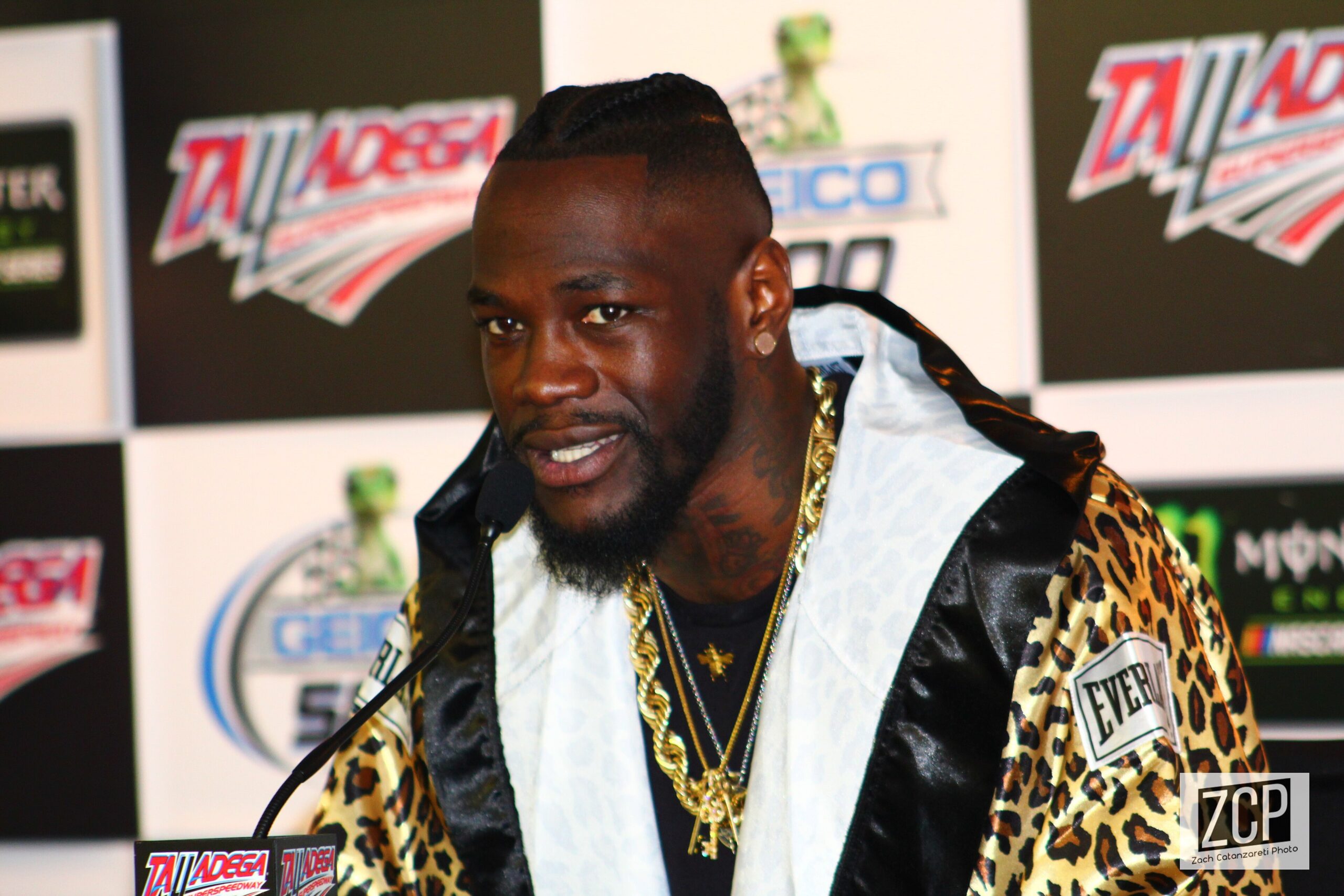
Deontay Wilder has reportedly accepted an offer to face Jai Opetaia at heavyweight on the Tyson Fury–Anthony Joshua undercard, creating the possibility of a crossroads fight with consequences far greater than its supporting position on the card might suggest.
Wilder’s manager, Shelly Finkel, told boxing journalist Dan Rafael that Wilder had accepted the proposed fight and was waiting to learn whether it would proceed. Dana White, Opetaia’s promoter, separately told Sky Sports that the cruiserweight is “more than likely” to appear on the December 11 event in Cardiff and that Wilder is among the opponents being discussed.
Those developments make Wilder–Opetaia a serious possibility. They do not make it official.
Neither Opetaia’s acceptance nor signed contracts have been confirmed. No promoter, broadcaster or venue has formally announced the matchup, and the official Principality Stadium event listing confirms Fury–Joshua—not Wilder–Opetaia. The proposed bout should therefore be treated as an active negotiation rather than a completed fight.
If it is finalized, however, the matchup would ask two significant questions at the same time. Wilder would be attempting to prove that he remains capable of influencing the heavyweight division. Opetaia would be testing whether the qualities that have established his authority at cruiserweight can survive against a former heavyweight champion.
That is not an ordinary undercard attraction.
It is a career examination for both men.
Wilder Has Accepted an Offer, but Opetaia’s Position Remains Unclear
According to Rafael’s October 9 report, Finkel said Wilder had accepted the offer to fight Opetaia at heavyweight as the co-feature beneath Fury–Joshua. Finkel also made clear that Wilder’s team was awaiting confirmation.
That distinction matters because boxing negotiations frequently produce announcements from one side before the other side has agreed to every condition. A fighter can accept the general concept of a bout while contracts, financial terms, weight conditions, broadcast requirements and final approval remain unresolved.
The available reporting does not establish whether Opetaia has accepted the fight. It does not establish that contracts have been issued or signed. It also does not identify who must provide the final approval before the matchup can be formally added to the card.
White’s comments to Sky Sports strengthen the possibility without resolving those questions. He confirmed that discussions were underway and identified Wilder as one of the opponents being considered for Opetaia. That places the matchup beyond unsupported online speculation, but it still leaves several stages between discussion and fight night.
There is another unresolved possibility. Boxing News reported that Finkel had also discussed a potential Wilder fight against Murat Gassiev. No agreement for that alternative matchup was reported, but its existence demonstrates why Wilder–Opetaia cannot yet be treated as settled.
Wilder may have accepted one offer while other options remain under consideration.
Until the complete undercard is announced, Opetaia’s position becomes clear and contracts are confirmed, the most accurate description is simple: Wilder–Opetaia is proposed.
The excitement is real.
The fight is not—at least not yet.
The Matchup Would Put Wilder’s Heavyweight Relevance on Trial
Wilder enters these discussions with a familiar advantage and a difficult burden.
His name still carries significance because of what he accomplished at heavyweight, but reputation cannot answer the question facing him now. At this stage of his career, Wilder must demonstrate that he can still defeat opponents capable of creating their own opportunities rather than merely being treated as a recognizable attraction.
Boxing News reported that Wilder defeated Derek Chisora by split decision in April 2026 and scored two knockdowns. That result gave Wilder a victory, but a split decision against another veteran does not automatically restore a fighter to the front of the heavyweight division.
It provides evidence that Wilder can still win a serious fight.
It does not establish how much of his former threat remains.
Opetaia would present a different kind of examination because the proposed bout would not be built around two aging heavyweights attempting to outlast one another. Wilder would be facing a leading cruiserweight seeking to bring his own momentum into the larger division.
The obvious questions would concern Wilder’s ability to manage Opetaia’s speed, movement and activity. Those qualities cannot simply be assumed to transfer unchanged at heavyweight, but they also cannot be dismissed because Opetaia has spent his career in a lighter division.
Wilder would need to produce answers in real time.
A victory could create immediate momentum and place him back into conversations surrounding meaningful heavyweight fights. It would not automatically make him a leading contender, especially when the proposed opponent would be entering unfamiliar divisional territory. Still, defeating Opetaia would show that Wilder remains capable of handling a dangerous fighter arriving with confidence and ambition.
A loss would be considerably more damaging.
Losing to Chisora would have been viewed as a sign that Wilder could no longer reliably defeat established veterans. Losing to Opetaia at heavyweight could suggest that a smaller fighter moving up was already better equipped to compete at a meaningful level in Wilder’s own division.
That would not necessarily force retirement, but it would become difficult to explain what Wilder was still pursuing beyond name-driven opportunities.
For Wilder, this is not simply another recognizable matchup.
It could determine whether his heavyweight relevance remains competitive or merely commercial.
Opetaia Would Be Risking More Than an Unbeaten Heavyweight Experiment
Opetaia’s side of the equation is different because he would be moving toward opportunity rather than trying to recover lost ground.
Sky Sports reported that Opetaia stopped Noel Mikaelian in the ninth round in September 2026. That result maintained his momentum at cruiserweight and helped create the possibility of a larger assignment on one of boxing’s most visible cards.
Facing Wilder would allow Opetaia to test himself at heavyweight without taking an ordinary introductory fight. Instead of gradually adjusting to the division, he would enter against a former champion whose established reputation would make the outcome immediately important.
That creates obvious rewards.
If Opetaia defeated Wilder convincingly, he would gain heavyweight attention that could take several lower-profile fights to build. He would also acquire a recognizable name for his record and place himself in position for more substantial opportunities in the division.
But defeating Wilder would not settle every question.
It would not automatically prove that Opetaia could overcome younger, more active heavyweights. It would not establish how he would perform against the division’s full range of sizes and styles. It would not guarantee that the physical advantages he has enjoyed at cruiserweight would remain equally effective against larger opposition.
It would establish that he could defeat Wilder on that night.
That would be meaningful, but it should not be inflated into proof of complete heavyweight readiness.
The risk is just as real. Opetaia would be entering a division where assumptions about his durability, power and control have not yet been tested under the conditions this matchup would create. Wilder’s heavyweight power would be central to the intrigue, but it should remain a question rather than a prediction.
Can Opetaia withstand Wilder’s cleanest attacks? Can he prevent Wilder from creating the moments that have defined so much of his career? Would Opetaia’s speed and activity allow him to control the fight, or would the demands of competing at heavyweight alter those advantages?
No negotiation report can answer any of that.
Opetaia would also be putting his existing momentum at risk. A move to heavyweight can be framed as ambition, but a damaging defeat could complicate his position even if he later returned to cruiserweight. Fighters do not always emerge from major physical tests with their previous trajectory untouched.
This is why the proposed bout should not be described as a low-risk opportunity for Opetaia simply because Wilder has more to lose.
Opetaia would be pursuing a faster route to heavyweight relevance.
Faster routes usually carry sharper consequences.
A Finalized Fight Would Create Opportunity, Not Immediate Heavyweight Authority
Wilder–Opetaia would be easy to market because it combines a former heavyweight champion with a leading cruiserweight willing to enter the larger division. Placing it beneath Fury–Joshua at Principality Stadium would give the fight an enormous platform and make the winner part of the conversation surrounding the heavyweight landscape.
But visibility and authority are not the same thing.
The winner would gain momentum, attention and leverage. He would not automatically become the division’s leading challenger. Wilder would still need to show that one victory represented sustained competitive value. Opetaia would still need to demonstrate that success against Wilder could be repeated against other heavyweights.
The loser would face the more immediate questions.
For Wilder, defeat could turn a comeback into a closing argument. His April victory over Chisora would become less persuasive as evidence of a genuine return, and future opportunities might depend more heavily on his name than on confidence in his competitive position.
For Opetaia, defeat would require context. Losing to an experienced heavyweight would not erase what he has accomplished at cruiserweight, but the manner of the loss would matter. A competitive performance could show that he belongs in the division even without producing a victory. A one-sided or damaging defeat could encourage an immediate return to cruiserweight and raise questions about whether the experiment should continue.
That is what makes the proposed fight compelling.
Both men could gain something that their current positions do not provide. Wilder could recover credibility. Opetaia could acquire heavyweight legitimacy. Both could also leave Cardiff with more restrictive futures than the ones they carried into the ring.
Before any of that can happen, boxing still has basic business to complete.
Opetaia’s acceptance needs confirmation. Contracts need to be signed. The weight terms, purse arrangements and bout length remain undisclosed. The organizers must formally announce the contest as part of the Fury–Joshua card.
Until then, the matchup exists as a potentially excellent idea with unfinished paperwork.
Boxing has lost plenty of potentially excellent ideas in that space.
LET’S TALK ABOUT IT
If Wilder–Opetaia is finalized, which man has more to gain—and more to lose?
Would beating Wilder immediately establish Opetaia as a legitimate heavyweight threat, or would he still need to defeat a younger, more active contender?
Outlets cited in this story
- Boxing News
- Sky Sports
Spot an error? Send a correction. We fix mistakes in the open.