Emanuel Navarrete Faces O’Shaquie Foster for Control of 130 Pounds — But Undisputed Status Will Remain Out of Reach

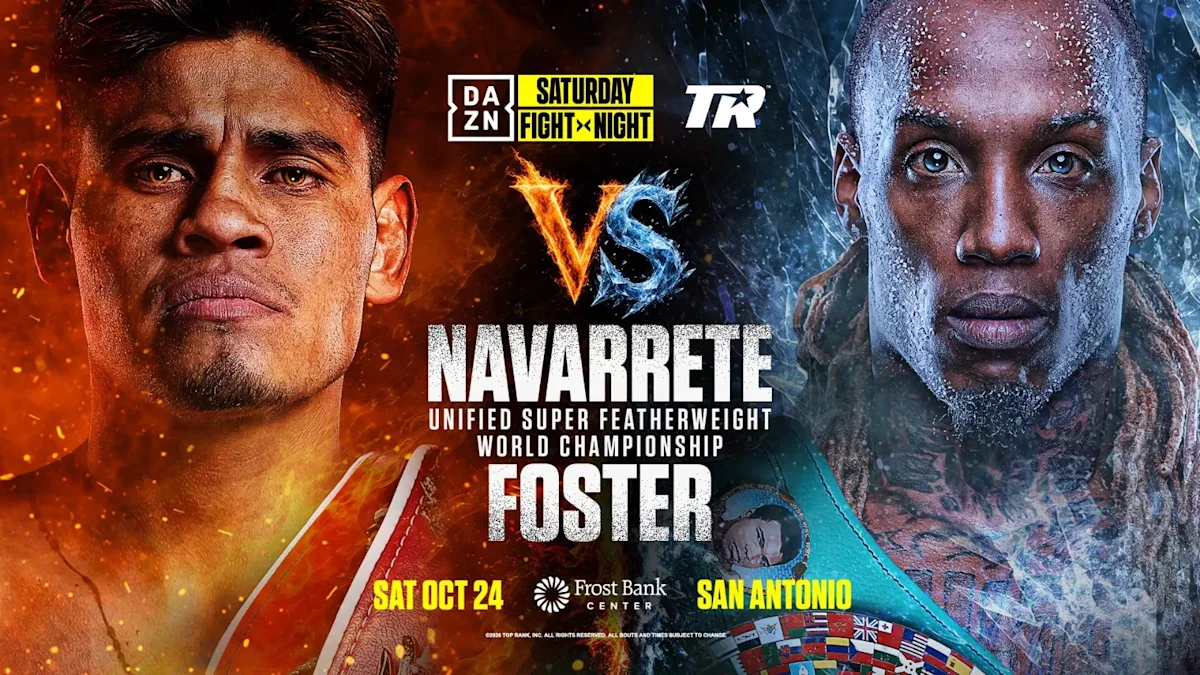
Emanuel Navarrete and O’Shaquie Foster will enter the ring Saturday with three major titles between them and a chance to establish something boxing rarely provides: a clear leader in a competitive division.
Navarrete will defend his WBO and IBF super-featherweight titles against Foster, the WBC champion, in a 12-round unification fight at Frost Bank Center in San Antonio. Top Rank’s official weigh-in results listed Navarrete at the 130-pound limit and Foster at 129.8 pounds, clearing both champions for one of the most consequential fights available in the division.
The main DAZN broadcast is scheduled to begin October 24 at 8 p.m. ET and 5 p.m. PT, according to Top Rank. No result was available in the sources reviewed before publication.
This fight will not produce an undisputed champion because the remaining major sanctioning-body title is not involved. It can still determine the man at 130 pounds. The Ring has attached its vacant junior-lightweight championship after ranking Navarrete and Foster first and second in the division, giving the winner a claim that extends beyond collecting another belt.
The distinction matters.
Undisputed status is a technical achievement requiring every major sanctioning-body championship. Divisional supremacy is a competitive judgment based on who defeated whom. Navarrete and Foster cannot settle the first question Saturday, but they can provide a convincing answer to the second.
The Division’s Two Leading Champions Are Finally Meeting
Top Rank lists Navarrete with a record of 40-2-1 and 33 knockouts, while Foster enters at 25-3 with 12 knockouts. Those records show different levels of stopping power, but the importance of the matchup is defined more clearly by the titles and rankings attached to it.
Navarrete arrives with two sanctioning-body belts. Foster brings a third. The Ring considers them the top two fighters in the division and will recognize the winner as its champion.
That creates unusually direct matchmaking in a sport where leading fighters can remain separated by promotional affiliations, mandatory obligations and competing title paths. Instead of asking which champion deserves to be considered the division’s best, the boxing public will watch two of the strongest claimants attempt to settle the argument against each other.
Foster said during the final press conference that he had pursued the Navarrete fight for almost three years. He also said he was prepared to adjust to whatever Navarrete presented in the ring. That adaptability will be important against a champion whose record includes 33 knockouts and whose presence can turn an orderly contest into a demanding physical fight.
Navarrete, meanwhile, said he changed aspects of his nutrition and preparation and would enter the bout at “100 percent.” That is his assessment of his condition, but the official weigh-in established the most immediate fact: he made the 130-pound limit exactly.
Neither fighter has been left with an easy excuse on the scale. The belts are in position, both champions made weight, and the division’s leading places are ready to be contested.
A Victory Would Create the Strongest Claim at 130 Pounds
Belts alone do not always identify the best fighter in a division. Boxing has too many titles, too many mandatory challengers and too many champions who can operate on separate tracks for that assumption to remain reliable.
This matchup is different because the competitive case and the championship case point in the same direction.
If Navarrete wins, he will have defended his position while adding Foster’s WBC title to the WBO and IBF belts he already holds. He will also have defeated the fighter The Ring ranked immediately behind him. That would leave little basis for another super-featherweight to claim a stronger résumé within the division.
If Foster wins, he will have beaten the division’s No. 1-ranked fighter and taken two additional titles from him. Foster would move from being one of several recognized champions to owning three of the four major sanctioning-body belts, along with The Ring championship.
Either result would produce the same broad conclusion: the winner deserves to be recognized as the leader at 130 pounds.
Foster believes the implications could reach beyond the division. He told The Ring reporter Manouk Akopyan that defeating Navarrete should place him on pound-for-pound lists, according to BoxingNews24.
That is Foster’s stated expectation, not a guaranteed ranking outcome.
Pound-for-pound recognition is subjective. Different publications and observers use different standards, and defeating one elite opponent does not automatically secure a place on every list. The manner of victory, Foster’s wider body of work and the performances of fighters in other weight classes would all influence how that discussion develops.
A Foster victory would nevertheless give him a serious argument. Beating a two-belt champion ranked first in the division would be more than another successful title defense. It would be the defining win of his championship run and evidence that his ambitions belong in a larger conversation.
Navarrete has a similar opportunity even if he has not framed it in the same terms. Defeating Foster would strengthen his standing by removing the clearest rival to his authority at super-featherweight. A champion does not need universal pound-for-pound approval to demonstrate control of his own division.
Sometimes the most meaningful statement is also the simplest: beat the other leading fighter.
Three Belts Still Will Not Make the Winner Undisputed
The importance of Navarrete-Foster should not lead to an inaccurate label. This is a three-belt unification, not an undisputed championship fight.
The remaining major super-featherweight title will still exist outside the winner’s possession. Until that belt is added, the champion emerging from San Antonio cannot properly be called undisputed.
That qualification does not make the fight incomplete as a sporting test. The winner can be the recognized best fighter in the division without owning every available championship. It simply means two separate goals must be distinguished.
Saturday can establish supremacy.
Another fight would still be required to establish undisputed status.
The path toward that final belt may not remain open for long. The Ring reported that the WBO delayed Navarrete’s mandatory obligation to permit the Foster unification. Under the arrangement described by the publication, the winner must complete the mandated WBO defense within 180 days or risk losing that title.
That deadline could force an immediate decision.
The winner may want to pursue the remaining champion and attempt to complete the undisputed championship. The WBO obligation, however, could require a different fight first. Other sanctioning bodies may eventually impose their own demands, injuries can alter schedules, and negotiations for another unification can take longer than expected.
This is how boxing can produce clarity and instability at the same time.
For one night, three major belts and the division’s two leading fighters will occupy the same ring. By the following morning, the unified champion could already be facing competing obligations that threaten to separate those titles again.
No purse figures were disclosed in the reviewed sources, and no future opponent should be assumed before the result and the governing organizations’ next decisions become official.
The Winner Must Turn One Defining Night Into a Reign
Navarrete-Foster can answer the most important current question at super-featherweight, but it cannot answer every question surrounding the division.
Winning the fight will establish leadership. Keeping the titles together will require another level of work.
The champion will need to satisfy the reported WBO obligation or reach an arrangement that preserves the belt. He will need to defend the unified position against legitimate challengers. If undisputed status is the objective, he will also need to secure the remaining major championship before boxing’s administrative machinery breaks apart what this fight created.
That sequence matters because a unification victory should represent the beginning of a reign rather than the end of a negotiation.
Navarrete has an opportunity to confirm that the division still belongs to him by defeating the champion closest to his position. Foster has an opportunity to reverse the order, take three belts and convert a long-pursued matchup into the most significant victory of his career.
The official records, weights, titles and rankings already establish the scale of the contest. Promotional language is not necessary. Nor is an invented promise that the winner will immediately become a pound-for-pound fixture or proceed directly into another unification.
The evidence required now is what happens in the ring.
After that, the next standard becomes whether the winner can preserve the unified championship and pursue the one belt still missing.
LET’S TALK ABOUT IT
Does the winner of Navarrete-Foster deserve to be recognized as the unquestioned leader at 130 pounds even without holding the fourth major title?
Should the winner satisfy the reported WBO mandatory obligation first, or immediately pursue the remaining champion and attempt to become undisputed?
Outlets cited in this story
- BoxingNews24
- The Ring
- DAZN
Spot an error? Send a correction. We fix mistakes in the open.