
Janibek Alimkhanuly and Jacob Bank Agree to Vacant Title Fight — But the Winner Will Still Have More to Prove

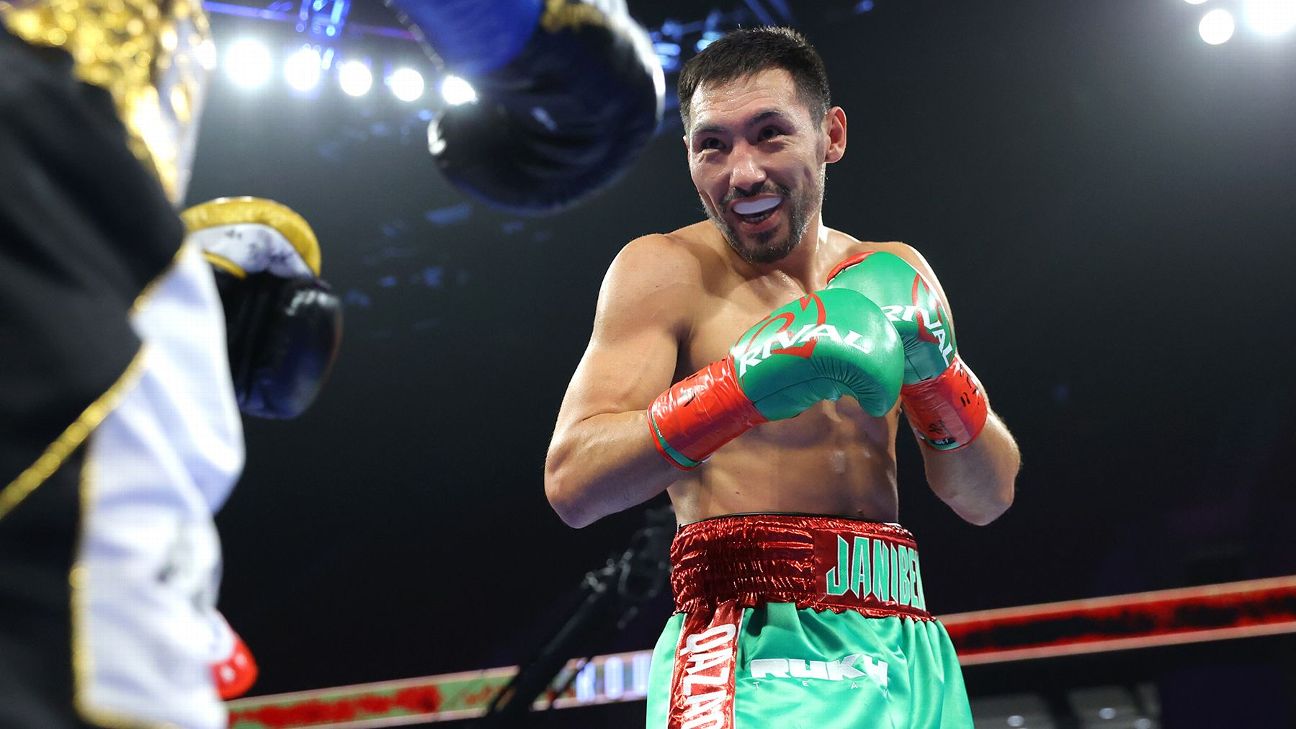
Janibek Alimkhanuly and Jacob Bank have reached an agreement to fight for the vacant WBO super-middleweight championship, ensuring that one unbeaten contender will leave the matchup with a recognized world title at 168 pounds.
WBO president Gustavo Olivieri confirmed that the organization received formal written notification from both teams before its October 7 negotiation deadline, according to Boxing News. The agreement prevents the fight from proceeding to a purse bid and advances the WBO’s effort to crown a successor to Hamzah Sheeraz, who relinquished the championship rather than make his ordered defense against Alimkhanuly.
The essential part of the deal is settled: Alimkhanuly and Bank have agreed to fight for the vacant title. Most of the event itself, however, remains unresolved publicly. No official date, venue, promoter, broadcaster or financial terms have been announced.
The Ring has reported that December in Denmark is being targeted, but neither the WBO nor the fighters’ teams have officially confirmed that plan. Until they do, Denmark remains a reported possibility rather than an established destination.
The fight will produce a WBO champion. It will not necessarily establish the leading fighter in the super-middleweight division.
That distinction should define how the winner is evaluated.
Sheeraz’s Decision Created the Opening
Alimkhanuly’s opportunity initially came through an ordered fight with Sheeraz, not Bank.
According to The Ring, Queensberry Promotions won the September 16 purse bid for Sheeraz’s mandatory defense against Alimkhanuly with an offer of $1,001,809. The fight appeared to have moved beyond negotiations and into the promotional stage, but Sheeraz voluntarily relinquished the WBO championship on September 18 before the defense could take place.
That decision left Alimkhanuly without the champion he had been ordered to face, but it did not remove him from the title picture.
On September 22, the WBO directed Alimkhanuly and Bank to negotiate for the vacant championship. The organization identified Bank as its No. 3-ranked contender and the highest available challenger. The order gave the two sides until October 7 at 4 p.m. Atlantic time to reach an agreement and established a $300,000 minimum bid if the contest had to proceed to a purse-bid hearing.
The written notice received by the WBO means that process will no longer be necessary.
For the organization, the agreement provides a direct path toward filling the vacancy. For Alimkhanuly, it preserves the title opportunity he had already secured as Sheeraz’s mandatory challenger. For Bank, it creates the most significant opening of his career.
It also produces an unusual championship fight in which both men are unbeaten, yet neither is entering as the reigning champion.
The WBO belt became available because Sheeraz surrendered it. Alimkhanuly and Bank can claim it only by defeating each other.
Alimkhanuly Arrives With Experience and Complications
Alimkhanuly enters the proposed fight with the more established championship background.
The Ring lists him at 17-0 with 12 knockouts. He previously held middleweight titles before moving into the WBO’s super-middleweight championship structure and becoming the mandatory challenger to Sheeraz.
His progression to this opportunity has not been uncomplicated.
According to The Ring, Alimkhanuly tested positive for the prohibited substance meldonium before a scheduled fight in December 2025. He was subsequently stripped of his IBF middleweight title and received a suspension from the WBO. The organization later lifted that suspension after he vacated its middleweight championship and moved to super-middleweight.
That history belongs in the record because it forms part of the path that brought him to 168 pounds. It should not be ignored, but it also should not replace analysis of the fight in front of him.
Alimkhanuly remained positioned for a super-middleweight title opportunity, first against Sheeraz and now against Bank. He did not cause the championship to become vacant, and he should not be criticized for accepting the next available opponent after Sheeraz relinquished it.
The task has simply changed.
Instead of attempting to take the title from the reigning champion, Alimkhanuly must defeat another unbeaten contender to begin a new championship run in a higher division. His previous success gives him name recognition and experience, but it does not automatically prove that he will carry the same authority into the super-middleweight class.
A title victory would validate his move in an immediate and meaningful way. It would still be the beginning of his case at 168 rather than the final argument.
Bank Has the Opportunity to Move From Contender to Champion
Bank enters with a different kind of résumé.
The Ring records him at 20-0 with 11 knockouts and reported that he was next in the WBO rankings after the championship became vacant. The WBO’s September 22 order formally identified him as the highest available contender beneath Alimkhanuly for the vacant-title process.
That ranking gave Bank access to the opportunity. What he does against Alimkhanuly will determine whether he can transform that position into championship credibility.
An unbeaten record carries value, particularly when both fighters enter without a professional defeat. It creates legitimate intrigue because neither man has yet been forced to recover from a loss, and one of them may leave the contest with both a championship and a perfect record intact.
But undefeated records are not proof of equality, and they are not proof of divisional supremacy.
Bank’s 20 victories have placed him close enough to the championship for the WBO to select him as the next available challenger. The Alimkhanuly fight represents his chance to demonstrate that he belongs beyond the contender level.
Beating a former middleweight titleholder would be a serious accomplishment. It would give Bank a recognized championship, strengthen his negotiating position and make him relevant to every major discussion surrounding the future of the division.
It would not mean every question had been answered.
Bank would still need to show that he could defend the title against established super-middleweights and maintain his position after the circumstances of the vacancy were no longer part of the discussion. The belt would provide access to larger fights, but those fights would ultimately determine how much authority the title carried.
The same standard applies to Alimkhanuly.
The Belt Will Change the Winner’s Position, Not Settle the Division
World titles matter in boxing, even when they become vacant.
The winner of Alimkhanuly-Bank will possess the WBO championship and the formal leverage that comes with it. He will be able to enter future negotiations as a titleholder, attract challengers seeking a championship opportunity and pursue fights that may be more difficult to secure without a belt.
Those advantages are real.
So is the limitation.
Neither Alimkhanuly nor Bank will have defeated Sheeraz to become champion. That is not their fault, but it remains relevant when deciding what the victory proves. The winner will have defeated an unbeaten opponent for an available championship rather than dethroning the fighter who previously held it.
Boxing often compresses those two achievements into the same word: champion.
They do not always carry the same competitive meaning.
Defeating Bank would show that Alimkhanuly can move into the super-middleweight division and overcome the WBO’s highest available contender. Defeating Alimkhanuly would give Bank the strongest victory of his career and establish him as more than a fighter elevated by a ranking.
Either result deserves full credit.
What it should not produce is an automatic declaration that the winner has become the best super-middleweight in boxing. A sanctioning organization can award its championship, but supremacy across an entire division requires a broader standard than winning one vacant-title fight.
That is especially true in a fragmented championship structure, where different organizations can recognize different titleholders and where the most accomplished fighter does not always possess every available belt.
The next opponent will therefore matter almost as much as the result of this fight.
A new champion who pursues established divisional names will have an opportunity to convert organizational status into wider recognition. A champion who remains separated from the strongest available opposition may retain the belt without settling the larger competitive question.
Alimkhanuly-Bank can determine who owns the WBO title.
What follows will determine what that ownership means.
LET’S TALK ABOUT IT
Will the winner of Alimkhanuly-Bank deserve to be viewed immediately as one of the leading super-middleweights, or must he defeat an established divisional name first?
Which future opponent would give the new WBO champion the clearest opportunity to prove that the belt represents more than an available vacancy?
Outlets cited in this story
- Boxing News
- The Ring
Spot an error? Send a correction. We fix mistakes in the open.