
Vasiliy Lomachenko Cools Talk of Gervonta Davis — But O’Shaquie Foster Offers a Clearer Route

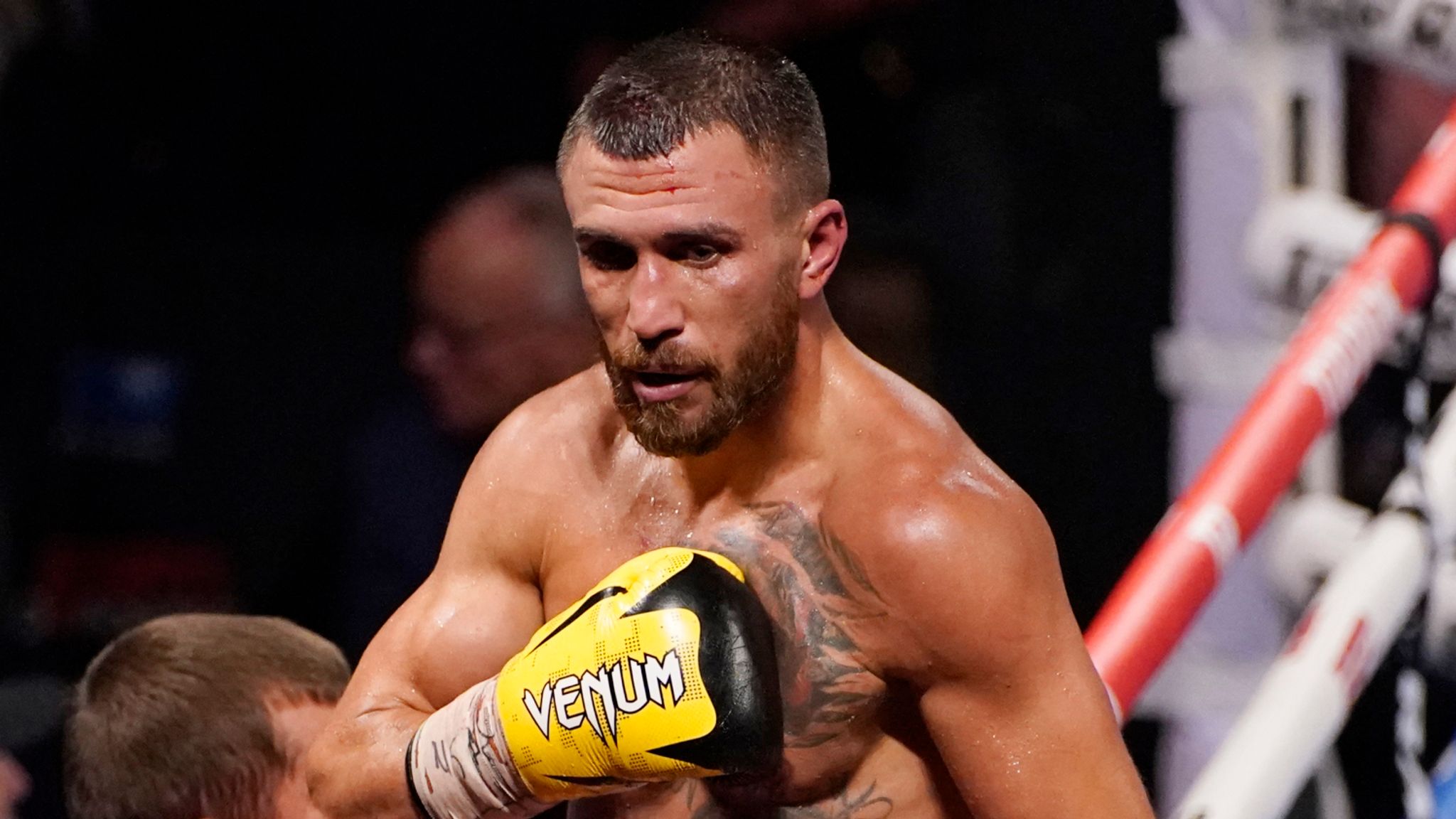
Vasiliy Lomachenko is not ready to build his comeback around a possible fight with Gervonta Davis. Before discussing one of boxing’s biggest names, the former three-division champion wants evidence that his body can still handle the demands of an actual contest.
“You run too fast with the question,” Lomachenko told Fight Hub TV when asked about facing Davis, according to Boxing News. “I need to check my body in a real fight.”
That answer is cautious, but it is not an outright rejection. Lomachenko announced his retirement in June 2025 and has not fought since stopping George Kambosos Jr. in May 2024. Although he is reportedly preparing to return at super-featherweight, no opponent, date, venue or broadcast arrangement has been officially announced.
The Ring reported in May that Lomachenko was ending his retirement and targeting a fall 2026 return. Brian Custer later said Lomachenko told him he intended to fight in November at 130 pounds, according to Boxing News. Those reported plans have not been finalized publicly.
A Davis fight may attract more attention than any other available matchup, but attention is not the only consideration. Lomachenko’s manager, Egis Klimas, has identified becoming undisputed at super-featherweight as the objective of the comeback. O’Shaquie Foster’s recent unification victory has now concentrated three of the division’s four major championships in one place.
That gives Lomachenko a more coherent destination than a speculative blockbuster with Davis.
It does not give him an automatic route there.
Lomachenko Needs to Find Out What His Body Can Still Do
Lomachenko’s response to the Davis question reflects the central uncertainty surrounding his return. His résumé establishes what he has accomplished, but it cannot establish what he will be physically capable of doing after retirement and an extended period outside the ring.
Top Rank’s official event record lists his most recent appearance as an 11th-round technical knockout of Kambosos on May 12, 2024. The victory earned Lomachenko the vacant IBF lightweight title and moved his professional record to 18-3 with 12 knockouts.
Top Rank subsequently recorded his retirement announcement on June 5, 2025. If Lomachenko returns on the reported timetable, he will be attempting to resume his career more than two years after his last competitive round.
That is why the first fight matters more than the name attached to it.
Lomachenko needs to test whether his timing remains sharp enough to control distance, whether his legs can still produce the angles that defined his best performances and whether his body can sustain the activity required to overwhelm elite opposition. Training can provide indications, but it cannot reproduce the consequences of an opponent disrupting his rhythm, attacking his body and forcing him to adjust under pressure.
Boxing News has reported that Charly Suarez has been mentioned as a possible comeback opponent. That matchup remains unconfirmed, and there has been no official announcement identifying Suarez—or anyone else—as Lomachenko’s next opponent.
There is also no sourced indication that Davis or his representatives are pursuing negotiations. Treating Lomachenko’s answer as evidence of an active fight being delayed would therefore exaggerate the situation. At this stage, Davis is a hypothetical option being raised with Lomachenko, not an announced opponent or a confirmed negotiating partner.
Lomachenko’s position is straightforward: first prove that the comeback is physically viable, then discuss where it can lead.
Foster’s Victory Has Reshaped the Championship Route at 130 Pounds
The super-featherweight division changed significantly on October 24, when Foster defeated Emanuel Navarrete by unanimous decision.
Top Rank reported scores of 118-108, 118-108 and 115-111 for Foster, who added the IBF and WBO championships to the WBC title he already held. One champion now controls three of the four major belts at 130 pounds.
For a returning fighter whose team has publicly identified undisputed status as the goal, that concentration matters.
An undisputed campaign can become complicated when championships are divided among several fighters working with different promoters, networks and mandatory obligations. A contender may have to secure multiple opportunities over several years while remaining healthy, active and highly ranked. Even champions can see unification plans collapse because another titleholder takes a different fight or loses before negotiations are completed.
Foster’s victory has simplified the theoretical route. Defeating him would place three championships in the winner’s hands, leaving only the remaining belt necessary to complete the undisputed championship.
That does not mean Foster is waiting for Lomachenko. No fight between them has been announced, and the supplied reporting contains no indication that negotiations have begun. Foster has his own career, obligations and potential opponents to consider.
It does mean his position now aligns directly with the ambition Klimas has outlined for Lomachenko. If the comeback is genuinely about becoming undisputed at 130 pounds, the division’s three-belt champion has greater strategic relevance than a major fight without a defined championship purpose.
Davis may offer the larger spectacle. Foster offers a clearer connection to the stated goal.
A Famous Name Is Not the Same as a Championship Claim
Lomachenko’s achievements will inevitably create opportunities that would not be available to an ordinary returning contender. He has won championships in three weight divisions, headlined major events and spent years competing near the top of the sport.
None of that automatically makes him the leading challenger at super-featherweight in 2026.
Lomachenko has not competed at 130 pounds during this comeback because the comeback has not happened yet. He has not defeated a current contender to establish his place in the division, and he has not demonstrated how effectively he can move back down after last fighting at lightweight.
His history deserves respect. The current contenders deserve a fair process.
That distinction becomes especially important when three championships are held by one fighter. Foster’s belts may make undisputed status look unusually accessible, but they also make a fight with him extremely valuable. Other contenders who have remained active in the division can reasonably argue that Lomachenko should have to establish his claim instead of advancing on reputation alone.
A credible comeback victory would begin that process. The quality of the opponent would matter, as would the quality of Lomachenko’s performance. Beating an opponent chosen only to provide rounds would confirm that he can complete a fight, but it would not necessarily prove that he is ready for a three-belt champion.
Lomachenko must show more than flashes of his former skill. He must demonstrate sustained movement, defensive awareness, durability and enough offensive activity to control a serious opponent over the course of a real fight.
His return should answer whether the old strengths remain functional, not merely familiar.
Foster Fits the Legacy Plan Better Than Davis—for Now
A fight with Davis would likely generate greater mainstream interest than a championship route through the super-featherweight division. Davis brings exceptional drawing power, dangerous punching and the kind of public attention that can transform a bout into an event.
The competitive purpose of that matchup, however, remains undefined within Lomachenko’s reported comeback plan.
There is no reported agreement, no confirmed weight and no sourced indication of mutual negotiations. There is not even an officially announced Lomachenko comeback fight from which serious Davis discussions could logically develop.
Foster represents something different. His three championships create a direct connection between one potential opponent and Lomachenko’s stated legacy ambition.
That does not make Foster the easier fight. A unified champion who has just defeated Navarrete decisively should not be treated as a convenient collection of belts. Lomachenko would have to earn the opportunity and then defeat the man holding them.
The distinction is between structure and speculation.
Foster provides structure: a successful comeback, a credible claim to contend at 130 pounds, an opportunity against the unified champion and, if Lomachenko were to win, a pursuit of the final championship.
Davis currently provides speculation: an enormous matchup that might be possible in theory but has no publicly established place in either fighter’s immediate plans.
That is not evidence that Lomachenko fears Davis or intends to avoid him. His refusal to promise a blockbuster before testing his body is a reasonable acknowledgment of where his career stands. If he returns and looks exceptional, the range of meaningful options will expand quickly.
If he struggles, suffers another delay or discovers that his body cannot reproduce what his mind still understands, neither the Davis discussion nor the undisputed plan will carry the same credibility.
The comeback fight will provide the first useful answer.
LET’S TALK ABOUT IT
Should Lomachenko prioritize a championship route toward O’Shaquie Foster over a possible blockbuster with Gervonta Davis?
And has Lomachenko’s résumé earned him an accelerated title opportunity at 130 pounds, or should he have to defeat a leading contender first?
Outlets cited in this story
- Fight Hub TV
- Boxing News
- The Ring
Spot an error? Send a correction. We fix mistakes in the open.