Evander Holyfield Says Tyson Fury Can Fight Anyone — But Anthony Joshua Is Arriving Years Too Late
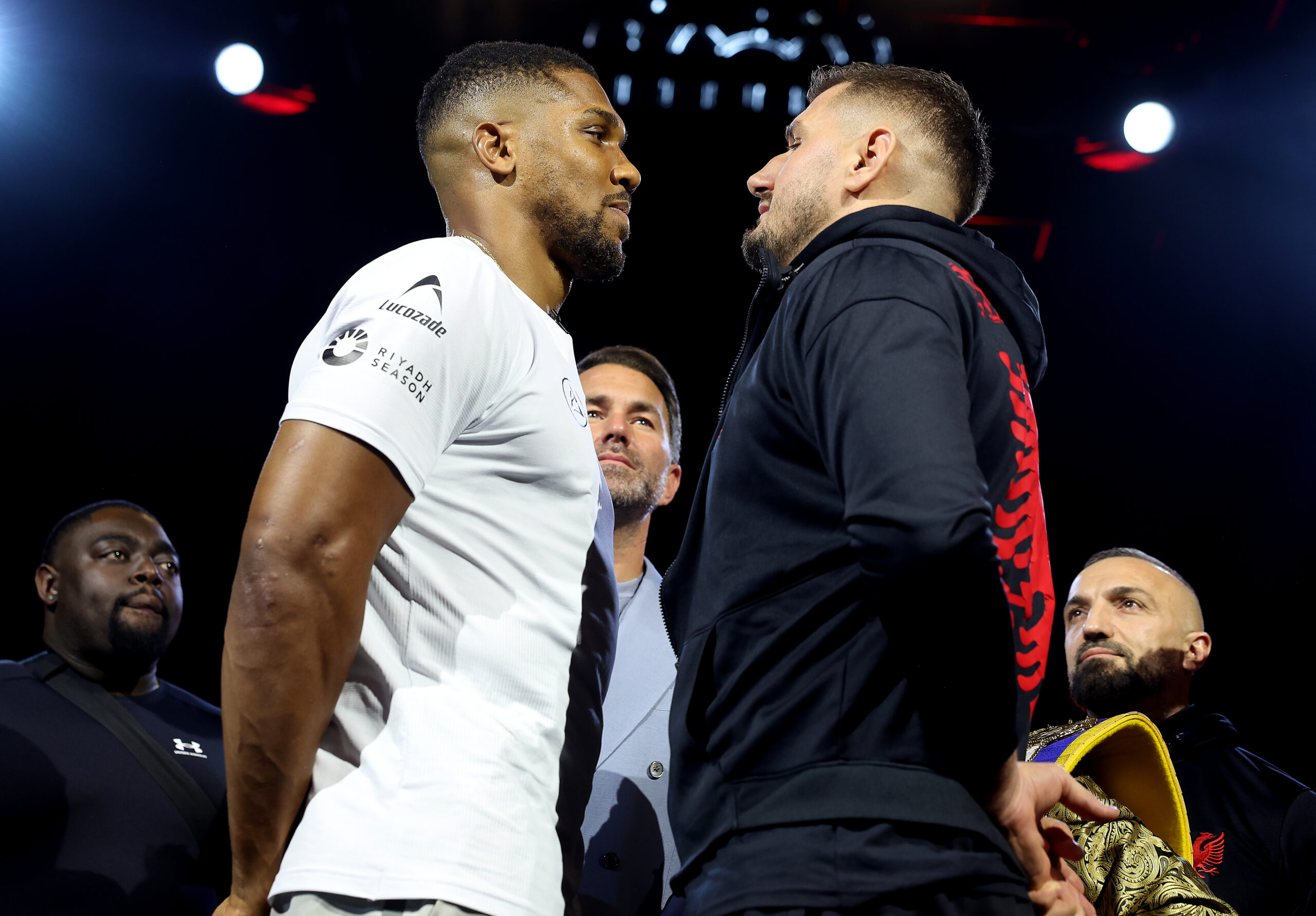
Anthony Joshua faces off with Kristian Prenga at a London press conference.
Evander Holyfield has backed Tyson Fury to defeat Anthony Joshua when Britain’s two most prominent heavyweights finally meet on December 11, 2026, at Principality Stadium in Cardiff, Wales.
Sky Sports reported Holyfield’s prediction on November 22 under the headline “He can fight anybody,” adding the former undisputed heavyweight champion’s voice to a debate British boxing has been trying to settle for years. The remark concerns Tyson Fury—not Mike Tyson—and Sky Sports did not publish a complete transcript or detailed technical explanation of why Holyfield favors him.
The prediction still carries weight. Holyfield understands the demands of major heavyweight rivalries, and his endorsement reinforces the case that Fury’s size, movement and adaptable style could present Joshua with a difficult problem. But the larger story is not simply that Holyfield picked Fury.
It is that Fury and Joshua are finally fighting after the matchup has already lost some of its ability to define an era.
Netflix confirms that this will be their first professional meeting and will stream the event live globally to its members. The fight remains culturally significant, commercially enormous and personally decisive for both men. It can establish who wins their head-to-head rivalry and reshape how the closing chapters of their careers are remembered.
What it cannot do is recreate the moment when both men stood closer to their peaks and British heavyweight supremacy appeared capable of being settled without qualifications.
Holyfield’s Prediction Strengthens Fury’s Case Without Explaining It
According to Sky Sports, Holyfield expects Fury to win. That is the extent of what can safely be established from the published report.
Sky Sports presented Holyfield’s view under the phrase “he can fight anybody,” but it did not provide a full transcript explaining whether his prediction was based on Fury’s movement, dimensions, experience, adaptability or something else. Any attempt to supply a detailed technical argument on Holyfield’s behalf would therefore go beyond the available reporting.
The endorsement nevertheless reflects the broader confidence Fury has long inspired among former fighters and observers. Fury has built his reputation on being unusually difficult to solve. He can box from distance, alter his rhythm and force opponents to make repeated adjustments during a fight.
Joshua brings a different kind of danger. His power and direct offensive approach mean Fury cannot treat the contest as a ceremonial conclusion to an old rivalry. Joshua does not need to win every minute if he can create the right exchange, and Fury’s ability to control the pace will matter only if he prevents Joshua from establishing the kind of range and timing that allow him to punch with conviction.
Holyfield’s prediction should therefore be treated as an informed opinion, not a settled verdict.
Fury still has to prove him right.
Fury and Joshua Are Selling Two Different Paths to Victory
At the September 30 press conference, Fury predicted that he would outbox Joshua, according to Netflix. The statement fits the identity Fury is expected to bring into the contest: control the range, disrupt Joshua’s rhythm and turn the fight into a technical problem that must be solved round after round.
Joshua focused on conditioning and the importance of fighting effectively throughout the contest. That emphasis is equally revealing.
A strong start will not be enough if Joshua cannot maintain his concentration and physical output. Fury’s style can make opponents work even when little appears to be happening. Feints, changes of distance and prolonged tactical pressure can drain a fighter who becomes tense or begins searching too aggressively for one decisive punch.
Joshua’s best chance may depend on balancing urgency with patience. He must apply enough pressure to prevent Fury from becoming comfortable without following him recklessly or allowing frustration to dictate the fight. He also needs to remain dangerous deep into the contest, because Fury’s confidence tends to grow when he believes an opponent has run out of tactical answers.
Fury’s stated plan sounds simpler: outbox Joshua.
Executing it may be more complicated. Joshua’s power ensures that clean mistakes can carry serious consequences, and Fury will be facing an opponent whose career is also tied to the outcome. This is not merely another major event for either man. It is the fight that will determine which of them owns the rivalry British boxing spent years discussing without resolving.
The contest may come down to which fighter can impose his preferred version of the night.
Fury wants a boxing match shaped by movement, variation and accumulated control. Joshua needs to make that control uncomfortable, punish predictable exits and remain effective long enough to force Fury into sustained danger.
Those are the fighters’ stated positions and the logical demands of the matchup. Neither should be confused with a guaranteed outcome.
The Records Show Accomplishment—and the Cost of Waiting
Netflix lists Fury’s record as 36-2-1 with 25 knockouts. Joshua is listed at 30-4 with 27 knockouts.
Those records confirm that two accomplished, dangerous heavyweights will enter the ring in Cardiff. They also reveal why the fight no longer carries the same sporting clarity it once might have possessed.
Both men have accumulated losses. Both have experienced moments that complicated the strongest claims made on their behalf. Both now enter this long-awaited meeting with questions that did not exist when the demand for the fight first reached its loudest point.
That does not make the contest meaningless.
A victory would give one man something neither currently possesses: a professional win over the other. It would settle the direct rivalry in the most basic and legitimate way boxing offers. Whatever arguments remain about timing, form or career trajectory, the winner would be able to say that when Fury and Joshua finally shared a professional ring, he prevailed.
That matters.
It could also significantly alter the late-career legacy of the winner. Fury could validate Holyfield’s confidence and strengthen the argument that his technical versatility remained decisive against the defining British rival of his generation. Joshua could overturn the expectations of those favoring Fury and claim the signature personal victory that had escaped both men while the matchup remained trapped in negotiation and speculation.
But a result in 2026 cannot tell us with certainty what would have happened at an earlier stage.
A decisive Fury victory would not prove that every previous version of Fury would have beaten every previous version of Joshua. A Joshua knockout would not erase the tactical arguments that made Fury the preferred choice among many observers when both men occupied different positions in the heavyweight landscape.
The fight will answer who wins now.
It cannot fully answer who was better then.
The Performance Will Matter Almost as Much as the Result
Boxing records preserve outcomes, but the way those outcomes are achieved shapes how careers are remembered.
If Fury controls the fight from beginning to end, his victory will support the belief that his boxing intelligence and adaptability were always the central problem Joshua could not solve. If Joshua imposes himself physically and wins decisively, the result will challenge the assumption that Fury’s style made him the inevitable superior in their matchup.
A narrow or controversial outcome would settle far less. It could establish an official winner while immediately creating demand for another fight and extending the same debate that followed both men into Cardiff.
That is why the performance matters.
This contest is not only about whether one fighter’s hand is raised. It is about whether either man can still produce something resembling the qualities that once placed him at the center of the heavyweight division. Fury must show that his ability to control opponents remains intact. Joshua must demonstrate that his conditioning, discipline and power can hold together across the entire contest.
The result will own the record books. The performance will determine how much meaning people attach to it.
Even then, the peak-versus-peak argument will survive because it is built around a fight that never happened at the ideal time. That hypothetical cannot be resolved retroactively. It can only be replaced by the reality of what Fury and Joshua are capable of producing on December 11.
Cardiff Will Settle the Rivalry, Not the Entire Era
Principality Stadium is a fitting stage for a fight that has carried enormous importance in British boxing. The scale of the venue and Netflix’s global distribution reflect the commercial power Fury and Joshua still possess.
Promoter Frank Warren told Sky Sports that both fighters would receive record paydays for British boxers. No confirmed purse figures were disclosed in the reviewed reporting, so Warren’s statement should be understood as a promoter’s claim rather than a publicly verified financial breakdown.
The claim also captures the strange tension surrounding the event.
The fight may be more commercially powerful because of the years of anticipation, missed opportunities and changing circumstances. Every delay added another layer to the story. Each separate setback made the eventual meeting feel less certain, and that uncertainty increased the spectacle once an agreement was finally reached.
But commercial escalation is not the same as sporting improvement.
The most valuable version of a fight is not always the version that provides the clearest answer. Fury and Joshua can still produce a memorable heavyweight event, but the passage of time has introduced too many qualifications for the result to serve as an uncontested verdict on British heavyweight supremacy at its highest point.
Cardiff will give us a winner.
It will not give us back the years when this rivalry might have defined the division without an asterisk attached to the timing.
LET’S TALK ABOUT IT
Does Fury versus Joshua still determine British heavyweight supremacy, or does it only settle a rivalry that should have been decided years earlier?
And does Evander Holyfield’s backing reflect Tyson Fury’s remaining advantages, or the greater unanswered questions surrounding Anthony Joshua?
Outlets cited in this story
- Sky Sports
Spot an error? Send a correction.
Keep reading
More Analysis →
David Morrell Stops Julio Rodriguez in the First Round — But the Rebound Is Not Redemption
David Morrell needed a victory after Zak Chelli stopped him in the 10th round on May 9. He needed to interrupt the momentum of a damaging defeat, restore some confidence…

Liam Paro Gives Devin Haney a 24-Hour VADA Deadline — But Boxing Has a Bigger Problem
Liam Paro’s team has given Devin Haney 24 hours to enroll in VADA testing for their scheduled December 19 welterweight title unification, placing one of boxing’s major year-end fights under…
 REAL TALK THE BOXING STREETS
Moses Itauma Plans February Return — But Winning Alone Will Not Complete the Rebuild
Moses Itauma is reportedly targeting February 2027 for his first fight since Filip Hrgovic handed him the first defeat of his professional career. The return would begin an important rebuilding…
REAL TALK THE BOXING STREETSAmari Jones Stops DeAundre Pettus in Eight — But the Title Test Comes Next
Amari Jones already held the position every rising contender spends years pursuing. He was unbeaten, ranked as the IBF’s mandatory middleweight challenger and waiting for the championship picture to clear.…