







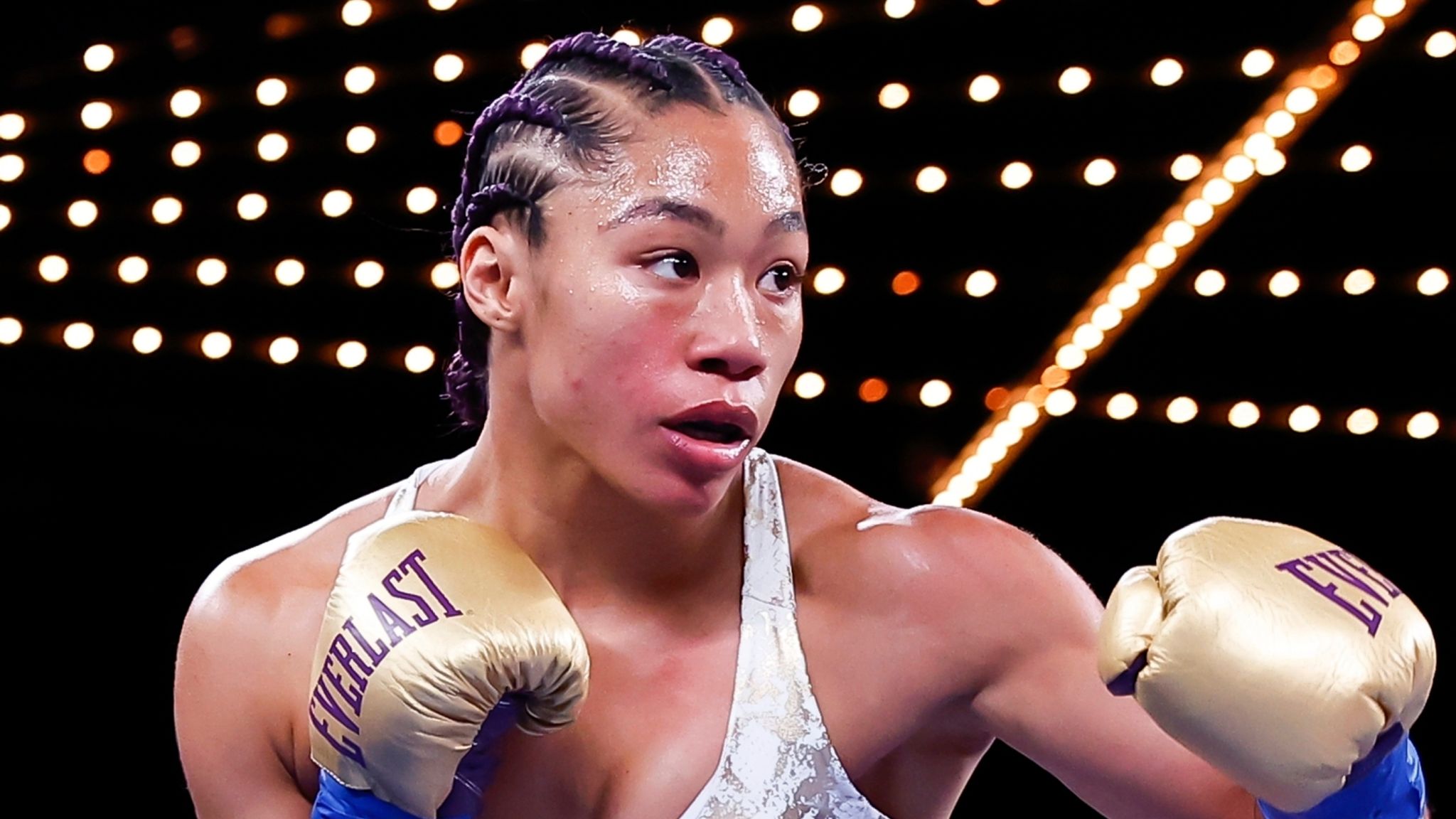
Alycia Baumgardner has spent the last several years establishing herself as one of the most recognizable fighters in women’s boxing, but her November 8 move to lightweight may tell us more about her championship ambition than another defense at 130 pounds ever could. Baumgardner isn’t moving up and searching for the easiest available path toward […]
Alycia Baumgardner has spent the last several years establishing herself as one of the most recognizable fighters in women’s boxing, but her November 8 move to lightweight may tell us more about her championship ambition than another defense at 130 pounds ever could. Baumgardner isn’t moving up and searching for the easiest available path toward calling herself a two-division champion. She’s challenging undefeated IBF lightweight champion Elif Nur Turhan, a fighter who has quickly developed a reputation as one of the most physically dangerous women in the division.
Baumgardner and Turhan will headline MVPW-07 at College Park Center in Arlington, Texas, with Baumgardner moving from super featherweight to challenge for Turhan’s IBF lightweight championship. The fight will be contested over ten three-minute rounds, and the card itself represents another major investment from Most Valuable Promotions in women’s boxing, with four world-title fights scheduled for the event. Baumgardner enters at 18-1 with seven knockouts, while Turhan is 14-0 with eight stoppages.
Those records don’t immediately communicate why this matchup is so interesting. Eight knockouts in 14 victories may not look extraordinary if you’re accustomed to reading men’s boxing records, but Turhan’s power has become one of the defining characteristics of her rise. She didn’t win the IBF championship through a vacant-title opportunity or a controversial decision. She took it from Beatriz Ferreira, the unbeaten Brazilian Olympic gold medalist who entered their December 2025 fight with one of the strongest amateur pedigrees anywhere in women’s boxing. Turhan overwhelmed her and stopped her in the fifth round.
That is the fighter Baumgardner has chosen for her lightweight debut.
Turhan Changed Her Career in Five Rounds
Before the Ferreira fight, Turhan was dangerous but relatively unknown outside serious followers of women’s boxing. Ferreira was supposed to provide the kind of sophisticated challenge that would establish how far Turhan’s aggressive style could actually take her against elite opposition. Instead, Turhan turned the fight into a physical beating.
Boxing247’s ringside account described Turhan repeatedly hurting Ferreira with right hands, forcing knockdowns and eventually overwhelming her in the fifth. Ferreira’s amateur credentials and unbeaten professional record made the result particularly significant because Turhan hadn’t simply stopped another contender. She had physically dismantled a fighter with the technical background to theoretically punish the openings created by Turhan’s aggression.
Turhan has subsequently defended the championship against Taylah Gentzen and Gabriela Tellez, improving to 14-0 before signing with MVP in August. That progression matters because Baumgardner isn’t encountering a fighter who produced one spectacular upset and disappeared. Turhan has continued winning and now arrives in Arlington with the opportunity to use Baumgardner’s name to transform herself from a dangerous champion into a much larger attraction.
That’s the part of the matchup people shouldn’t overlook. Baumgardner may be the bigger star, but Turhan arguably has more to gain. If she stops or convincingly defeats Baumgardner, every conversation surrounding the lightweight division changes immediately.
Baumgardner Could Have Chosen an Easier Way to Become a Two-Division Champion
This is where Baumgardner deserves credit.
Moving into another weight class and collecting a championship can sometimes be more strategic than dangerous. Boxing has enough sanctioning organizations that a successful champion can occasionally identify the most favorable stylistic matchup, move into position and carefully pursue whichever belt presents the easiest opportunity.
Turhan doesn’t look like that kind of opportunity.
Baumgardner already owns the WBA, IBF and WBO championships at super featherweight and previously became undisputed at 130. She doesn’t need another belt simply to prove she can become a world champion. The meaningful part of this move is the quality and physical threat represented by the woman holding the championship she wants. MVP itself describes Turhan as one of the most dangerous punchers in women’s boxing, while The Ring notes that she destroyed previously unbeaten Ferreira to claim the title.
Baumgardner has advantages of her own. She’s faster, more polished technically and has accumulated considerably more experience in high-profile championship fights. Her victories over Terri Harper and Mikaela Mayer demonstrated different parts of her game, while her years at championship level have forced her to develop beyond the explosive puncher who initially captured widespread attention.
The question at lightweight is how those skills translate when the woman coming forward is naturally accustomed to carrying 135 pounds.
Five pounds doesn’t sound like much until somebody is punching you with it.
Caroline Dubois Is the Fight Waiting on the Other Side
There is another reason Baumgardner’s move makes sense. Lightweight contains a much larger opportunity if she gets through Turhan.
Caroline Dubois currently holds The Ring, WBC and WBO lightweight championships, and she has already made clear that she expects Baumgardner to defeat Turhan. Dubois recently predicted that Baumgardner should be able to outbox the Turkish champion and openly discussed a potential unification fight early next year.
That’s where November 8 could become the first half of a much bigger story.
If Baumgardner wins the IBF championship, a fight with Dubois would potentially put most of the meaningful lightweight hardware into one event while matching two fighters whose personalities and history already contain enough tension to sell the fight without manufacturing a rivalry. Baumgardner would arrive as the established American star and former undisputed champion moving into another division, while Dubois would have the opportunity to defend her position against somebody entering what she considers her territory.
That is exactly the type of progression women’s boxing needs. One major fight should create the next major fight rather than producing a championship that spends the following year being defended against opponents casual fans have never heard of.
But Dubois shouldn’t become such an attractive future opponent that Baumgardner begins mentally fighting her before Turhan.
The champion standing directly in front of her has already ruined one elite fighter’s plans.
This Is a Dangerous Style for Baumgardner
Baumgardner’s technical ability should give her opportunities against Turhan. She can counter, move and punch hard enough to discourage reckless entries. She has also competed in enough championship fights that the moment itself shouldn’t overwhelm her.
Turhan presents a different kind of problem because she appears comfortable making fights physically unpleasant. Her victory over Ferreira wasn’t built around winning a cautious tactical contest. She pressured an accomplished boxer and forced her into exchanges she eventually couldn’t survive. That type of opponent can make technical superiority irrelevant if the boxer can’t consistently maintain the distance required to use it.
Baumgardner therefore has to resist the temptation to prove she can match Turhan’s physicality simply because she’s moving into the champion’s division. The smarter argument for Baumgardner is likely to be made with her feet, timing and counters rather than attempting to demonstrate that she can stand directly in front of a naturally larger puncher.
Turhan has the opposite challenge. Baumgardner isn’t Ferreira, and assuming the same pressure will produce the same result would ignore how differently elite fighters solve problems. Turhan has to find a way to impose her strength without becoming predictable enough for Baumgardner to repeatedly walk her into counters.
That’s why this fight is considerably more interesting than the champion-versus-star billing suggests. Both women have obvious routes to victory, but both routes become dangerous if either fighter becomes too committed to proving a point.
Baumgardner Is Trying to Expand Her Legacy, Not Protect It
One of the easiest things for an established champion to do is become comfortable. Baumgardner could remain at 130 pounds, continue defending multiple championships and maintain her position as one of women’s boxing’s recognizable names. Moving to lightweight introduces variables she doesn’t have to accept.
Turhan is naturally established in the division. Baumgardner has to determine how her speed and power translate upward. If she wins, she immediately creates pressure for a fight with Dubois. If she loses, people will inevitably question whether leaving a division she already controlled was unnecessary.
That’s what makes the decision meaningful.
There is no substantial legacy reward without corresponding risk.
Baumgardner has already experienced how quickly boxing careers can change. She became a major name by traveling to Sheffield and stopping Terri Harper, then built on that breakthrough by defeating Mayer and eventually becoming undisputed. Those accomplishments created the position she now occupies, but maintaining that position forever isn’t the same thing as expanding it.
At 32, this is the point where Baumgardner can begin determining how ambitious the second half of her championship career will be.
Turhan represents the first answer.
REAL TALK
Boxing fans frequently say they want champions to move up, take risks and chase the best available competition, but that praise often disappears the moment the risk produces a loss. That’s part of what makes decisions like Baumgardner’s worth appreciating before we know the outcome.
If she stayed at super featherweight and continued winning, nobody could reasonably call her career unsuccessful. She’s already been undisputed and has defeated championship-level opposition. Moving to 135 isn’t something she has to do to validate what she accomplished at 130. She’s doing it because another division presents another challenge, another championship and potentially an even bigger fight with Dubois.
Turhan has reached this opportunity from the opposite direction. She doesn’t have Baumgardner’s profile or résumé, but she possesses the championship and has already demonstrated that reputation means very little once the bell rings. Ferreira brought an Olympic gold medal and an unbeaten professional record into their fight. Turhan sent her home without the IBF belt.
That’s why November 8 shouldn’t be framed as Baumgardner arriving at lightweight to collect another championship. The belt already belongs to somebody who fought hard to take it, and Turhan now gets the chance to prove that her victory over Ferreira wasn’t merely the night she announced herself to boxing. It may have been the beginning of something much larger.
Baumgardner wants to become champion in another division and then potentially move toward Dubois. Turhan wants to turn somebody else’s next chapter into the defining chapter of her own career.
Neither woman needs artificial controversy to make that interesting.
The risk already does the work.
LET’S TALK ABOUT IT
Does Alycia Baumgardner deserve more credit for choosing Elif Nur Turhan for her lightweight debut instead of pursuing an easier route toward becoming a two-division champion?
And if Baumgardner beats Turhan on November 8, should MVP move immediately toward Baumgardner-Caroline Dubois for lightweight supremacy, or would you rather see Baumgardner establish herself at 135 with another fight first?

