Deontay Wilder Has Five British Volunteers — Each One Brings a Different Risk
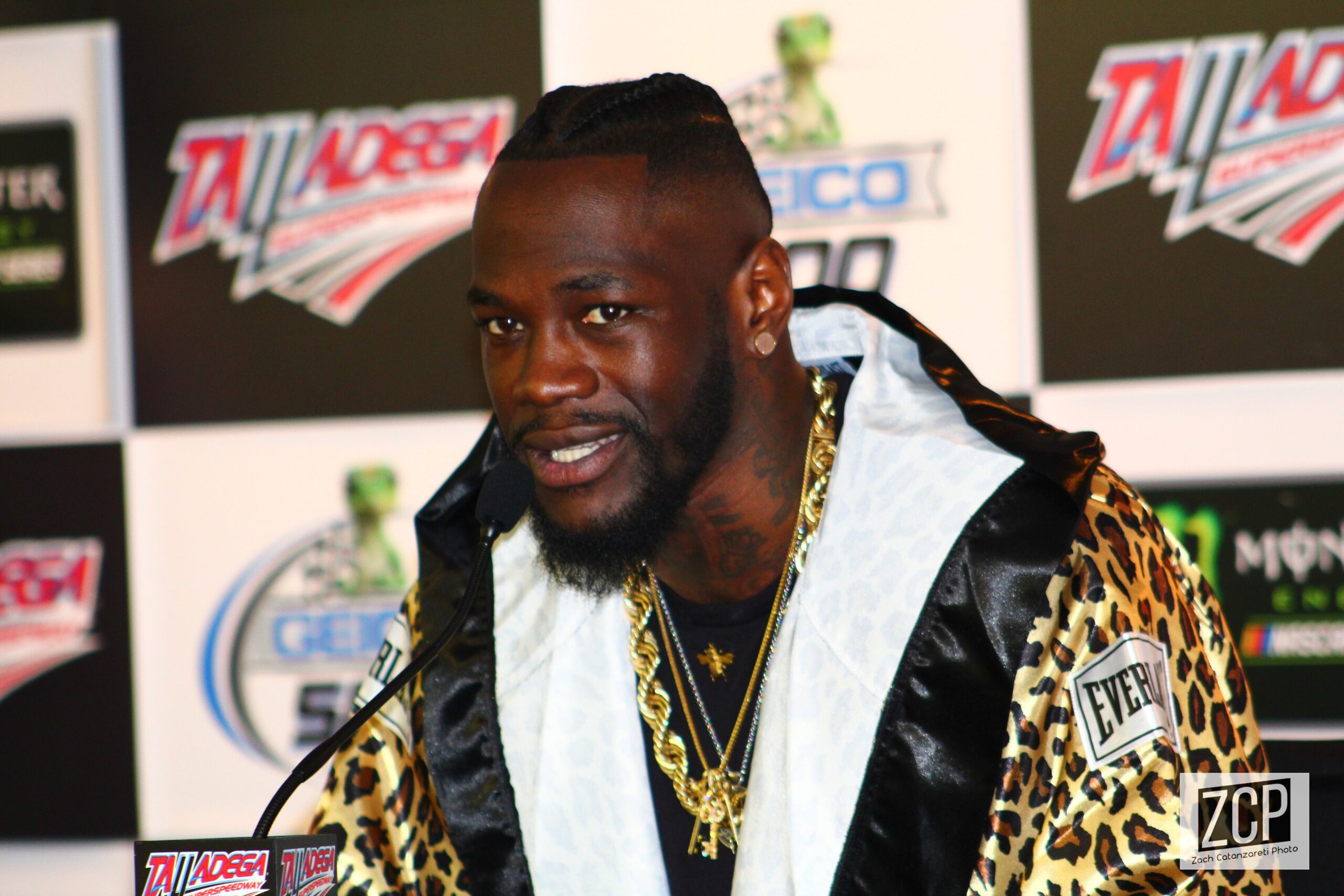
Deontay Wilder speaking at a podium during a 2018 event.Image: Zach Catanzareti Photo / CC BY-SA 2.0 / Wikimedia Commons
Deontay Wilder needs a new opponent, and Britain’s heavyweight division has not been shy about offering options.
Jai Opetaia has withdrawn from his scheduled fight with Wilder on the December 11 Tyson Fury–Anthony Joshua undercard at Principality Stadium in Cardiff. Opetaia’s co-promoter, Mick Francis, confirmed that the cruiserweight injured his hand during his September fight against Noel Mikaelian and aggravated the problem in training. Opetaia apologized to Wilder and his team while making clear that his focus remains becoming undisputed at cruiserweight.
The withdrawal leaves Wilder’s expected place on one of boxing’s biggest cards without a confirmed opponent. Netflix had listed Wilder against Opetaia in its November 11 fight-card announcement, but organizers have not published an official replacement.
According to Boxing News, Derek Chisora, Dillian Whyte, Lawrence Okolie, Richard Riakporhe and Frazer Clarke have all expressed interest in stepping into the opening. They are not interchangeable names. Each would bring a different level of experience, ambition, commercial value and tactical difficulty to a fight that could shape Wilder’s route back toward heavyweight contention.
Five volunteers have entered the conversation.
That does not mean any of them has secured the assignment.
Chisora and Whyte Offer Names Wilder Cannot Easily Dismiss
Derek Chisora and Dillian Whyte would give the replacement fight immediate public meaning because both are familiar heavyweight figures rather than anonymous short-notice opponents.
Boxing News reports that Chisora has offered to face Wilder in an eight-round fight and is discussing financial terms. The outlet also describes him as the frontrunner, but neither the reported negotiations nor his position at the head of the queue has been officially confirmed.
Chisora’s appeal is straightforward. He brings experience, recognizable pressure and a reputation built through major heavyweight occasions. That familiarity would make the fight easier to understand and promote: Wilder would not simply be staying active against a late substitute; he would be facing a veteran whose name carries weight with British boxing audiences.
That recognition would also create greater risk for Wilder.
A victory over an established opponent would carry more value than beating a replacement with little public profile. A difficult performance, however, would invite stronger questions about what Wilder can still offer. Chisora would enter with little reason to be intimidated by the occasion, and his willingness to make fights physical could force Wilder to establish control rather than wait indefinitely for one decisive opening.
Whyte offers a different version of the established-name test. Unlike several of the other candidates, he has directly and publicly confirmed his availability.
“If they want it then they know where I am,” Whyte told Sky Sports News. He also said he was already training for a planned December 18 return, which would at least place him in an active preparation period if the Wilder opportunity became real.
That statement proves Whyte wants the fight. It does not prove that organizers have made him a formal offer.
A Wilder–Whyte matchup would carry the tension of two known heavyweights trying to establish where they still belong. Wilder would be expected to demonstrate that his power remains a decisive force under major-event pressure. Whyte would be trying to convert an unexpected opportunity into evidence that he still deserves significant assignments.
Either Chisora or Whyte would make the replacement more than a holding exercise. Their names would attract attention, but that attention would raise the consequences for everyone involved. Wilder would gain a credible platform for rebuilding momentum, yet he would also surrender the protection that comes with facing an opponent the wider audience does not know.
If the purpose of keeping Wilder on the card is to measure his remaining contender potential, Chisora and Whyte offer two of the clearest tests available among the reported volunteers.
Okolie and Riakporhe Bring Awkward Cruiserweight Dimensions
Lawrence Okolie and Richard Riakporhe present another question: how should Wilder handle physically imposing fighters associated with cruiserweight competition who see the opening as an opportunity rather than an obligation?
Boxing News reports that Okolie has put himself forward, although there has been no official confirmation that he received a formal approach. His candidacy carries some of the same intrigue that made Opetaia an unusual opponent in the first place. This would not be a conventional heavyweight replacement selected only because he was already moving through the division’s established queue.
Okolie represents size, awkwardness and the possibility of an untidy tactical fight. That could create a frustrating assignment for Wilder, especially on limited preparation for a new opponent. A late replacement changes more than the name printed on the poster. It can alter the distance, rhythm and type of physical exchanges a fighter expects to encounter.
Wilder would still carry the obvious threat that defines any matchup involving him, but an awkward opponent can make delivering that threat more complicated. If Okolie were selected, Wilder’s task would involve imposing his preferred range and preventing the contest from becoming a succession of disrupted exchanges.
Riakporhe has been more public about his willingness to take the chance. Sky Sports reported that he said on social media he would face Wilder on less than four weeks’ notice and was prepared for a 12-round fight.
That is a strong declaration of intent. It is not evidence that a contract has been offered or that the fight is close to completion.
Riakporhe’s appeal comes from physical strength, ambition and an apparent willingness to accept the pressure of a major assignment without a full camp designed specifically for Wilder. For him, the opportunity would be enormous. A credible performance could immediately change the scale of the conversations surrounding his career. A victory would do considerably more.
The danger is that willingness can be confused with readiness.
Preparing for a heavyweight puncher on short notice is not simply a matter of agreeing to the fight. The selected opponent would need to adjust training, complete the contractual process, receive medical clearance and arrive with a plan capable of surviving the moments when Wilder’s power becomes the central fact of the contest.
Okolie and Riakporhe may offer the most unusual stylistic questions among the five British candidates. That could make either matchup attractive, but neither man should be presented as Wilder’s next opponent unless organizers officially confirm it.
Reported interest is the beginning of the process, not the end.
Frazer Clarke Would Be a Gamble in Both Directions
Frazer Clarke represents a different kind of replacement.
Sky Sports and Boxing News report that Clarke has called for the Wilder fight. Where Chisora and Whyte would arrive as established heavyweight names, Clarke would enter as the younger heavyweight trying to climb the ladder through one dramatic opportunity.
That creates risk in both directions.
For Clarke, the fight would bring an immediate increase in profile, scrutiny and danger. Instead of progressing through a carefully planned sequence of assignments, he would be stepping into a major stadium card against one of the division’s most recognizable punchers. The opportunity would be difficult to reject, but its value would depend heavily on the preparation time, financial terms and sporting conditions attached to it.
For Wilder, Clarke would represent an ambitious opponent with more to gain than lose in public perception. That can be a difficult kind of replacement. A younger heavyweight accepting a major step up is not arriving merely to complete the card; he is arriving to take the older fighter’s position.
Wilder would be under pressure to look authoritative. If he won emphatically, the result could support the argument that his power remains capable of separating him from rising opposition. If he struggled, the performance would encourage questions about whether the heavyweight landscape is beginning to move beyond him.
Clarke’s candidacy therefore carries less historical familiarity than Chisora or Whyte but potentially more long-term significance. Selecting him would turn the fight into a test between Wilder’s established threat and a British heavyweight’s attempt to accelerate his career.
That is a compelling story.
It is also a considerable gamble to arrange on short notice.
The Replacement Changes the Meaning, Not the Current Facts
The selected opponent will determine what Wilder’s December 11 appearance actually means.
Chisora would bring pressure, experience and commercial familiarity. Whyte would bring an established heavyweight identity and the urgency of another contender-level opportunity. Okolie would create awkward physical and tactical questions. Riakporhe would bring strength and open ambition. Clarke would represent the younger heavyweight trying to force his way up the ladder.
Those differences matter because a comeback assignment is judged partly by the opponent selected. Wilder could emerge from the Cardiff card with renewed momentum, more uncertainty or a serious setback. The British heavyweight who receives the opportunity could gain a career-changing platform—or discover why public enthusiasm is easier than standing in front of Wilder when the punches begin.
What the replacement does not change is equally important.
Opetaia has withdrawn after aggravating a hand injury. No new opponent has been officially announced. Contracts, financial terms and medical clearances still have to be resolved. Wilder’s continued participation is expected by Boxing News, but the revised card remains unsettled.
The evidence also needs to be separated cleanly.
Whyte directly declared his availability to Sky Sports News. Riakporhe’s social-media offer and Clarke’s callout were reported by Sky Sports. Boxing News reports that Okolie has put himself forward and that Chisora offered to fight eight rounds while discussing financial terms. The outlet’s description of Chisora as the frontrunner remains unconfirmed.
Jarrell Miller is an additional possibility outside the five British volunteers. BoxingScene reports that Miller said he received a call about facing Wilder, but no contract or official selection has been announced.
The first definitive answer must come from organizers through a revised fight-card announcement. Everything before that belongs in its proper category: direct statements, media reports, negotiations and unconfirmed possibilities.
Once the opponent is selected, the larger questions move into the ring. Can Wilder still impose his power under the pressure of a major event? Can a replacement prepare quickly enough to produce a credible performance? Does the result move Wilder back toward contention, or expose limitations that a carefully chosen opponent might have concealed?
Until a contract is completed and the card is revised, five British heavyweights have an opportunity in front of them.
None of them officially has the fight.
LET’S TALK ABOUT IT
Which of the five British heavyweights—Derek Chisora, Dillian Whyte, Lawrence Okolie, Richard Riakporhe or Frazer Clarke—would present the greatest risk to Deontay Wilder?
Should organizers choose the biggest established name, the most difficult stylistic matchup or the younger heavyweight with the most to gain?
Outlets cited in this story
- BoxingScene
- Boxing News
- Sky Sports
Spot an error? Send a correction.
More on Deontay Wilder
All 15 Deontay Wilder stories →
Deontay Wilder and Jarrell Miller Renew Heavyweight Rivalry — But the Fight Remains Unconfirmed
Deontay Wilder needs a new opponent for December 11, and Jarrell Miller says he has been contacted about taking the assignment. That possibility has revived a longstanding heavyweight rivalry, producing…
Jai Opetaia Withdraws From Deontay Wilder Fight — But Derek Chisora Claims Sparring Was the Real Cause
Jai Opetaia’s heavyweight gamble has been placed on hold before he could prove whether his championship qualities at cruiserweight would translate against one of boxing’s most dangerous punchers. Opetaia was…
Bakhodir Jalolov Suggested as Deontay Wilder’s Replacement Opponent — But No Negotiations Have Been Reported
Deontay Wilder needs a new opponent for the December 11 Tyson Fury–Anthony Joshua undercard in Cardiff, and the heavyweight selected could reveal more than organizers intend. Jai Opetaia withdrew from…
Deontay Wilder’s Jai Opetaia Fight Is Reportedly Off — But Cardiff’s Replacement Could Define His Comeback
Deontay Wilder’s planned heavyweight fight against Jai Opetaia has reportedly collapsed less than four weeks before the former champion was scheduled to appear on the Tyson Fury–Anthony Joshua undercard in…