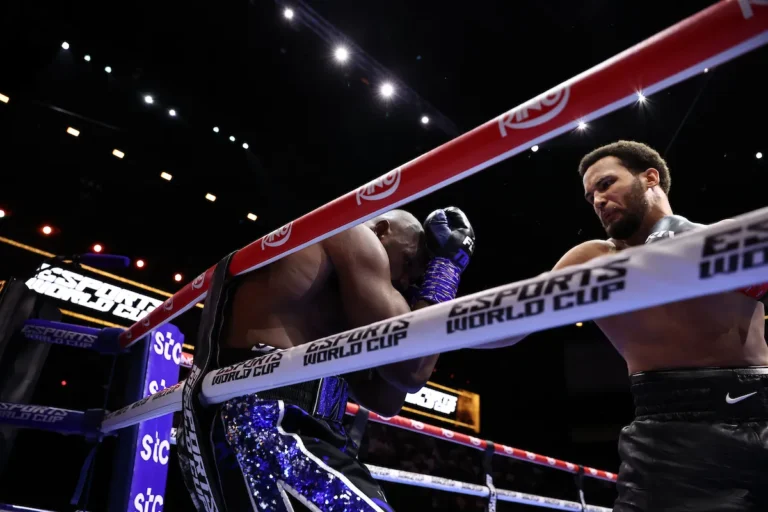







Ben Whittaker has never had much trouble getting people to pay attention to him. The showboating, reflexes, personality and increasingly destructive knockouts have made him one of the most recognizable young fighters in British boxing, and now he’s already thinking about the kind of fight that could turn that attention into something much bigger. Whittaker […]
Ben Whittaker has never had much trouble getting people to pay attention to him. The showboating, reflexes, personality and increasingly destructive knockouts have made him one of the most recognizable young fighters in British boxing, and now he’s already thinking about the kind of fight that could turn that attention into something much bigger.
Whittaker still wants David Benavidez.
There’s just one fairly significant problem. Benavidez isn’t a light heavyweight anymore.
After establishing himself at 175 pounds, Benavidez moved to cruiserweight and has continued building his career there, meaning the matchup Whittaker once discussed within his own division would now require him to eventually move up approximately 25 pounds. Whittaker isn’t pretending that’s something he intends to do tomorrow. He says light heavyweight remains his division, wants to accomplish everything he can there first, and views a potential move toward Benavidez as something for later in his career.
That’s what makes this more interesting than another fighter attaching his name to a superstar. Whittaker isn’t saying Benavidez should come back down and give him an opportunity he hasn’t earned. He’s talking about building himself into the kind of fighter who might eventually be able to follow Benavidez upward.
Before any of that matters, however, Whittaker has some unfinished business at 175.
Conor Wallace Is Where the Fantasy Has to Meet Reality
Whittaker faces Conor Wallace on October 3 in Birmingham in an IBF final eliminator. The stakes are straightforward: the winner becomes the mandatory challenger for Dmitry Bivol’s IBF championship, although Bivol’s existing obligations mean the eventual title opportunity may not arrive immediately. Wallace is also widely regarded as the most significant professional test Whittaker has faced so far.
That’s exactly the kind of fight Whittaker needs before we spend too much time imagining Wembley Stadium against Benavidez.
Whittaker is 12-0-1 with nine knockouts, and his recent performances have certainly created momentum. He has stopped four consecutive opponents inside two rounds, including Richard Rivera in the second round of his American debut. The problem with destroying opponents that quickly is that spectacular finishes don’t necessarily answer the questions that become important at championship level. We know Whittaker can embarrass opponents when he’s comfortable. We know he possesses speed, timing and enough power to punish mistakes. What we still need to see is how he handles somebody capable of taking away some of those advantages and forcing him to adjust over a longer fight.
Wallace isn’t David Benavidez or Dmitry Bivol, but he’s a legitimate step in that direction. He’s ranked above Whittaker by the IBF, has more professional experience and earned his position through the organization’s system. If Whittaker is serious when he says he wants to dominate light heavyweight before moving on, this is exactly the kind of fight that needs to start proving the claim.
The Benavidez Conversation Didn’t Come Completely Out of Nowhere
One reason Whittaker continues discussing Benavidez is that the interest hasn’t been entirely one-sided.
Last year, Whittaker revealed that Jose Benavidez Sr., David’s father and trainer, contacted him directly and expressed interest in making the fight. At the time, Whittaker openly acknowledged that he wasn’t ready. He had only 11 professional fights, while Benavidez had accumulated more than 30 and had already spent years competing at world-championship level.
That was actually a sensible response.
Whittaker and Benavidez aren’t separated by some enormous age gap that makes waiting impossible. Whittaker is 29, while Benavidez has simply accumulated far more professional experience. The difference between them isn’t primarily age. It’s what they’ve already been through inside a professional ring.
Benavidez has fought championship rounds, defeated established contenders and carried his style through multiple weight divisions. Whittaker’s professional résumé is still being built.
That’s why Whittaker’s current position makes considerably more sense than demanding the fight immediately. He recognizes Benavidez as a major future target while acknowledging that he needs to establish himself first.
The danger would be allowing the fantasy fight to become more important than the career sitting directly in front of him.
Whittaker Has a Real Opportunity at Light Heavyweight
Benavidez leaving 175 actually created additional space for fighters like Whittaker.
Bivol remains the central figure in the division, while the championship picture around him continues to evolve. If Whittaker defeats Wallace, he’ll have a formal route toward Bivol through the IBF rather than relying on social-media attention or promotional influence to secure the opportunity.
That matters because Whittaker’s career has occasionally created more discussion about his personality than his résumé.
People know the dancing.
They know the showboating.
They know the clips where he makes opponents miss and looks into the crowd.
They know the highlight-reel knockouts.
Becoming a mandatory challenger changes the conversation. It moves Whittaker from somebody people believe could eventually become an elite light heavyweight toward somebody positioned to actually prove it.
And if he eventually fights Bivol, we’re going to learn far more about Whittaker than any Benavidez callout can tell us.
Bivol represents almost the opposite kind of challenge from the fights where Whittaker has been able to express himself freely. He’s disciplined, technically precise and exceptionally difficult to drag away from his structure. A fighter can’t simply rely on athleticism and personality against somebody like that.
If Whittaker wants to dominate 175, that’s the level he eventually has to solve.
Benavidez Would Be an Entirely Different Problem
The attraction of Whittaker-Benavidez is obvious because the styles immediately create a question.
Whittaker believes his movement, defense and ability to make opponents miss at close range could create problems for Benavidez’s relentless pressure. He has said that he actually likes fighting that type of aggressive style because he’s dealt with it since childhood.
That confidence isn’t unreasonable. Whittaker is tall, athletic and comfortable using reflexes in situations where other fighters would rather create distance. A fighter capable of making Benavidez miss while remaining close enough to counter could theoretically create interesting moments.
The word theoretically is doing a lot of work there.
Benavidez isn’t simply a pressure fighter who walks forward throwing punches. His pressure is supported by combinations, physical strength, stamina and years of experience against high-level opposition. Moving up to cruiserweight also means Whittaker would be encountering a physically larger version of the problem than the one he originally called out at light heavyweight.
Whittaker’s speed might travel upward.
His reflexes might travel upward.
What nobody knows is whether those advantages would remain as significant after adding enough mass to compete effectively with a cruiserweight.
That’s why this isn’t merely a bigger version of a light-heavyweight fight. Moving from 175 toward 200 changes the physical equation.
Wembley Sounds Great, but First Build the Fight
Whittaker has talked about eventually fighting Benavidez at Wembley Stadium, and there’s nothing wrong with thinking that big. Boxing needs fighters capable of imagining events rather than merely opponents.
The important part is understanding how you turn an ambitious idea into something people actually demand.
Right now, Benavidez is the much more accomplished professional fighter. Whittaker brings personality and potential, but the sporting case for the matchup isn’t remotely as developed as the promotional possibilities.
That can change quickly.
Beat Wallace.
Become mandatory.
Win a world championship.
Fight another elite light heavyweight.
If Whittaker does those things while continuing to develop his audience, the Benavidez conversation stops sounding like a young fighter mentioning a famous name and starts sounding like two accomplished fighters moving toward a legitimate crossover event.
The difference between those situations is résumé.
Whittaker seems to understand that, which is why his most important statement wasn’t that he wants Benavidez. It was that he wants to dominate his own division first.
REAL TALK
There’s nothing wrong with having an ambition that’s several steps ahead of your current position. In boxing, you almost need that kind of imagination because the fighters who eventually become major attractions usually saw something for themselves before everybody else did.
The problem begins when talking about the destination becomes a substitute for completing the steps required to reach it.
Whittaker has enough charisma that he could probably spend the next year generating headlines by mentioning Benavidez, Bivol and every other major name between light heavyweight and cruiserweight. His personality makes those comments travel further than they would from an ordinary contender. But the thing that will ultimately make those names take him seriously isn’t another viral interview. It’s what happens against fighters like Wallace.
That’s why this stage of Whittaker’s career may be more important than the eventual superfight he’s imagining. He’s approaching the point where showmanship has to become accomplishment. The same confidence that makes him dance in front of opponents and talk about Wembley has to survive when somebody takes away the easy openings and forces him to solve a difficult fight.
If Whittaker becomes champion at 175 and establishes himself against the best fighters available there, moving up for Benavidez becomes exactly the kind of ambition boxing should encourage. It would represent a successful champion deliberately entering a more dangerous division to chase a bigger challenge.
If he skips the accomplishments and simply follows the money upward, the story feels completely different.
Whittaker says he wants the first version.
Now comes the part where he has to build it.
LET’S TALK ABOUT IT
Should Ben Whittaker forget about David Benavidez until he wins a world championship at light heavyweight, or is talking about that future fight smart promotion while he builds toward it?
And if Whittaker eventually becomes a champion at 175, would you rather see him try to clean out the light-heavyweight division or move straight toward cruiserweight for the much bigger Benavidez fight?