






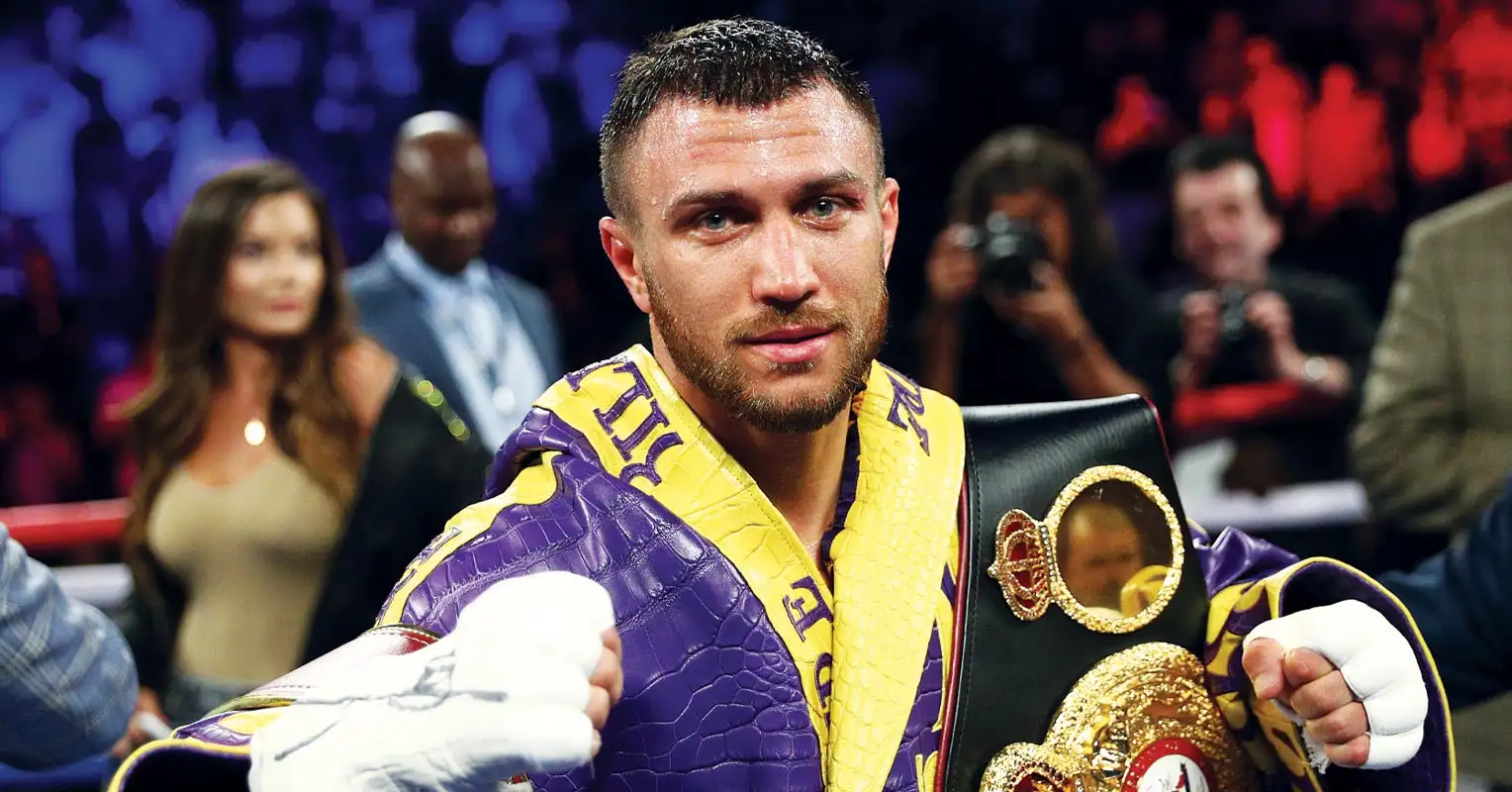
Vasiliy Lomachenko already has the kind of career that doesn’t require another fight. He’s a two-time Olympic gold medalist, a three-division professional champion and one of the most technically celebrated fighters of his generation. He retired with very little left to prove, and at 38 years old, nobody would have questioned him if the final […]
Vasiliy Lomachenko already has the kind of career that doesn’t require another fight. He’s a two-time Olympic gold medalist, a three-division professional champion and one of the most technically celebrated fighters of his generation. He retired with very little left to prove, and at 38 years old, nobody would have questioned him if the final image of his professional career remained his stoppage victory over George Kambosos Jr.
Apparently, Lomachenko isn’t satisfied with that ending.
He’s coming back, and according to his manager Egis Klimas, there is a very specific reason behind it. Lomachenko still wants the accomplishment that escaped him during the most frustrating portion of his professional career: an undisputed championship. This time, instead of trying to complete that mission at lightweight, the plan is to return to 130 pounds and pursue all four major super-featherweight belts.
That immediately makes this comeback more interesting than another former champion returning because somebody offered enough money.
It also makes it considerably more dangerous.
Lomachenko hasn’t fought since May 2024. He hasn’t competed at 130 pounds since 2017. He’s now 38, and the very qualities that made him special—his feet, reactions, angles and ability to process what an opponent is doing faster than the opponent can adjust—are exactly the qualities age tends to negotiate with first.
If Lomachenko is really coming back to become undisputed, this isn’t a farewell tour.
He’s giving himself one of the hardest assignments of his career.
Undisputed Is the One Thing Missing
Lomachenko’s professional career moved at an almost ridiculous pace from the beginning.
After an amateur career that included two Olympic gold medals, he challenged Orlando Salido for a world championship in only his second professional fight. He lost a split decision, then defeated Gary Russell Jr. in his very next appearance to become WBO featherweight champion in just his third professional bout. He eventually won championships at featherweight, super featherweight and lightweight.
What he never became was undisputed.
He came extremely close at lightweight.
Lomachenko unified three major championships before Teofimo Lopez defeated him in 2020 and took those belts. Lomachenko later rebuilt and eventually challenged Devin Haney for the undisputed lightweight championship in 2023, losing a unanimous decision in a fight whose scoring remains heavily debated among boxing fans.
He responded by stopping Kambosos in the 11th round in Australia in May 2024 to win the IBF lightweight championship. That turned out to be his final appearance before announcing his retirement in June 2025.
So when Klimas says Lomachenko is coming back specifically to fulfill his dream of becoming undisputed, there’s history behind those words.
This isn’t a goal somebody invented to promote a comeback.
It’s unfinished business.
Going Back to 130 Makes Sense — Until You Remember He’s 38
There’s also something intriguing about where Lomachenko intends to attempt it.
Super featherweight.
For years, one of the arguments surrounding Lomachenko’s losses at lightweight was that he was competing above his optimal weight. Shakur Stevenson recently made that exact point while calling Lomachenko one of boxing’s most underrated fighters, arguing that Lomachenko was naturally closer to a featherweight competing against physically larger men at 135.
That doesn’t erase the Lopez or Haney losses. Fighters choose their divisions, and Lomachenko was good enough at lightweight to win multiple championships there.
But size mattered.
Now he intends to return to the division where he held the WBO championship between 2016 and 2018.
Conceptually, that sounds perfect. A smaller Lomachenko returning closer to his natural fighting weight, potentially eliminating some of the physical disadvantages he experienced against larger lightweights.
Then you remember that the last time Lomachenko actually made 130 pounds was nearly nine years ago.
Making a weight comfortably in your twenties and making the same weight at 38 after spending years competing five pounds heavier aren’t necessarily the same experience. The comeback is reportedly targeted for November, but there is still no officially announced opponent, date or venue.
Before we start fantasy-booking Lomachenko against every champion at 130, I want to see what he looks like on the scale and then what his legs look like after six or eight rounds.
Because the scale will tell us whether he can make 130.
The fight will tell us whether he should.
Anthony Cacace Appears to Be the First Championship Target
Klimas has now provided more clarity about how Lomachenko wants to navigate the division.
Anthony Cacace currently holds the WBA championship, and Lomachenko’s team is targeting that belt as one part of the undisputed plan. Meanwhile, Emanuel Navarrete and O’Shaquie Foster are scheduled to meet October 24 in a three-belt unification involving the WBO, IBF and WBC titles.
You can immediately see what Lomachenko’s team is envisioning.
Win one championship.
Let Navarrete and Foster consolidate three others.
Then make one fight for everything.
On paper, that’s almost too perfect.
Boxing rarely cooperates that easily.
Cacace is scheduled to face Nick Ball on December 19, and the winner is expected to have a mandatory obligation involving Elnur Samedov. Navarrete and Foster have their own championship responsibilities as well. Lomachenko can’t simply arrive after more than two years away and expect the entire division’s mandatory structure to disappear because he’s famous.
His name will unquestionably help him.
The WBO president has already indicated that Lomachenko’s accomplishments could justify approving him for an immediate title opportunity at 130.
But wanting an undisputed path and finding a clean undisputed path are very different things.
The November Opponent Matters More Than It Normally Would
Earlier reporting suggested Lomachenko wasn’t interested in tune-ups. When his comeback was first revealed in May, sources said he wanted “big fights only.”
I understand the mentality.
At 38, Lomachenko doesn’t have three years to slowly rebuild himself through the rankings. If this comeback is really about becoming undisputed, every fight has to move him toward that objective.
Still, there’s a difference between wasting time and gathering information.
Lomachenko has been inactive for more than two years. He needs to discover what remains before putting himself directly into a championship fight against an elite opponent.
That’s why I wouldn’t necessarily consider one comeback fight a meaningless tune-up.
It could be an evaluation.
Does the footwork still look effortless?
Can he still create those unusual angles without requiring an extra fraction of a second?
Does his output remain consistent in the later rounds?
How does his body respond to making 130?
Those questions matter more than whether he knocks somebody out impressively.
Lomachenko’s entire style depends on physical tools working together with an extraordinary boxing mind. The intelligence isn’t going anywhere. The concern is whether his body can still execute what his brain sees.
Forget Tank Davis for Now
Naturally, Gervonta Davis’ name has already returned to the conversation.
Lomachenko and Davis have been linked for years, and they were in discussions before Lomachenko stepped away from boxing. When news of the comeback first surfaced, a potential Tank fight immediately became part of the speculation again.
It’s an enormous fight.
It may still happen.
But if Klimas is accurately describing Lomachenko’s motivation, Tank shouldn’t be the priority right now.
Undisputed at 130 should be.
That’s actually what makes the comeback more compelling to me. A Davis fight could easily be explained as an older fighter pursuing one final enormous payday. There’s nothing wrong with that, but we’ve seen that comeback story countless times.
Going back to 130 and trying to systematically collect the championships is different.
That requires Lomachenko to prove he’s still an elite fighter rather than merely a famous one.
And the division isn’t going to hand him the accomplishment because of what he did ten years ago.
This Comeback Could Change How We Remember the Lightweight Years
There’s another layer to all of this.
If Lomachenko returns to 130 and looks spectacular, we’re inevitably going to revisit the argument about whether lightweight was ever the ideal division for him.
Imagine a 38-year-old Lomachenko moving back down and beating current champions.
People are immediately going to look backward at Lopez and Haney and wonder how Lomachenko’s career might have unfolded if he had spent more of his prime competing closer to his natural size.
That’s not an excuse for his defeats.
Lopez beat the version of Lomachenko standing in front of him. Haney received the official decision when they fought. Those results belong on the record.
But careers can still be understood differently with additional context.
Lomachenko chased greatness at lightweight because that’s where some of the biggest opportunities existed. He won championships there and nearly achieved his undisputed goal.
He also spent years fighting men who eventually moved into significantly heavier divisions.
Now he appears to be asking himself whether the dream can still be completed somewhere else.
REAL TALK
What makes this comeback interesting is that Lomachenko isn’t apparently trying to recreate his prime. That would be impossible.
He’s trying to finish something his prime couldn’t finish.
There’s a difference.
Athletes sometimes spend the final stages of their careers chasing the version of themselves that no longer exists. They convince themselves that if they train hard enough, the reflexes will return, the speed will come back and everything will feel exactly like it did ten years earlier.
That usually ends badly.
Lomachenko’s path only makes sense if he understands that the fighter returning at 38 doesn’t need to be identical to the fighter who embarrassed opponents at 28. He needs enough of the physical ability to allow all that accumulated experience to continue working.
Maybe moving back to 130 helps.
Maybe the time away really did allow his body to recover, as Klimas says.
Or maybe November reminds us why fighters retire in the first place.
That’s what makes this worth watching. Lomachenko isn’t returning with an undefeated record to protect or a legacy that desperately needs rescuing. His accomplishments are already secure.
He’s risking the comfortable ending because there’s one box he never checked.
Undisputed.
At 38, after more than two years outside the ring, he’s apparently willing to find out whether that door is actually closed or whether there’s enough of Vasiliy Lomachenko left to walk through it.
LET’S TALK ABOUT IT
Would becoming undisputed at 130 at age 38 be the greatest accomplishment of Lomachenko’s professional career, considering the layoff and his age?
And if Lomachenko looks elite in his November comeback, would you rather see him stay completely focused on collecting the super-featherweight championships, or abandon that plan if the long-awaited Gervonta Davis fight becomes available?