




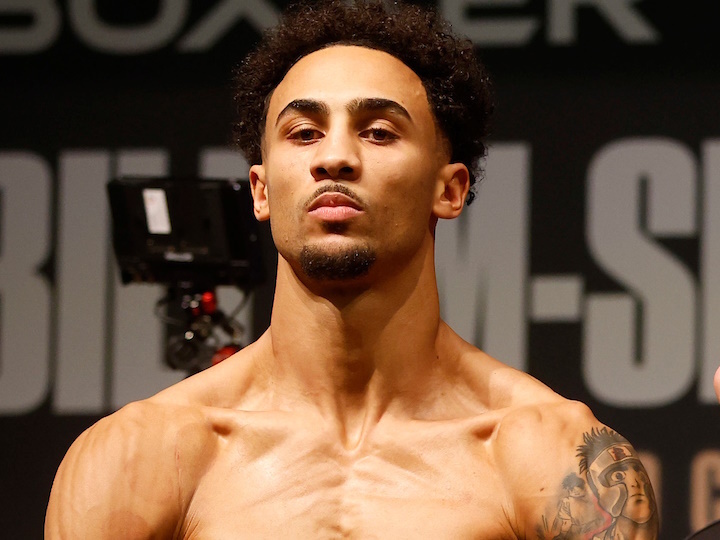
Ben Whittaker has already decided where Conor Wallace belongs in his story. The British light heavyweight described Wallace as a “stepping stone” during their October 1 press conference and called the fight his opponent’s “World Cup Final,” according to Matchroom-distributed comments published by Boxing 24/7. Whittaker then repeatedly poked Wallace in the chest during their […]
Ben Whittaker has already decided where Conor Wallace belongs in his story.
The British light heavyweight described Wallace as a “stepping stone” during their October 1 press conference and called the fight his opponent’s “World Cup Final,” according to Matchroom-distributed comments published by Boxing 24/7. Whittaker then repeatedly poked Wallace in the chest during their face-off before the fighters were separated.
The confrontation supplied the attention. The fight will determine whether the dismissal was justified.
Whittaker and Wallace meet October 3 at Utilita Arena Birmingham, with DAZN providing worldwide coverage. The IBF lists the contest among its sanctioned bouts and Matchroom identifies it as a final eliminator for the IBF light-heavyweight championship. The WBC has also confirmed that Whittaker’s Silver title will be at stake.
That makes Wallace more than another opponent selected to support Whittaker’s rise. He enters with a strong record, a high IBF position and enough knockout power to challenge the assumption that he is simply appearing in somebody else’s showcase.
Whittaker’s confidence has helped accelerate his profile. His recent stoppage victories have added substance to the presentation. But a world-title eliminator demands a different kind of proof.
Calling Wallace a stepping stone does not establish the gap between them.
Whittaker has to demonstrate it.
Wallace Has Earned More Respect Than Whittaker’s Label Suggests
Whittaker did acknowledge that Wallace is tough, but his larger message was clear: he views the Australian as another obstacle between himself and the world-title level.
That confidence fits the personality Whittaker has presented throughout his professional career. He understands that boxing rewards fighters who can make people watch before the opening bell. The showmanship, dismissive comments and physical face-off all keep attention fixed on him.
None of those things determines what happens once the fight begins.
Matchroom’s July announcement listed Whittaker at 12-0-1 with nine knockouts and Wallace at 17-1 with 12 knockouts. The same announcement identified Wallace as the IBF’s No. 2-ranked contender.
Those figures do not guarantee Wallace will win, but they make the “stepping stone” description difficult to accept without scrutiny. He has more professional victories than Whittaker has fights, and 12 of his 17 wins have ended by knockout. According to the WBC, Wallace most recently stopped Walter Gabriel Sequeira in the sixth round in April 2026.
Wallace has therefore earned his position through more than promotional convenience. He is entering a sanctioned final eliminator with a record and ranking that justify his presence.
That is why the face-off should not become the main evaluation of the matchup. Whittaker poking Wallace may suggest confidence, an attempt to provoke a reaction or another performance designed to sell the event. It does not prove he can control Wallace’s pressure, absorb his power or maintain his own composure if the fight becomes difficult.
Wallace now has an opportunity to challenge the entire framing of the promotion.
If Whittaker dominates, the “stepping stone” label will look like an accurate expression of the competitive difference. If Wallace forces him into an uncomfortable fight, the description will appear premature even if Whittaker ultimately wins. If Wallace produces the upset, the phrase will become evidence of how quickly boxing can confuse attention with achievement.
The label came first.
The proof has to follow.
Whittaker’s Recent Stoppages Support the Hype Without Settling the Question
Whittaker is not entering this eliminator on personality alone.
According to the WBC, he won its Silver light-heavyweight title by stopping Benjamin Gavazi in the first round in November 2025. He then defended that championship by stopping Richard Rivera in the second round on June 27, 2026.
Those performances matter. Consecutive early stoppages indicate that Whittaker has been converting his talent and confidence into decisive professional results. He has not merely looked stylish or attracted attention; he has ended fights quickly while advancing his position.
The WBC Silver title will again be at stake against Wallace, giving Whittaker something tangible to defend alongside his unbeaten professional record.
Momentum, however, is not the same as complete readiness.
A first-round stoppage over Gavazi and a second-round finish against Rivera do not automatically answer how Whittaker will perform against every contender near the top of the division. Quick victories can demonstrate power, timing and the ability to exploit openings, but they may not reveal how a fighter responds when an opponent survives the early attack and begins creating different problems.
Wallace represents the immediate test because he brings his own knockout record and has reached this position through the IBF rankings. Whittaker may prove too fast, too creative or too technically capable for him. He may also discover that a ranked opponent with serious ambition will not cooperate with the script.
That uncertainty is what gives the fight value.
Whittaker’s profile has grown faster than the number of rounds required to establish every part of his championship case. His recent results support the belief that he is moving toward the highest level. They do not remove the need to show how he handles resistance when a fight does not end immediately.
A convincing victory would provide important evidence. Whittaker would have defeated an IBF No. 2 contender, protected his WBC Silver title and earned the position associated with a final eliminator.
A difficult victory could still advance him while identifying areas that need work.
A loss would show that the promotion reached the destination before the fighter did.
Winning the Eliminator Would Create Positioning, Not Instant Readiness
The IBF final-eliminator designation gives the result consequences beyond Whittaker’s record.
Boxing 24/7 reported Matchroom’s position that the winner will become mandatory challenger to the winner of the expected Dmitry Bivol–Callum Smith fight. That pathway should still be described carefully because the expected championship matchup and the timing of any future mandatory challenge have not been finalized in the supplied reporting.
Even Whittaker’s promoter is not presenting an immediate title fight as certain.
Eddie Hearn told DAZN that Whittaker would “very likely” compete once more before challenging the relevant champion, according to Boxing News 24. Hearn mentioned Anthony Yarde or the winner of a possible Joshua Buatsi–Willy Hutchinson fight as potential opponents.
None of those fights is confirmed.
The possibilities nevertheless reveal how Matchroom may be thinking about Whittaker’s development. Winning an eliminator could secure a high-level position while another major domestic or divisional fight provides experience before the championship opportunity arrives.
That approach carries both value and risk.
A fight with Yarde, Buatsi or Hutchinson could prepare Whittaker for the demands of challenging a world champion. It could test his durability, decision-making and ability to adjust against an opponent with greater top-level experience. It could also cost him momentum or expose limitations after he has already earned mandatory status.
That is the tension between being entitled to an opportunity and being prepared to make the most of it.
Whittaker first has to defeat Wallace before any of those discussions become practical. Treating future opponents as the real tests would repeat the same mistake created by the “stepping stone” label: looking beyond the man who has already earned a place in front of him.
The title pathway makes October 3 important.
It does not make the result predictable.
Zuffa Speculation Cannot Replace the Wallace Result
Whittaker’s future has also become part of the promotion.
In an interview distributed by Uncrowned, Whittaker welcomed the possibility of Dana White attending the Birmingham event. That has contributed to speculation about potential interest from Zuffa Boxing.
White’s attendance has not been confirmed, and no verified offer from Zuffa has been disclosed.
Hearn has also challenged the idea that Whittaker is immediately available. He told The FightWire that the fighter is not yet one year into a three-year Matchroom agreement, according to Boxing News 24.
That places the business conversation in the proper context. Whittaker may be interested in attention from other promoters, and rival organizations may recognize his commercial potential. Neither possibility changes the contract description supplied by Hearn or establishes that a move is close.
More importantly, Whittaker’s leverage will depend on results.
The showmanship makes him marketable. The highlights help expand his audience. The possibility of competing promotional interest creates headlines.
Beating ranked opponents is what strengthens the business case.
Wallace can increase Whittaker’s value by giving him a credible victory, but only if Whittaker actually earns it. A poor performance would complicate the larger talk surrounding future titles, high-profile opponents and promotional options. A defeat would shift much of that attention toward the man currently being dismissed.
The October 2 weigh-in will provide the official weights, which were not available before the scheduled public event. No verified purse figures have been disclosed in the reviewed sources. Those unknowns should remain unknown rather than being filled with speculation.
The essential facts are already strong enough.
Whittaker is defending his WBC Silver title in an IBF final eliminator. Wallace is a ranked contender with one loss and 12 knockouts. The winner advances toward a world-title opportunity, even if another fight may come first.
Everything else is secondary to the result.
REAL TALK
Boxing needs personalities.
A fighter who can attract attention creates opportunities for himself, his opponents and the sport around him. Whittaker understands that business, and his willingness to perform outside the ring has helped separate him from other talented fighters still trying to build an audience.
The danger begins when promotion starts being treated as proof.
Calling Wallace a stepping stone is effective because it creates a clear story: Whittaker is the future star, while Wallace is merely one more obstacle on the route. That framing may ultimately be correct, but it has not yet been established.
Wallace’s 17-1 record, 12 knockouts and IBF position do not prove that he will beat Whittaker. They do prove that he has earned more respect than the role of anonymous supporting opponent.
A final eliminator creates accountability because it connects the promotion to a meaningful consequence. Whittaker is not only defending a title or protecting his unbeaten record. He is trying to move into position for a world-championship opportunity.
If he wins convincingly, the performance will validate much of the confidence surrounding him. If he struggles, the fight may show why another test before a championship challenge would be sensible. If he loses, Wallace will have exposed the mistake of treating a live contender like a completed step.
Whittaker supplied the prediction.
Wallace brings the challenge.
The ring decides whether the label survives.
LET’S TALK ABOUT IT
Does Ben Whittaker’s recent form justify calling Conor Wallace a stepping stone, or has he dismissed a legitimate contender before proving the competitive gap?
And if Whittaker wins the final eliminator, should he pursue the championship opportunity as soon as possible or take the additional high-level fight Eddie Hearn has discussed?