




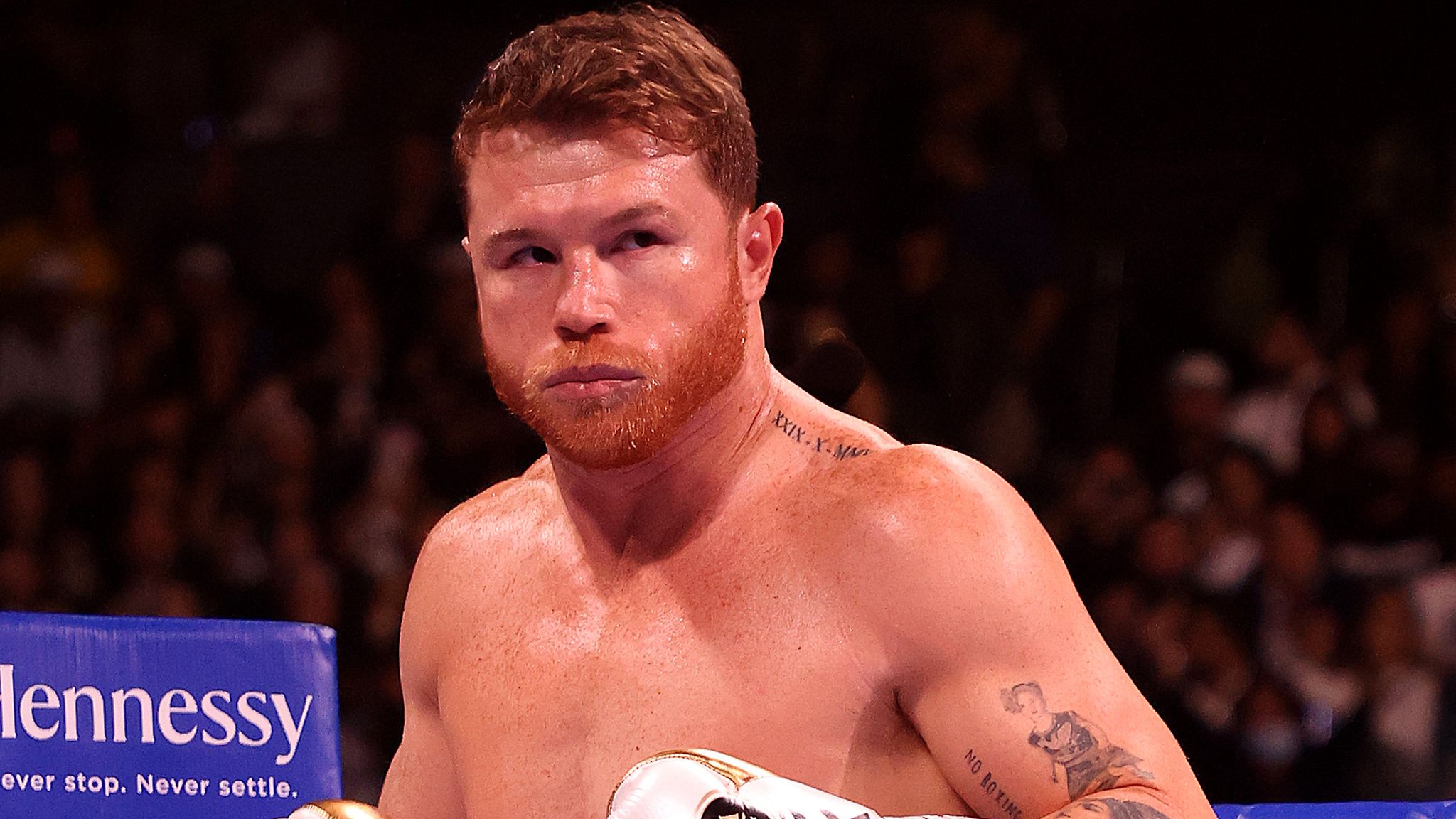
Canelo Alvarez already knows where he wants the final fight of his career to take place. He does not yet know what competitive position he will occupy when that night arrives. Alvarez told ESPN that he wants his last fight staged in Mexico and has pictured himself ending his career at Estadio Azteca. He also […]
Canelo Alvarez already knows where he wants the final fight of his career to take place.
He does not yet know what competitive position he will occupy when that night arrives.
Alvarez told ESPN that he wants his last fight staged in Mexico and has pictured himself ending his career at Estadio Azteca. He also confirmed that he held a Zoom conversation with stadium executive Emilio Azcárraga about the possibility. That discussion did not produce an announced agreement, opponent or date.
Before any farewell can be finalized, Alvarez has a much more immediate assignment. The WBC confirms that he will challenge unbeaten super-middleweight champion Christian Mbilli on October 31 at The Venue in Riyadh. Arab News reports that the Riyadh Season event will air on DAZN pay-per-view.
That fight could determine what an eventual Mexico homecoming represents. Victory could return Alvarez to championship status and create the possibility of a title fight at Estadio Azteca. Defeat could establish Mbilli as the division’s new central figure while forcing Alvarez to reconsider what he wants from the final stage of his career.
Canelo can imagine the ending.
Mbilli has the opportunity to rewrite everything leading into it.
Estadio Azteca Is Canelo’s Ambition, Not an Announced Event
Alvarez’s desire to end his career in Mexico carries obvious personal and historical meaning. Although his biggest fights have taken him to major stages outside the country, a final appearance before a home audience would allow him to close his career where his connection with Mexican supporters began.
According to ESPN and Infobae, Alvarez became inspired by the possibility after attending Mexico national-team matches at Estadio Azteca during the 2026 World Cup. He told ESPN, “I want my last fight to be in Mexico,” and said he could visualize himself competing inside the stadium.
The conversation with Azcárraga shows that the idea has moved beyond a private fantasy. It does not mean a fight has been booked.
There is no confirmed date, opponent or financial arrangement. It is also unknown whether the proposed event would involve a championship, whether it would satisfy one of Alvarez’s existing contractual commitments or whether the stadium has offered a specific window for staging it.
ESPN reports that Alvarez believes only a handful of fights remain in his career. He has not announced a retirement date, and he has not identified the Mbilli contest as his final appearance.
That distinction needs to remain clear.
Talking about the preferred location of a last fight is not the same as announcing retirement. Alvarez may already be thinking about his exit, but his schedule and status will depend partly on results he cannot control in advance.
The October 31 fight is the first of those variables.
If Alvarez defeats Mbilli, he could approach an Azteca event as a reigning WBC champion with another major fight still available. If he loses, the stadium idea could remain commercially attractive, but the sporting purpose of the event would change. It might become a rebuilding fight, a non-title farewell or an opportunity against an opponent selected primarily for the occasion.
None of those outcomes has been confirmed.
The only certainty is that Alvarez wants the final scene in Mexico. The circumstances surrounding that scene remain unwritten.
Canelo’s Existing Agreements Must Leave Room for Mexico
The business of arranging a farewell could be almost as complicated as choosing the opponent.
WBC president Mauricio Sulaimán said Alvarez has two fights remaining under his agreement with Sela: the Mbilli contest and another event expected in 2027. Separately, Boxing News 24 cited Dan Rafael in describing the Mbilli fight as the third bout in a four-fight Riyadh Season agreement.
Those accounts point toward another contractual commitment after October 31, but they should not be treated as interchangeable descriptions without complete agreement details. The supplied reporting does not establish where the remaining fight must take place or whether it could be staged in Mexico.
An Azteca event would require several parties to align. Alvarez would need a viable opponent, stadium availability and cooperation from the commercial partners holding rights connected to his remaining schedule. Broadcast arrangements, promotional control and the competitive purpose of the fight would also need to be settled.
No financial terms have been disclosed, and there is no basis to assume that the Zoom discussion with Azcárraga resolved any of those issues.
Canelo’s drawing power makes the concept realistic. His name can attract attention independent of a title, and a final fight in Mexico would carry significance even if it were promoted primarily as a farewell.
But the strongest version of the event would be a meaningful contest rather than a ceremony with gloves.
That is why Mbilli matters so much. Alvarez’s position after October 31 will influence the opponent who makes sense, the championship stakes available and the amount of time he may want before returning. A decisive win could make the Mexico fight feel like the closing chapter of another title reign. A difficult defeat could make the same event feel like an attempt to recover control of an ending that had already begun to move away from him.
The stadium may provide the setting.
The Mbilli result will help determine the story being told inside it.
Christian Mbilli Is the Champion, Not a Farewell Opponent
The conversation surrounding Alvarez naturally gravitates toward his future, but Mbilli is not arriving in Riyadh to help organize another fighter’s retirement.
He is the WBC super-middleweight champion, and Canelo is challenging for his title.
The WBC lists Alvarez at 63-3-2 with 39 knockouts and Mbilli at 29-0-1 with 24 knockouts. Mbilli won the interim championship by stopping Maciej Sulecki in the first round in June 2025, according to the WBC, before retaining that position with a draw against Lester Martinez.
The WBC elevated Mbilli to full champion in January 2026 after the championship became vacant.
That résumé does not carry the history of Alvarez’s career, but it gives Mbilli something more relevant to October 31: current championship status. He is unbeaten in 30 professional fights, and he enters with an opportunity to secure the defining victory of his career.
Alvarez arrives under different circumstances than the dominant champion who once controlled the division. The WBC records that Terence Crawford defeated him by unanimous decision in September 2025 and took his super-middleweight championships. The organization also reports that Alvarez underwent elbow surgery in early 2026.
The Mbilli fight was originally scheduled for September 12. According to the WBC, it was moved to October 31 because personal matters delayed the beginning of Alvarez’s training camp.
None of those facts proves that Alvarez has entered permanent decline. Losing to Crawford does not mean he cannot defeat Mbilli, and undergoing surgery does not establish that his elbow will fail under fight conditions. The postponement also should not be converted into an assumption that he will arrive unprepared.
Together, however, those details create legitimate questions.
Can Alvarez still control distance and pace against an active, unbeaten champion? Will his repaired elbow allow him to punch comfortably throughout the fight? Can he maintain his defense and accuracy if Mbilli forces sustained exchanges?
Mbilli faces questions of his own. His draw with Martinez showed that holding championship status does not make every contest straightforward. Against Alvarez, he must prove that his pressure and output can remain effective without giving the more experienced fighter predictable openings.
This is not a ceremonial stop before Canelo moves on to Mexico.
It is a championship fight capable of changing the direction of the division.
The Result Could Transform Canelo’s Final Chapter
A Canelo victory would restore him as a recognized super-middleweight champion. It would also demonstrate that the Crawford loss, surgery and disrupted schedule had not removed him from the elite level.
That outcome would add considerable weight to the Azteca idea.
A championship fight in Mexico could become more than an emotional homecoming. It could offer Alvarez the opportunity to finish his career while defending or contesting a major title, giving the event competitive stakes alongside its historical and commercial appeal.
Even then, victory would not confirm when he plans to retire. Alvarez could decide that beating Mbilli justifies continuing longer than expected, especially if other significant fights remain available.
A Mbilli victory would produce a different set of questions.
Defeating Alvarez would give Mbilli the signature result missing from his current record and strengthen his claim to leadership at super middleweight. The story should then focus on what he accomplished, not simply on whether Canelo looked old or should retire.
Alvarez could still pursue his proposed Mexico farewell after a loss. His popularity would not disappear, and Estadio Azteca could remain an appropriate place for the final fight of his career. But the event would no longer begin with the same championship momentum.
Retirement would not become automatic.
Alvarez has not said he will stop if Mbilli defeats him. A loss could lead him to complete another contracted fight, pursue a final victory at home or reassess his schedule entirely. Any stronger conclusion would be speculation.
That is what makes October 31 important. The contest should provide more useful evidence than another discussion about future plans.
Alvarez must show whether he can still dictate a fight against an unbeaten champion. Mbilli must show whether he can take control of the division while sharing the ring with its most recognizable active figure. The result will determine whether Canelo leaves Riyadh as champion, remains a challenger or begins placing greater priority on how he exits.
After that, the Azteca plan will still require something concrete.
A conversation confirms interest. An official agreement would confirm the fight.
REAL TALK
Boxing likes to begin celebrating a legend’s farewell before the final opponents have agreed to follow the script.
The famous fighter receives the attention. The venue becomes part of the mythology. Every remaining bout gets framed as another step toward an ending that appears to have been designed in advance.
The opponent can ruin that design.
Christian Mbilli is not being asked to attend a retirement ceremony. He is defending the WBC championship that Alvarez wants to regain, and he has his own career to build. For Mbilli, October 31 is not about helping Canelo reach Estadio Azteca with the right momentum. It is about proving that super middleweight has moved into a different era.
If Canelo wins, he deserves credit for reclaiming a championship from an unbeaten titleholder after losing to Crawford and undergoing surgery. That would make a future Mexico event more significant and strengthen the argument that he remains capable of choosing an ambitious final opponent.
If Mbilli wins, the response cannot be limited to asking what went wrong with Canelo.
Boxing has a habit of treating the younger or less famous champion as a measuring device for the star. If the star wins, his greatness is renewed. If he loses, the discussion turns immediately toward his decline. The opponent’s performance becomes secondary in both versions.
Mbilli has earned the chance to make himself the central figure.
Canelo may eventually receive the ending he wants in Mexico, and Estadio Azteca could provide a fitting stage for one of the most important careers of his generation. But no venue can guarantee that his final chapter develops according to plan.
The active champion is not a supporting character in somebody else’s farewell story.
Canelo has chosen the destination.
Christian Mbilli gets a chance to change what it means.
LET’S TALK ABOUT IT
Would beating Mbilli make Estadio Azteca the right setting for Canelo’s final championship fight, or should he face another leading contender before calling it a career?
If Mbilli wins on October 31, should the conversation center on Canelo’s retirement—or on Mbilli becoming the new defining figure at super middleweight?