


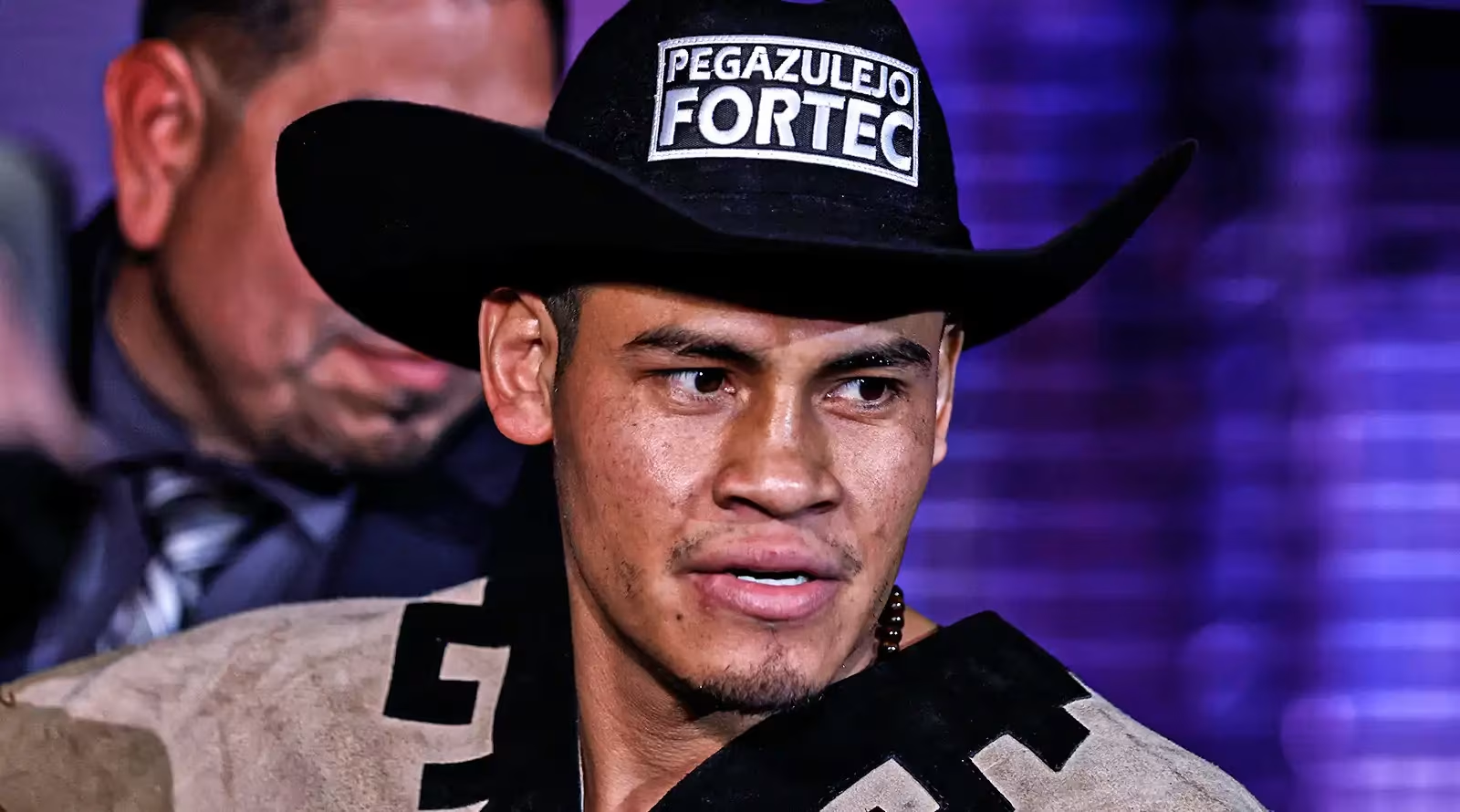
Boxing fans spend a lot of time complaining about what’s wrong with boxing. Fighters don’t fight often enough. Champions protect their undefeated records. Too many people wait for the perfect payday. Too many careers become exercises in avoiding risk while promoters explain why the fights everybody wants somehow can’t be made. Then there’s Emanuel Navarrete. […]
Boxing fans spend a lot of time complaining about what’s wrong with boxing. Fighters don’t fight often enough. Champions protect their undefeated records. Too many people wait for the perfect payday. Too many careers become exercises in avoiding risk while promoters explain why the fights everybody wants somehow can’t be made.
Then there’s Emanuel Navarrete.
Navarrete isn’t undefeated. He isn’t technically perfect. He doesn’t fight like somebody who came out of a laboratory designed to produce textbook boxing. Sometimes his punches come from strange angles, his feet aren’t always where a trainer would draw them on a whiteboard, and he’s willing to take shots that other elite fighters spend entire training camps learning how to avoid.
But if we’re talking about fighters who represent what people claim they love about boxing, Emanuel “Vaquero” Navarrete deserves considerably more appreciation than he receives.
He’s 40-2-1 with 33 knockouts, has won world championships in three divisions, currently holds the WBO and IBF championships at 130 pounds and has spent nearly eight consecutive years competing somewhere around the world-title level. He tried to become champion in a fourth weight class, failed, moved back down and continued fighting dangerous opponents anyway.
Now he’s preparing to fight WBC champion O’Shaquie Foster on October 24 in San Antonio.
Three championships will be on the line.
That’s Emanuel Navarrete.
The man’s career doesn’t really have a safe mode.
Navarrete Became Champion the Hard Way
Navarrete’s championship story began in December 2018 against Isaac Dogboe.
Dogboe was the champion. Navarrete was the challenger. Navarrete entered Madison Square Garden and took the WBO junior-featherweight championship from him by unanimous decision.
Then they fought again.
Navarrete didn’t simply repeat the victory. He dropped Dogboe twice and stopped him in the 12th round. From there, Navarrete made five successful defenses of the WBO championship before moving to featherweight. The WBO’s own history of his career notes that those five defenses all ended by knockout or technical knockout.
That’s where the pattern started becoming obvious.
Navarrete wasn’t interested in becoming comfortable at 122 pounds simply because he’d figured out how to win there.
He moved up.
At featherweight, he defeated Ruben Villa for the vacant WBO championship in October 2020. Villa was a skilled southpaw, and Navarrete dropped him in both the first and fourth rounds before winning a unanimous decision. He subsequently defended the championship against Christopher Diaz, Joet Gonzalez and Eduardo Baez.
Then he moved up again.
Some fighters spend years protecting one championship.
Navarrete kept looking for another mountain.
The Liam Wilson Fight Tells You Almost Everything About Navarrete
If somebody had never watched Emanuel Navarrete and asked me for one fight that explains why people call him a warrior, Liam Wilson would be somewhere near the top of the list.
Navarrete moved to super featherweight in February 2023 to fight Wilson for the vacant WBO championship. The fight nearly went disastrously wrong.
Wilson hurt Navarrete badly and dropped him in the fourth round. Suddenly the fighter attempting to become a three-division champion was dangerously close to suffering his first defeat in more than a decade.
Navarrete survived.
Then he turned the fight around.
By the ninth round, Navarrete had broken Wilson down and stopped him, becoming a world champion in a third division. Even the WBO’s official account of Navarrete’s championship history describes the Wilson fight as a situation where he was on the verge of defeat before recovering to win by dramatic stoppage.
That’s the thing about Navarrete.
He doesn’t need a fight to look clean.
He needs to still be there when it gets dirty.
There are technically better fighters in boxing. There are fighters with prettier combinations, tighter defense and more conventional footwork.
Navarrete’s greatest weapon might be his willingness to remain uncomfortable longer than the person standing across from him.
Then He Went Straight at Oscar Valdez
Winning the championship wasn’t enough.
Six months after beating Wilson, Navarrete fought Oscar Valdez.
That’s exactly the kind of matchup boxing fans constantly ask champions to take. Valdez was an accomplished two-division champion, a fellow Mexican fighter with power, experience and absolutely no reason to make Navarrete’s night easy.
Navarrete beat him by unanimous decision.
Then they did it again.
Their December 2024 rematch was even more decisive. Navarrete dropped Valdez three times and finished him with a body shot in the sixth round. The WBO described it as a return to form after Navarrete’s unsuccessful move to lightweight, with Navarrete using his unusual angles and looping punches to repeatedly blunt Valdez’s aggression.
There’s something important about that phrase: return to form.
Because between those two Valdez fights, Navarrete did something that tells us even more about his mentality.
He went looking for a fourth championship.
Navarrete Lost — And Somehow That Made Me Respect Him More
In May 2024, Navarrete moved to lightweight and challenged Denys Berinchyk for the vacant WBO championship.
He lost a split decision.
That gave Navarrete the second defeat of his professional career and ended his attempt to become a four-division champion.
And you know what?
Good.
Not good that he lost. Good that he tried.
This is where boxing has developed a strange relationship with undefeated records. We tell fighters we want them to challenge themselves, but the moment somebody loses, we immediately start subtracting from their value.
Navarrete could have remained at 130 pounds and continued defending his championship.
Instead, he tried something harder.
It didn’t work.
He went back to super featherweight and knocked Oscar Valdez out.
That’s what a loss is supposed to look like in a healthy sport. It becomes information, not a career obituary.
Navarrete discovered that lightweight wasn’t going to give him an easy fourth championship, accepted the result and continued moving forward.
His willingness to lose might actually be one of the reasons his career is so entertaining.
He isn’t protecting a perfect number.
He’s pursuing fights.
Eduardo Nuñez Was Another Fight He Didn’t Need to Make Easy
Navarrete’s February 2026 fight against IBF champion Eduardo “Sugar” Nuñez gave him another opportunity to choose difficulty.
Nuñez entered with a 29-1 record and a 19-fight winning streak.
Navarrete already had the WBO championship. He didn’t need another belt to call himself a world champion.
He wanted it anyway.
The result was one of the strongest performances of Navarrete’s career. According to the WBO’s official account, Navarrete used his familiar pressure and volume to take control, repeatedly punished Nuñez and eventually left his right eye badly swollen. The fight was stopped one second into the 11th round, making Navarrete the unified WBO and IBF champion. The scorecards at the stoppage were 98-92, 98-92 and 100-90 for Navarrete.
Think about the evolution there.
The same fighter who had to drag himself out of trouble against Liam Wilson was now breaking down another champion over ten punishing rounds.
Navarrete hasn’t become less of a warrior as he’s gotten older.
He’s become a more experienced one.
His Style Probably Shouldn’t Work This Well
This might be my favorite thing about watching Navarrete.
He looks wrong until suddenly everybody else looks wrong.
His punches can be wide. He changes rhythm. He attacks from awkward positions. He’ll throw combinations that don’t resemble the neat sequences young fighters practice on focus mitts. He has an unusually long 72-inch reach for a 5-foot-7 fighter, yet he frequently chooses to turn fights into physical exchanges rather than simply controlling opponents safely from outside. Top Rank lists him at 5-foot-7 with that 72-inch reach, while The Ring’s fighter analysis describes his approach perfectly: action over style, willing to take a shot to land his own.
That’s why calling Navarrete “awkward” almost undersells him.
Awkwardness becomes a skill when you’ve spent years mastering positions other fighters don’t understand.
His opponents train for conventional punches and conventional rhythms. Navarrete starts throwing punches from places where the normal defensive reactions don’t always work.
Then comes the volume.
Then comes the pressure.
Then comes another strange punch from another strange angle.
And eventually the opponent realizes this ugly-looking problem is extremely difficult to solve.
Now He’s Fighting O’Shaquie Foster Because Apparently Two Belts Aren’t Enough
This is where Navarrete’s warrior reputation stops being nostalgia and becomes something happening right now.
On October 24, Navarrete will fight WBC champion O’Shaquie Foster at Frost Bank Center in San Antonio.
Navarrete’s WBO and IBF championships will be at stake.
Foster’s WBC championship will be at stake.
Three belts.
The winner walks away holding three of the four major championships at super featherweight.
And Foster is not being brought in to make Navarrete look good.
He has been operating at an extremely high level himself, including recent victories over Stephen Fulton and Raymond Ford. Stylistically, he presents exactly the type of problem that could frustrate Navarrete: movement, timing, defense and the ability to box without voluntarily participating in the kind of chaotic fight Navarrete enjoys.
That’s what makes the matchup perfect.
Navarrete doesn’t need another opponent who will stand directly in front of him and cooperate with his style.
Give him a problem.
Give him something he has to solve.
Apparently, that’s what he wants anyway.
REAL TALK
There is something refreshing about a fighter whose career doesn’t require us to pretend the difficult nights never happened.
Navarrete has been dropped. He’s been hurt. He’s had a draw. He’s lost twice. He tried to win a championship in a fourth division and came up short. His fight with Charly Suarez became controversial before ultimately being changed to a no-contest after the California commission reviewed the accidental-headbutt sequence.
None of that ruins his story.
It makes the story believable.
Boxing has spent so much time marketing perfection that we’ve sometimes forgotten what makes fighters compelling in the first place. Warriors aren’t people who never encounter adversity. They’re people who keep walking toward difficult situations despite knowing exactly what adversity feels like.
Navarrete knows.
Liam Wilson almost had him.
Berinchyk beat him.
Robson Conceicao fought him to a draw.
None of those experiences convinced Navarrete that the answer was safer matchmaking.
He went back to Oscar Valdez.
Then he fought Eduardo Nuñez.
Now he’s fighting O’Shaquie Foster.
There’s a consistency in that which deserves respect.
Navarrete’s legacy may never be built around being the most technically perfect fighter of his generation. That’s fine. Boxing history has plenty of room for technicians.
It also needs fighters who make you check the schedule because you already know something might happen when their name is on the poster.
That’s Emanuel Navarrete.
He gives opponents opportunities because of the way he fights, but he gives himself even more opportunities because he’s comfortable living inside chaos. His imperfections aren’t something he has successfully hidden throughout his career. He’s built an entire championship style around them.
At 40-2-1, with championships across three divisions and two belts currently around his waist, Navarrete could probably justify becoming more selective.
Instead, he’s going after Foster’s belt.
That’s why I don’t need Emanuel Navarrete to be undefeated to call him a warrior.
I just need to look at who he keeps agreeing to fight.
LET’S TALK ABOUT IT
Is Emanuel Navarrete one of the most underappreciated warriors in boxing today, considering how consistently he’s taken difficult fights across multiple divisions?
And if Navarrete beats O’Shaquie Foster and walks away with three belts at 130 pounds, does that victory push him into a completely different conversation about the defining Mexican fighters of his era?