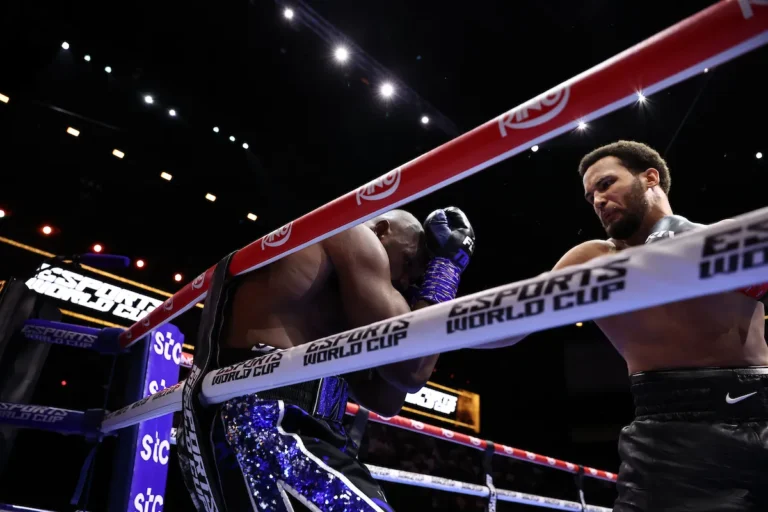






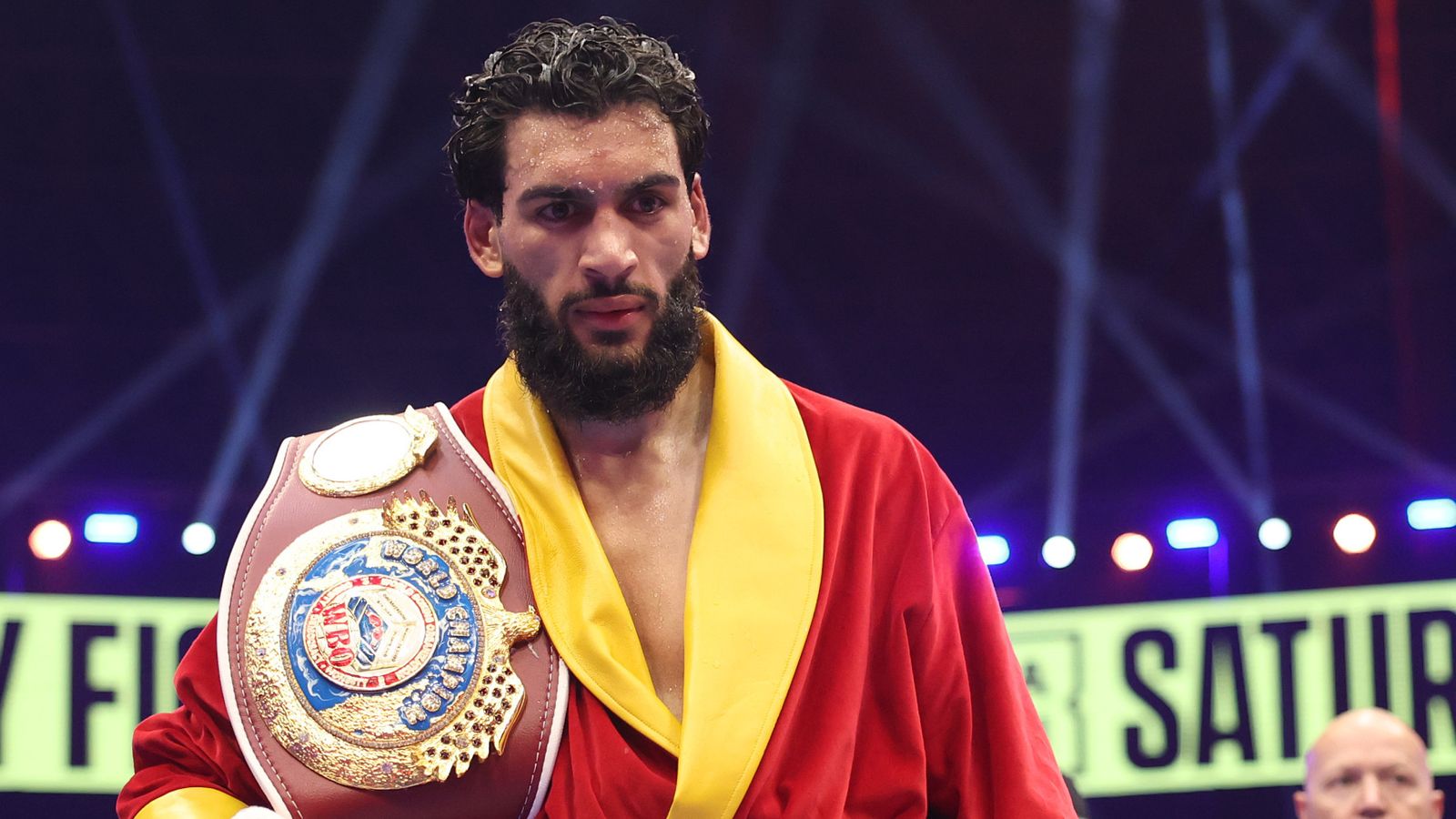
Hamzah Sheeraz spent years trying to become a world champion. Less than four months after finally getting there, he decided the WBO super middleweight championship wasn’t worth keeping under the terms being offered. Sheeraz has officially vacated his WBO title rather than proceed with an ordered mandatory defense against former unified middleweight champion Zhanibek “Janibek” […]
Hamzah Sheeraz spent years trying to become a world champion. Less than four months after finally getting there, he decided the WBO super middleweight championship wasn’t worth keeping under the terms being offered.
Sheeraz has officially vacated his WBO title rather than proceed with an ordered mandatory defense against former unified middleweight champion Zhanibek “Janibek” Alimkhanuly. The timing naturally makes the decision look dramatic because Queensberry Promotions, Sheeraz’s own promoter, had just won the purse bid to stage the fight with an offer of $1,001,809. Under the prescribed split, Sheeraz would’ve received approximately $751,357, while Alimkhanuly would’ve received about $250,452.
So there was no rival promoter controlling the event. There was no unresolved purse bid. The WBO had ordered the fight, Queensberry had secured the promotional rights, and potential dates and locations had already been proposed. Sheeraz simply decided not to proceed and surrendered the championship.
That immediately creates the question boxing fans are going to ask whether Sheeraz likes it or not: Did Hamzah Sheeraz just duck Janibek Alimkhanuly?
Maybe that’s too simple.
Because when you look closely at the money, Alimkhanuly’s controversial route into the mandatory position, Sheeraz’s larger ambitions at 168 pounds and where his promotional career may be headed, this starts looking like one of those boxing situations where several things can be true at the same time.
The Fight Was There — Sheeraz Chose Not to Take It
There’s no reason to dance around the basic fact.
Sheeraz had a mandatory obligation to Alimkhanuly and chose to relinquish the championship rather than fulfill it. The WBO formally confirmed that Queensberry notified the organization in writing that Sheeraz had considered the purse-bid terms and elected not to proceed.
That’s different from saying he was scared.
We don’t know that.
What we do know is that Sheeraz had already warned people that the economics could determine his decision. Before the purse bid, he openly discussed the possibility that the money might be too low for what he regarded as the biggest fight of his career. When the winning bid came in just above $1 million, his share landed around $750,000.
For most people, $750,000 is life-changing money. Professional boxing operates under a very different calculation.
Sheeraz has reportedly been earning seven-figure purses on major Riyadh Season and Ring events. If he believes he can make considerably more money against a less dangerous opponent—or position himself for a much larger fight—then accepting less money to face arguably the toughest opponent available to him becomes difficult to justify strictly as a business decision.
That’s precisely why boxing’s use of the word “ducking” becomes complicated.
A fighter can make a rational financial decision and still make a decision that disappoints fans competitively.
Those ideas aren’t mutually exclusive.
Sheeraz Had a Problem With Janibek Being Mandatory Before the Money Arrived
The purse wasn’t Sheeraz’s only objection.
He had been criticizing the WBO’s handling of Alimkhanuly for weeks, particularly after the Kazakh fighter’s positive test for meldonium derailed his scheduled middleweight unification fight with Erislandy Lara in December 2025. Alimkhanuly denied wrongdoing. The IBF stripped him of its middleweight championship, while the WBO initially suspended him before later terminating that suspension in July. After Alimkhanuly moved to super middleweight, the WBO designated him Sheeraz’s mandatory challenger.
Sheeraz publicly called the WBO’s decision a “joke” and argued that installing Alimkhanuly as mandatory effectively rewarded a fighter following a positive drug test.
Whether fans agree with Sheeraz or not, that objection didn’t suddenly appear after he saw Janibek standing across from him.
He had been telling everybody he disagreed with the WBO’s decision before the fight reached the purse-bid stage.
That context matters because there are really two separate arguments here. One is whether Alimkhanuly deserved to be installed as mandatory under those circumstances. The other is whether, once the WBO officially ordered the fight, Sheeraz should have defended the championship anyway.
You can believe the WBO handled Alimkhanuly’s situation poorly and still believe Sheeraz should have fought him.
You can also believe Sheeraz had every right to decide that a championship belt wasn’t worth accepting a fight he considered financially and professionally unattractive.
That’s where this gets interesting.
But Janibek Was Also a Serious Boxing Problem
We shouldn’t pretend the opponent had nothing to do with the calculation.
Alimkhanuly is 17-0 with 12 knockouts and previously held the WBO and IBF middleweight championships. He’s an experienced southpaw with an extensive amateur background and was already considered one of the more difficult middleweights in boxing before moving to 168 pounds.
That’s a very different proposition from making another manageable title defense.
Sheeraz won the vacant WBO championship by stopping Alem Begic in the second round in May, then retained it against Simon Zachenhuber by majority decision in July. Alimkhanuly represented a significant jump in difficulty from either of those opponents.
And that’s where fans are going to push back against the business explanation.
The championship is supposed to mean something.
If possessing the belt means accepting mandatory challengers, then eventually the champion is going to encounter somebody who represents terrible risk-to-reward. That’s practically the definition of a dangerous mandatory: somebody good enough to threaten your championship without necessarily bringing enough commercial value to compensate you for the danger.
If every champion vacated whenever that calculation became uncomfortable, the belts would become even less useful for determining who the best fighters actually are.
At the same time, fighters don’t receive bonus points at retirement for accepting the worst financial deal available simply because a sanctioning organization told them to.
That’s the conflict.
The Canelo Factor Changes Everything
Sheeraz isn’t hiding his larger ambition at super middleweight.
He wants Canelo Alvarez.
That’s understandable. Canelo remains one of boxing’s biggest commercial attractions, and a fight with him could produce the kind of money and exposure that dramatically changes Sheeraz’s career.
Sheeraz has spoken about targeting Canelo in 2027, and surrendering the WBO championship gives him freedom from the Alimkhanuly mandatory while allowing him to pursue whatever route his team believes gives him the best chance of reaching that fight.
But giving up the belt also removes one of Sheeraz’s strongest negotiating assets.
Being a world champion gives a fighter leverage. Canelo doesn’t need another belt to become commercially relevant, but somebody trying to secure a Canelo fight benefits from bringing something valuable to the table.
Sheeraz just voluntarily gave one of those things away.
That means his team presumably believes his name, marketability and position within the division can continue growing without the WBO championship—or that the freedom gained by abandoning the mandatory is more valuable than the belt itself.
That’s a gamble.
If Sheeraz lands Canelo or another enormous fight, people may look back at this decision as smart career management.
If he doesn’t, surrendering a world championship after one defense to avoid a $750,000 mandatory could look considerably different.
Frank Warren Doesn’t Sound Thrilled About It
One of the more revealing reactions came from Sheeraz’s own promoter.
Frank Warren has said he believes Sheeraz was wrongly advised to relinquish the championship and indicated that he would have preferred Sheeraz to fight Alimkhanuly.
That’s noteworthy because Queensberry wasn’t shut out of the situation. It had actually won the purse bid.
Usually, when a fighter vacates because the business doesn’t work, you might expect his promoter to be standing directly beside him explaining why it was the correct move.
Here, Warren’s public reaction suggests there was disagreement over the decision.
There’s another business layer as well. Sheeraz reportedly has one fight remaining on his Queensberry agreement and has publicly acknowledged that Zuffa Boxing could be an option when he becomes available, while stopping short of saying he intends to leave Queensberry.
That doesn’t prove his promotional future caused the WBO decision, but it does make the next several months considerably more interesting.
Sheeraz isn’t simply deciding which opponent comes next.
He may also be deciding what the next stage of his business career looks like.
Janibek’s Reaction Makes This Even Stranger
You might expect Alimkhanuly to spend the next several months calling Sheeraz a coward.
Instead, he has publicly asked fans to stop saying Sheeraz ran from him, saying Sheeraz made a decision based on his own plans and goals and expressing respect for him.
That’s a surprisingly measured response from the fighter who lost his mandatory opportunity.
It doesn’t change what happened. Sheeraz relinquished the championship rather than fight him.
But it reinforces why we should be careful about pretending we know Sheeraz’s motivation.
The action is documented.
The motive is something else.
Fans can reasonably criticize the decision without inventing what’s inside the fighter’s head.
Now the Belt Moves On Without Sheeraz
The WBO hasn’t waited around.
After Sheeraz vacated, the organization moved toward filling the championship vacancy, and its current listings show negotiations involving Alimkhanuly and Jacob Bank for the vacant super middleweight title.
That means the division will continue.
Janibek can pursue the championship.
Sheeraz can pursue whatever opportunities his team believes are more valuable.
And eventually we’ll get to judge both paths by what happens next.
That’s the part people sometimes forget when these decisions happen. Vacating a championship doesn’t end the argument. It postpones the verdict.
If Sheeraz walks directly into a huge fight, wins it and establishes himself among the elite at 168 pounds, the WBO belt may look like something he intelligently refused to let dictate his career.
If Janibek wins the vacant title and starts beating the top super middleweights while Sheeraz struggles to land the opportunities he expected, fans are going to revisit this moment repeatedly.
Career decisions don’t get evaluated only when they’re made.
They get evaluated by what they produce.
REAL TALK
There’s a reason this story creates such a strong reaction among boxing fans. We want championships to represent competitive achievement, while fighters increasingly have to treat those same championships as business assets.
Those two ideas don’t always cooperate.
From a fan’s perspective, the answer is easy: you’re the champion, Janibek is the mandatory, so fight him.
From Sheeraz’s perspective, the calculation includes considerably more. He’s looking at the opponent, the purse, the risk, his future earning potential, his promotional situation and the possibility of much larger fights. If his team believes the belt is preventing rather than creating those opportunities, giving it up becomes a legitimate business option.
But there’s a price attached to that freedom.
Once you surrender the championship instead of defending it against the man ordered to fight you, you lose some control over how people interpret the decision. You can explain the money. You can criticize the sanctioning body. You can point toward bigger opportunities.
Some fans are still going to call it a duck.
That’s part of boxing too.
The interesting thing is that Sheeraz appears willing to accept that criticism because he believes whatever comes next will be worth more than keeping the WBO belt.
Now he has to prove it.
Not by explaining the decision again, but by making the next decision count.
Because walking away from a $750,000 fight with Janibek makes perfect business sense only if the road you’re choosing actually leads somewhere better.
LET’S TALK ABOUT IT
Do you consider Sheeraz vacating the WBO championship rather than fighting Janibek a duck, or is turning down roughly $750,000 for a high-risk mandatory simply smart business when bigger opportunities may be available?
And if Sheeraz doesn’t land Canelo or another major fight in 2027, does this decision look completely different a year from now?