

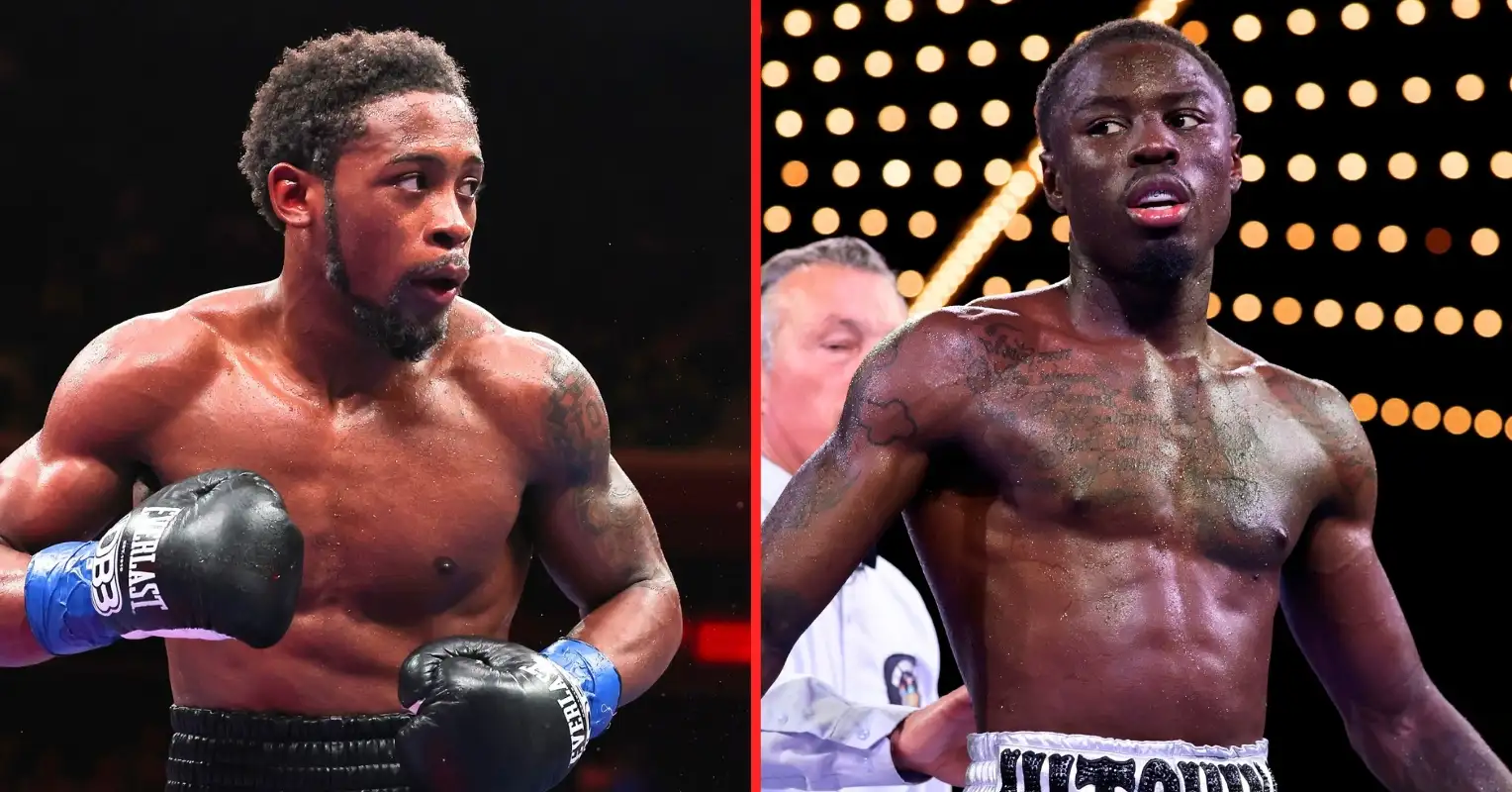
Timothy Bradley slightly favors Keyshawn Davis over Richardson Hitchins if their increasingly likely welterweight fight becomes official, and his reasoning makes sense. Bradley believes Davis has enough versatility to pressure Hitchins without simply following him around the ring, which is important against a boxer who becomes increasingly comfortable once he understands how an opponent is […]
Timothy Bradley slightly favors Keyshawn Davis over Richardson Hitchins if their increasingly likely welterweight fight becomes official, and his reasoning makes sense. Bradley believes Davis has enough versatility to pressure Hitchins without simply following him around the ring, which is important against a boxer who becomes increasingly comfortable once he understands how an opponent is trying to enter his range. But I’m almost more interested in what this fight represents than who Bradley thinks will win it.
Keyshawn Davis and Richardson Hitchins are both undefeated, both former world champions, both talented enough to make people talk about pound-for-pound potential, and both have reached a point where the conversation needs to move beyond what we think they could become.
They need each other.
Dana White has said Davis-Hitchins is “more than likely” to happen next, and the fight has been linked to the December 11 Anthony Joshua-Tyson Fury card in Cardiff. Nothing should be treated as official until the contracts and announcement say so, but this isn’t simply social-media matchmaking anymore. Hitchins has acknowledged the negotiations and calls the matchup a legitimate 50-50 fight.
If Zuffa Boxing gets this one across the finish line, it may be doing both fighters a favor.
Bradley Sees Something Keyshawn Can Do That Others Haven’t
Bradley’s breakdown centers on how Davis would approach Hitchins.
Hitchins is comfortable when opponents become predictable. Bradley specifically referenced Liam Paro, arguing that once Hitchins understood Paro’s entry points, he began timing him. Bradley believes Davis presents a different problem because he can vary his approach, make adjustments and potentially force Hitchins backward rather than allowing him to settle into his preferred rhythm.
That sounds simple until you actually watch Hitchins fight.
He’s the type of boxer who can make an opponent spend an entire night trying to solve distance. His style isn’t necessarily designed to give you the dramatic exchanges people clip for social media the next morning. It’s designed to make you increasingly frustrated as the rounds disappear.
That’s where Davis becomes interesting.
Keyshawn isn’t simply an aggressive puncher. He can box, counter and change gears. He’s also shown that when he recognizes an opening, he has considerably more finishing instinct than some of the technically oriented fighters Hitchins has encountered.
Bradley has been extremely high on that combination. Earlier this year, he went so far as to say he would rather fight Shakur Stevenson than Davis because, in his view, Keyshawn combines the ability to embarrass an opponent technically with the ability to knock him out.
Now Davis may finally get an opponent capable of testing whether that praise is justified.
Keyshawn Needs This Fight More Than Another Showcase
Davis has been in a strange position for a while.
His talent has never really been the problem. He’s an Olympic silver medalist, became WBO lightweight champion and has looked sensational at times. His stoppage of Jamaine Ortiz in January was particularly important because Ortiz had already established himself as an extremely difficult opponent. Davis dropped him twice and stopped him late, giving Keyshawn the kind of performance that seemed capable of moving his career into a different category.
But Davis’ career has also been interrupted by problems that had very little to do with whether he can fight.
His scheduled lightweight title defense against Edwin De Los Santos collapsed after Davis missed the 135-pound limit by 4.3 pounds, costing him the WBO championship. His move through the weight classes has subsequently become part of the story surrounding him.
He was later positioned for a WBO welterweight championship opportunity against Devin Haney but ultimately withdrew from that route. Reporting at the time said Davis rejected an earlier $3 million offer and later relinquished his mandatory position after Top Rank won the purse bid, under which his mandated share would have been approximately $2.14 million.
Whatever anybody thinks about those business decisions, they leave Davis needing something straightforward now.
A major fight.
No explanation required.
Hitchins gives him exactly that.
Hitchins Needs It Too
Hitchins’ career has its own complications.
He defeated Liam Paro to become IBF junior-welterweight champion in December 2024 and successfully defended the title against George Kambosos Jr. before eventually relinquishing the belt and moving to welterweight. In July, he made his 147-pound debut by defeating Ricardo Salas on points.
But Hitchins has never become the kind of attraction his ability might suggest he should be.
Part of that is stylistic. Technical fighters who prioritize control aren’t always rewarded commercially in the same way as knockout artists and personalities who generate controversy.
Some of it has also been circumstance.
His scheduled fight with Oscar Duarte earlier this year fell apart after Hitchins became ill following the weigh-in process. Davis publicly criticized him afterward, and Bradley was critical too. Hitchins subsequently moved up, which probably confirmed something everyone already suspected: making 140 pounds had become increasingly difficult.
Now he’s at welterweight without that excuse hanging over him.
And if Hitchins wants the fights he has publicly discussed against names such as Ryan Garcia, Devin Haney, Teofimo Lopez and Conor Benn, beating Keyshawn Davis would give him something much more valuable than calling those fighters out.
It would give them a reason to take him seriously.
The Winner Suddenly Becomes Very Important at 147
This is where the matchup becomes especially valuable.
Davis-Hitchins doesn’t need a championship belt attached to it to matter.
Both men are undefeated. Both have championship experience. Both are moving into a welterweight landscape filled with commercially valuable fighters, and neither can afford to spend the next several years waiting for those names to voluntarily choose them.
A victory changes that.
If Davis beats Hitchins convincingly, the argument that he’s one of America’s most talented fighters suddenly has the résumé support it has occasionally lacked.
If Hitchins beats Davis, particularly if he neutralizes Keyshawn’s offense and makes a fighter Bradley rates so highly look ordinary, then boxing has to reconsider where Hitchins belongs in the welterweight conversation.
Hitchins understands what’s at stake. He has described Davis as a great fighter and said he believes the winner belongs in the pound-for-pound conversation.
I wouldn’t automatically put either man on a pound-for-pound list based on one victory. There’s too much accomplished talent in boxing for that.
But I understand his larger point.
This isn’t supposed to be another developmental fight.
It’s a separation fight.
And That’s What Zuffa Boxing Should Be Doing
There’s another reason I like this matchup if Zuffa Boxing ultimately makes it.
We’ve heard plenty about how Dana White wants to change boxing. We’ve heard about different promotional structures, new fighters signing, major events and Zuffa’s ambitions within the sport.
Eventually all of that has to translate into fights.
Davis-Hitchins is the kind of matchmaking that would make the argument for them.
Two talented fighters in or near their primes, neither needing to be protected from the other, with the winner moving directly toward significantly bigger opportunities.
That’s much more interesting than signing recognizable fighters and giving them opponents designed primarily to preserve their marketability.
Boxing already knows how to do that.
If Zuffa genuinely wants to differentiate itself, make talented fighters prove where they belong.
Davis and Hitchins are perfect candidates.
REAL TALK
There comes a point in every talented fighter’s career where potential stops being a compliment.
Keyshawn Davis has been described as a future star for years. Richardson Hitchins has spent years telling people he’s one of the most skilled fighters in boxing. Both claims may be true, but eventually professional sports requires something beyond convincing people that you’re capable of greatness.
You have to put yourself somewhere greatness can be tested.
That’s what makes this matchup so refreshing.
Somebody’s undefeated record may disappear. Somebody may lose negotiating leverage. Somebody’s next payday may become smaller than it would have been if both fighters simply continued taking safer assignments.
That’s also exactly why the fight matters.
The modern boxing business can create an incentive to protect the possibility of being elite instead of actually discovering whether you are. An undefeated fighter remains marketable because everybody can imagine how good he might eventually become. The moment two undefeated contenders fight, one of those possibilities changes.
But the winner gains something far more valuable than a zero on BoxRec.
He gains proof.
Davis doesn’t need another opponent who allows people to say, “Wait until Keyshawn fights somebody.”
Hitchins doesn’t need another performance that produces an argument about whether his style is entertaining enough to attract major opponents.
Fight each other.
Then the conversation changes naturally.
If Keyshawn wins, Bradley’s belief in his versatility and finishing ability looks much more meaningful because it survived one of the more technically difficult opponents available to him.
If Hitchins wins, nobody can dismiss him as simply a defensive boxer calling out bigger names. He’ll have beaten one of the most highly regarded American talents of his generation.
That’s how fighters create leverage that promoters can’t manufacture.
You stop asking people to believe you’re elite.
You beat somebody else who believes the same thing.
LET’S TALK ABOUT IT
If Keyshawn Davis and Richardson Hitchins fight at welterweight, do you agree with Timothy Bradley that Keyshawn’s versatility gives him the edge, or does Hitchins’ ability to control distance turn this into exactly the kind of fight that could frustrate Davis?
And more importantly, should Zuffa Boxing make fights like Davis-Hitchins its identity—putting talented fighters against each other early instead of protecting undefeated records until a championship or massive payday forces the risk?