
Anthony Joshua’s Best Chance Against Tyson Fury May Be a Dog Fight — But Aggression Carries Its Own Danger
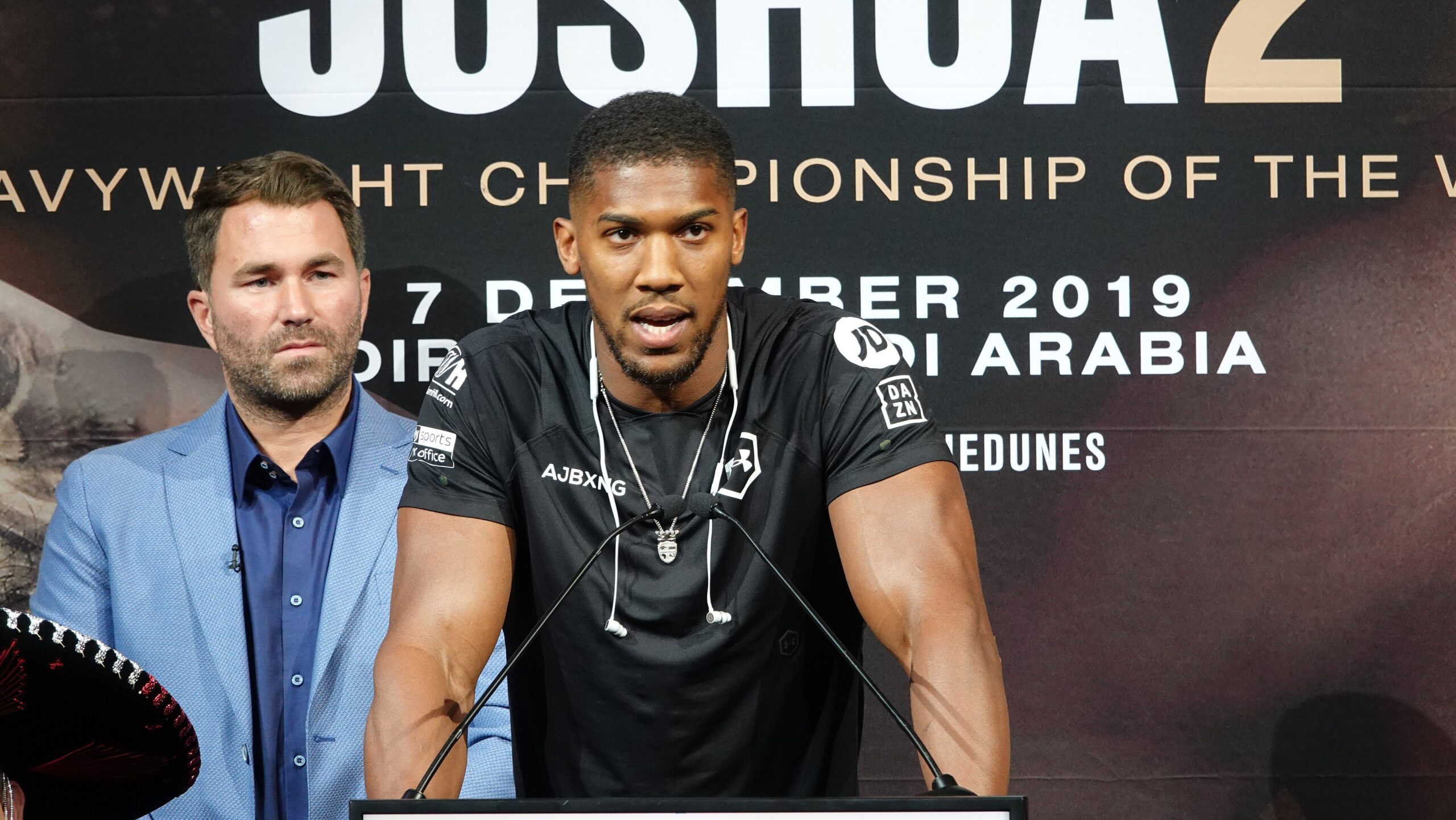
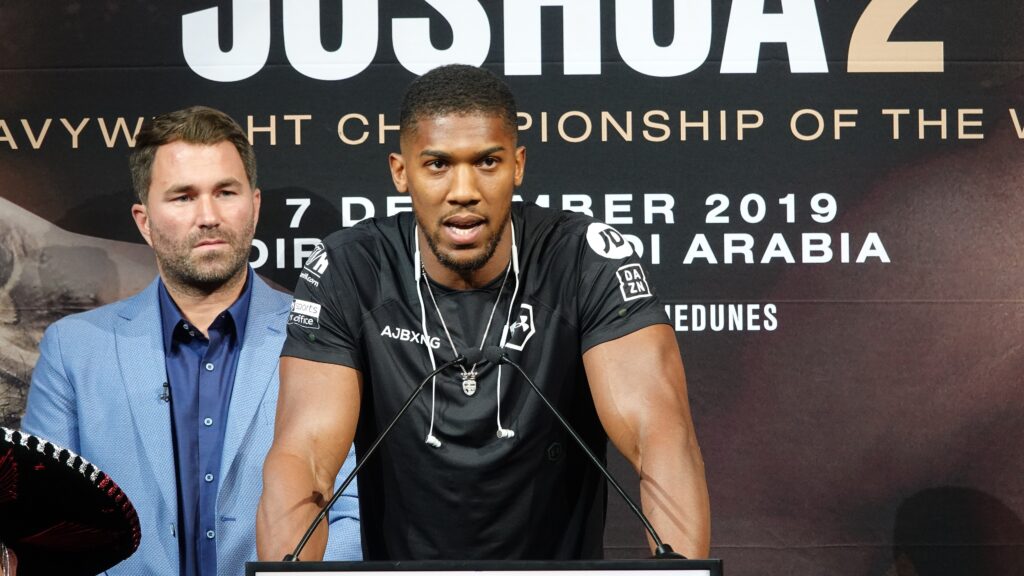
Anthony Joshua speaking at a press conference with promoter Eddie Hearn behind him.Image: JazzyJoeyD / CC BY-SA 4.0 / Wikimedia Commons
Anthony Joshua may have to abandon the comfort of a measured boxing match if he wants to defeat Tyson Fury.
That is the assessment of trainer Adam Booth, who believes Joshua’s most credible route to victory is forcing Fury into an aggressive fight before the former heavyweight champion can establish control. Speaking to IFL TV in comments reported by Boxing News, Booth argued that Joshua should approach the contest with the urgency Marvin Hagler brought to his famous three-round battle with Thomas Hearns.
Fury and Joshua are scheduled to meet at Principality Stadium in Cardiff on December 11. The Welsh Rugby Union confirmed the matchup on September 24, while Netflix has announced that it will stream the event live globally.
The occasion will be enormous, but the tactical question is relatively simple: Can Joshua make Fury fight his fight before Fury makes him hesitate?
Booth’s answer is not that Joshua should charge forward without discipline. It is that caution may become its own form of danger. If Joshua remains at range, waits for obvious openings and allows Fury to dictate the rhythm, Booth believes the contest could gradually move beyond Joshua’s control.
The alternative is a shorter, more violent fight in which neither heavyweight is allowed to feel comfortable.
That strategy may give Joshua his best opportunity. It could also expose him to exactly the kind of punishment he is trying to create.
Booth Believes Joshua Must Prevent Fury From Taking Control
Booth told IFL TV that Joshua should force a “dog fight” rather than attempt to outbox Fury in a conventional tactical contest. He compared the required mentality to Hagler’s approach against Hearns, when Hagler applied immediate pressure and refused to allow a dangerous opponent time to settle.
According to Boxing News, Booth said Fury could “hypnotise” Joshua if the fight becomes a controlled boxing match. The concern is that Fury’s movement, feints and lead-hand work could make Joshua increasingly reluctant to commit.
Booth specifically identified Fury’s orthodox left hand as an important obstacle. That hand does not need to produce dramatic damage to influence the fight. It can occupy Joshua’s attention, interrupt his preparation and make him reset before launching his own offense.
Joshua therefore has to do more than move forward. He has to get beyond Fury’s left hand without following him around the ring or walking predictably into counters.
That distinction separates pressure from recklessness.
Effective pressure would require Joshua to close distance behind his own jab, attack the body when Fury moves and continue working after the first exchange. He cannot allow a missed punch, a clinch or an awkward collision to end every offensive sequence. Fury has built much of his success around disrupting opponents and making them restart.
Booth’s prescription attempts to remove that comfort. He said the fight “probably shouldn’t go six rounds” if Joshua adopts the approach he believes is necessary.
That does not amount to a prediction that Joshua will win early. It is an argument about the conditions under which Joshua may be most dangerous.
A short fight would increase Joshua’s opportunity to impose his power and athleticism before Fury has collected enough information to adjust. It would also increase the likelihood of Joshua being caught while taking the risks required to make that happen.
Booth’s point is that the danger must be mutual.
A Patient Boxing Match Could Allow Fury to Establish His Rhythm
Joshua has reasons to value patience. His career has demanded tactical rebuilding, and controlled decision-making has often been presented as the answer whenever his performances have become too tense, too aggressive or too cautious.
Against Fury, however, patience can only help if it produces meaningful offense.
Waiting for a completely safe opening may allow Fury to control the distance without having to defend sustained attacks. Fury can change his rhythm, vary the speed of his punches and use feints to create uncertainty. An opponent who becomes preoccupied with reading every movement can spend long stretches reacting instead of initiating.
That appears to be what Booth means when he warns that Fury could hypnotise Joshua. The danger is not literal confusion. It is tactical paralysis.
Joshua cannot afford to spend the early rounds watching Fury establish patterns while landing occasional jabs and controlling the geography of the ring. Once Fury becomes comfortable, he can force Joshua to chase, clinch when the distance closes and make the bigger exchanges occur on his terms.
Booth’s proposed solution is urgency.
Joshua would need to pressure with enough intelligence to cut off exits rather than simply follow Fury. He would also need to make his attacks count after closing the distance. Getting inside Fury’s reach means little if Fury immediately ties him up, turns him and returns the fight to long range.
Joshua’s activity following clinches could become particularly important. If every break gives Fury time and space to rebuild his preferred distance, Joshua may find himself repeatedly completing the hardest part of the assignment without receiving the benefit.
The challenge is maintaining that pressure without becoming predictable. Fury is unlikely to provide the same look throughout the fight. He could begin at range, meet Joshua in the center or use his size in close quarters if he believes Joshua is wasting energy.
Booth has identified one credible route for Joshua, but Fury’s adaptability means that route will not remain open without resistance.
Turning the Fight Violent Could Be Just as Dangerous for Joshua
A dog fight sounds favorable to Joshua because of his punching power, but close-range aggression does not automatically neutralize Fury.
It may invite Fury to fight back.
Joshua would be exposing himself whenever he steps through the lead hand or commits to combinations. Fury could counter him on the way in, smother his work once he arrives or force him to carry weight in repeated clinches. If Joshua begins throwing with excessive urgency, Fury may also find opportunities between his punches.
The physical cost matters. Sustained pressure requires more energy than isolated attacks, particularly against an opponent who can move, lean and make every exchange awkward. Joshua cannot treat the opening rounds as a reckless sprint unless he is prepared for the possibility that Fury survives them.
That is where Booth’s assessment becomes a test of Joshua’s composure as much as his aggression.
Can Joshua accept return fire without abandoning the plan? Can he remain active after Fury disrupts his first attack? Can he continue applying pressure if the early power punches do not produce an immediate breakthrough?
Those questions are more important than whether Joshua simply begins quickly.
Controlled violence requires discipline. Joshua must create exchanges without allowing frustration to dictate them. He must remain aggressive enough to deny Fury a comfortable rhythm while still recognizing the counters, clinches and changes of stance or tempo that could be coming back.
There is also no guarantee Fury will remain at range. Booth’s comments explain why Joshua may not want a technical contest from the outside, but Fury could decide that meeting Joshua physically is the best way to exhaust or discourage him.
A dog fight would not belong exclusively to Joshua.
It would create the volatility Booth believes Joshua needs, but volatility does not choose a beneficiary in advance.
Booth Has Identified a Route to Victory, Not a Guaranteed Formula
Booth’s analysis changes how the matchup can be framed. It presents Joshua’s aggression not as an emotional gamble but as a tactical necessity designed to deny Fury time and control.
It does not prove Joshua cannot win another way.
Joshua’s actual team has not publicly confirmed that it will adopt Booth’s approach, and no outside assessment can account for every adjustment that may occur once the fight begins. The final strategy could include pressure without demanding an immediate war, or Joshua could attempt to establish his own jab before increasing the pace.
The available records also underline why neither man can be reduced to a simple tactical label. Netflix lists Fury at 36-2-1 with 25 knockouts and Joshua at 30-4 with 27 knockouts. Both have enough experience and power to punish a serious mistake.
There is also an unresolved issue surrounding the championship status of the event. Fury promoter Frank Warren told Sky Sports on October 12 that the WBA “super,” or primary, heavyweight championship would be contested in Cardiff.
That should be presented as Warren’s claim rather than settled sanctioning-body fact.
The WBA’s rankings published on October 31 list Murat Gassiev as heavyweight world champion, with Fury at No. 2 and Joshua at No. 3. The heavyweight section of those published rankings does not identify a separate “super” champion. Unless the WBA issues further clarification, the apparent discrepancy remains unresolved.
Whatever championship designation is ultimately attached to the fight, the tactical evidence will come from what happens in the ring.
The first indication will be whether Joshua can consistently get beyond Fury’s left hand. The next will be whether he remains active after Fury clinches, turns or counters him. Most revealing of all will be Joshua’s response if his early pressure fails to produce a knockdown or visible damage.
The official weigh-in may provide additional context about how each fighter intends to approach the contest, but no confirmed fight weights were provided by the reviewed sources. No confirmed purses have been reported in those sources either.
For now, Booth has offered a theory. December 11 will determine whether Joshua can turn it into a performance.
LET’S TALK ABOUT IT
Is Adam Booth right that Joshua must force Fury into an early dog fight, or would that approach create more opportunities for Fury to counter and control him physically?
Can Joshua sustain calculated aggression without becoming predictable, or does a short, violent contest give him the clearest chance of victory?
Outlets cited in this story
- Boxing News
- Sky Sports
Spot an error? Send a correction.
More on Anthony Joshua
All 18 Anthony Joshua stories →
Tyson Fury Gets Tony Sims’ Vote Over Anthony Joshua — But the Prediction Exposes What Boxing Lost
Tyson Fury should enter his long-awaited fight with Anthony Joshua as the favorite, according to Joshua’s former trainer Tony Sims. That sounds like a clear prediction until Sims explains why…
Tyson Fury Discusses an Oleksandr Usyk Trilogy — But Anthony Joshua Comes First
Tyson Fury is already discussing the possibility of fighting Oleksandr Usyk for a third time, but one major obstacle stands between that idea and reality: Anthony Joshua. Fury is scheduled…
Tyson Fury’s Camp Denies Injury Rumor — But Readiness for Anthony Joshua Remains Unproven
Tyson Fury’s camp has denied an unconfirmed injury rumor ahead of his December 11 fight with Anthony Joshua, leaving no verified reason to believe one of British boxing’s biggest matchups…
Tyson Fury Targets Wilder Knockout Tactics for Anthony Joshua — But the Blueprint May Not Fit
Tyson Fury appears to be preparing for Anthony Joshua with one of the most dominant performances of his career in mind. According to Boxing 247, Fury posted, “Big boy 280lbs…