Dana White Takes Control of the Fury–Joshua Undercard, Hearn Says — But Who Really Made the Call?
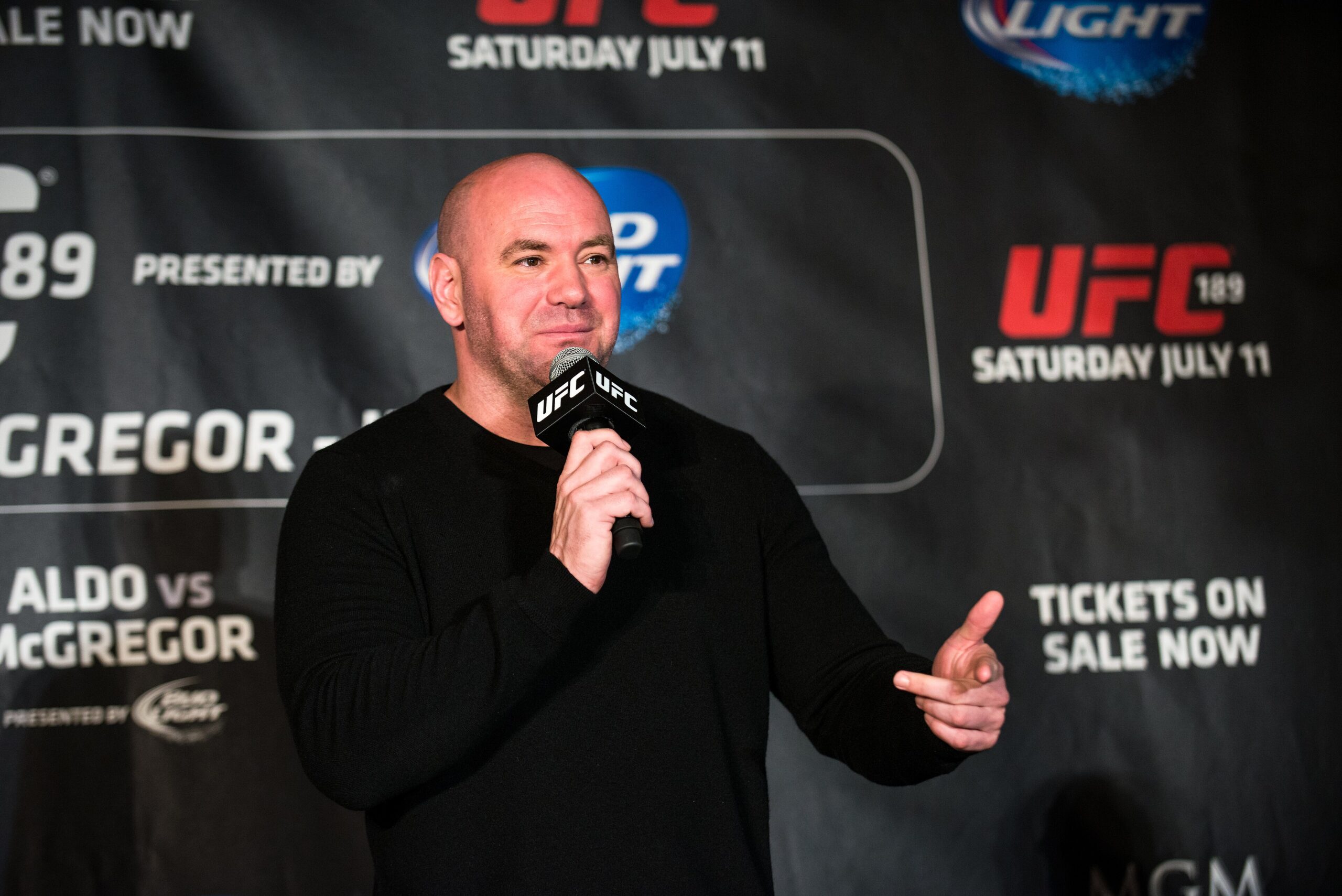
Dana White speaks into a UFC microphone at a 2015 press event.Image: Andrius Petrucenia / CC BY-SA 2.0 / Wikimedia Commons
Tyson Fury and Anthony Joshua finally have an official date, venue and supporting card. Yet the first major controversy surrounding their December 11 meeting at Principality Stadium in Cardiff is not about the two British heavyweights in the main event.
It is about who selected the fights underneath them.
Netflix Tudum officially lists four bouts: Fury against Joshua, Deontay Wilder against Jai Opetaia, Martin Bakole against Solomon Adebayo and Da’Mazion Vanhouter against Michael Essomba. Joe Cordina, the Welsh fighter Eddie Hearn wanted involved in the event, is not among them.
Hearn told iFL TV that he had “nothing to do” with the announced main card and described its composition as “really disappointing,” according to The Independent. He questioned why Vanhouter had been selected while Cordina—whom Hearn described as a two-time world champion from Wales—was left without a place.
More significantly, Hearn alleged that Turki Alalshikh followed Dana White’s advice when choosing the supporting bouts.
That accusation has transformed Cordina’s omission from a matchmaking complaint into a larger dispute over authority. If Hearn’s account is accurate, one of boxing’s most established promoters may have been reduced to proposing fighters while decisions were made elsewhere. But White, Alalshikh and the event organizers have not publicly confirmed Hearn’s version of events.
The card is official. The chain of command behind it is not.
Hearn’s Complaint Exposes His Apparent Lack of Control
Hearn’s frustration is understandable on a basic promotional level. Fury–Joshua is taking place in Cardiff, and Hearn believes Cordina’s connection to Wales made him an obvious candidate for the supporting card.
But Hearn’s comments reveal something more important than disagreement over one fighter.
He says he did not select the announced bouts.
That matters because Hearn has been one of the central promotional figures throughout Joshua’s professional career. A major Joshua event would traditionally be expected to carry significant Matchroom influence, particularly when the show is being staged in Britain. Hearn’s statement suggests that whatever input he provided did not give him final authority over the main card.
According to The Independent, Hearn specifically questioned Vanhouter’s inclusion and alleged that Alalshikh had acted on White’s advice. That may indicate White had meaningful influence over the selection process. It does not establish that he controlled the entire undercard, personally rejected Cordina or made every final decision.
No public explanation from White, Alalshikh, Netflix or the event organizers has clarified the arrangement.
That distinction is essential. Boxing regularly operates through overlapping relationships among promoters, broadcasters, financiers, advisers and sanctioning bodies. One person can recommend a matchup without possessing final authority. A streaming platform can have preferences without formally acting as the matchmaker. A promoter can negotiate a proposed fight without having the power to place it on the card.
Hearn has provided his account of the process. Until another decision-maker confirms or challenges it, that account remains an allegation from an interested promoter rather than a complete description of how the event was assembled.
Cordina Was Discussed, but a Proposal Is Not a Contracted Fight
Cordina’s name did not suddenly appear after the card was announced.
On October 1, BoxingScene reported that Hearn had proposed Cordina and several other fighters as possible opponents for Manny Pacquiao on the Fury–Joshua undercard. Hearn has since claimed that terms were agreed for Cordina to face Pacquiao. He also identified Abdullah Mason, Sam Noakes, Mark Chamberlain and Mauricio Lara as other opponents who had been discussed.
Those claims make clear that Cordina was part of the conversation.
They do not prove that he had secured a place.
Neither Pacquiao, Cordina nor the event organizers have publicly confirmed that a contract was signed for the proposed matchup. There is also no confirmation from the other fighters named by Hearn that they had accepted agreements to face Cordina on December 11.
That gap matters because boxing frequently allows preliminary negotiations to be described as though a fight is nearly complete. Terms can be discussed or even agreed in principle without contracts being executed, medical requirements being completed or the event’s ultimate decision-makers approving the bout.
On November 11, the same day Netflix published the announced four-fight card, BoxingScene reported that Pacquiao and Cordina were no longer being considered for the event. That report cited an unnamed official close to the situation but did not establish whether a proposed Cordina–Pacquiao fight had reached the contractual stage.
The available record therefore supports a narrower conclusion: Cordina was proposed for the card, including as a potential opponent for Pacquiao, but he was not included in Netflix’s announcement.
Anything beyond that requires evidence that has not been made public.
Vanhouter’s Selection Does Not Prove He Replaced Cordina
The most aggressive interpretation of the dispute is that Vanhouter took Cordina’s position on the show.
BoxingNews24 framed the controversy in those terms, while World Boxing News reported that White appeared to have taken control of the undercard. Both characterizations reflect the wider reaction to Hearn’s comments, but neither outlet supplied official confirmation that Vanhouter–Essomba directly replaced a planned Cordina fight.
There may never have been a single position contested by the two proposals.
Cordina was being discussed in connection with Pacquiao and several other possible opponents. Vanhouter is officially scheduled to face Essomba. Without contracts, internal card drafts or direct testimony from the people making the final decisions, there is no public evidence showing that organizers chose Vanhouter–Essomba only after removing Cordina from the same slot.
Hearn’s decision to question Vanhouter publicly creates the impression of a direct comparison. That does not make the comparison part of the documented matchmaking process.
It is possible that White recommended Vanhouter. It is possible that Alalshikh preferred the matchup. It is possible that Netflix or another event stakeholder influenced the composition of the televised card. It is also possible that the proposed Cordina fight failed for reasons unrelated to Vanhouter–Essomba.
At present, none of those possibilities has been confirmed.
What is confirmed is considerably simpler: Netflix lists Vanhouter–Essomba, and it does not list Cordina.
The Record Shows a Power Dispute Without a Confirmed Power Structure
The sequence of events explains why the controversy has gained attention while also showing how much remains uncertain.
First, Cordina was proposed as a possible opponent for Pacquiao, according to BoxingScene. Hearn says other opponents were also discussed and claims terms for the Pacquiao matchup had been agreed, although that has not been independently confirmed.
Second, Netflix announced four fights without Cordina or Pacquiao.
Third, BoxingScene reported that both men were no longer being considered for the card, citing an unnamed official close to the situation.
Fourth, Hearn publicly criticized the selection, denied involvement in choosing the announced main card and alleged that Alalshikh followed White’s advice.
Finally, no organizer publicly confirmed who held final matchmaking authority or whether Vanhouter’s fight displaced a Cordina proposal.
That timeline supports Hearn’s frustration, but it does not settle his larger claim.
The dispute does show that the traditional image of a promoter building the card around his leading fighter may no longer describe boxing’s biggest events. Hearn appears to have pitched names without controlling the outcome. If Alalshikh, White, Netflix or another stakeholder held greater authority, the Fury–Joshua event may offer another example of power moving away from the sport’s established promotional structure.
Promoters may still negotiate with fighters, develop proposed matchups and sell the public on an event. But the final decision could belong to the person financing the show, the executive shaping a new boxing venture or the platform distributing the product.
That would represent a meaningful change.
It would also require more evidence than Hearn’s complaint currently provides.
Transparency Would Settle More Than Cordina’s Status
The unanswered questions are not especially complicated.
Alalshikh could explain who approved the four announced bouts. White could confirm whether he recommended Vanhouter and define any role he or Zuffa Boxing played in assembling the card. Netflix or the event organizers could clarify whether the platform had input into the selection process. Hearn could produce stronger evidence showing how far the Cordina negotiations progressed.
Any of those developments would improve the public record.
The preliminary undercard announcement may also provide useful context. Cordina’s absence from the four listed fights does not necessarily prove that he has been excluded from every portion of the event, although BoxingScene reported that he was no longer under consideration. A complete card would remove that remaining uncertainty.
Hearn has said he expects to secure Cordina a significant fight in January, but he did not identify an opponent. That opportunity may reveal how strongly Matchroom remains committed to rebuilding Cordina’s position after the Cardiff disappointment.
It will not answer who controlled the Fury–Joshua card.
For that, boxing needs one of the actual decision-makers to speak.
LET’S TALK ABOUT IT
Does Hearn’s account suggest Dana White now holds meaningful matchmaking influence over boxing’s biggest events, or is there still too little evidence to know who selected the Fury–Joshua undercard?
And should Cordina’s omission be viewed as a genuine snub when no signed contract or direct replacement by Vanhouter–Essomba has been publicly confirmed?
Outlets cited in this story
- World Boxing News
- BoxingNews24
- BoxingScene
Spot an error? Send a correction.
More on Dana White
All 5 Dana White stories → REAL TALK THE BOXING STREETS
Vinnie Kemp Wins His Debut in Explosive Fashion — But Zuffa Boxing’s Next Move Matters More
Vinnie “The King of Violence” Kemp needed less than one round to give Zuffa Boxing a new personality to promote. Making his professional debut at Zuffa Boxing 12 on November…
Eddie Hearn Says He Beat Dana White — But Fury-Joshua Exposed a Much Bigger Fight for Control of Boxing
Eddie Hearn isn't pretending the dispute with Dana White was merely a misunderstanding that everybody quietly resolved behind closed doors. After weeks of White insisting that he would be involved…
Dana White Says Boxing Has Become “Very British” — Maybe America Should Ask Why
Dana White wasn't at the Anthony Joshua-Tyson Fury press conference in London, but his presence was felt anyway. His name came up during the event, the crowd had its own…
Why Is Boxing Trying to Make Ryan Garcia the Face of the Sport?
Ryan Garcia might be one of the easiest fighters in boxing to promote. He's young, recognizable, controversial, active on social media and capable of generating attention before he ever steps…