Eddie Hearn Criticizes Da’Mazion Vanhouter’s Fury–Joshua Card Placement — But Nobody Has Confirmed Joe Cordina Was Replaced
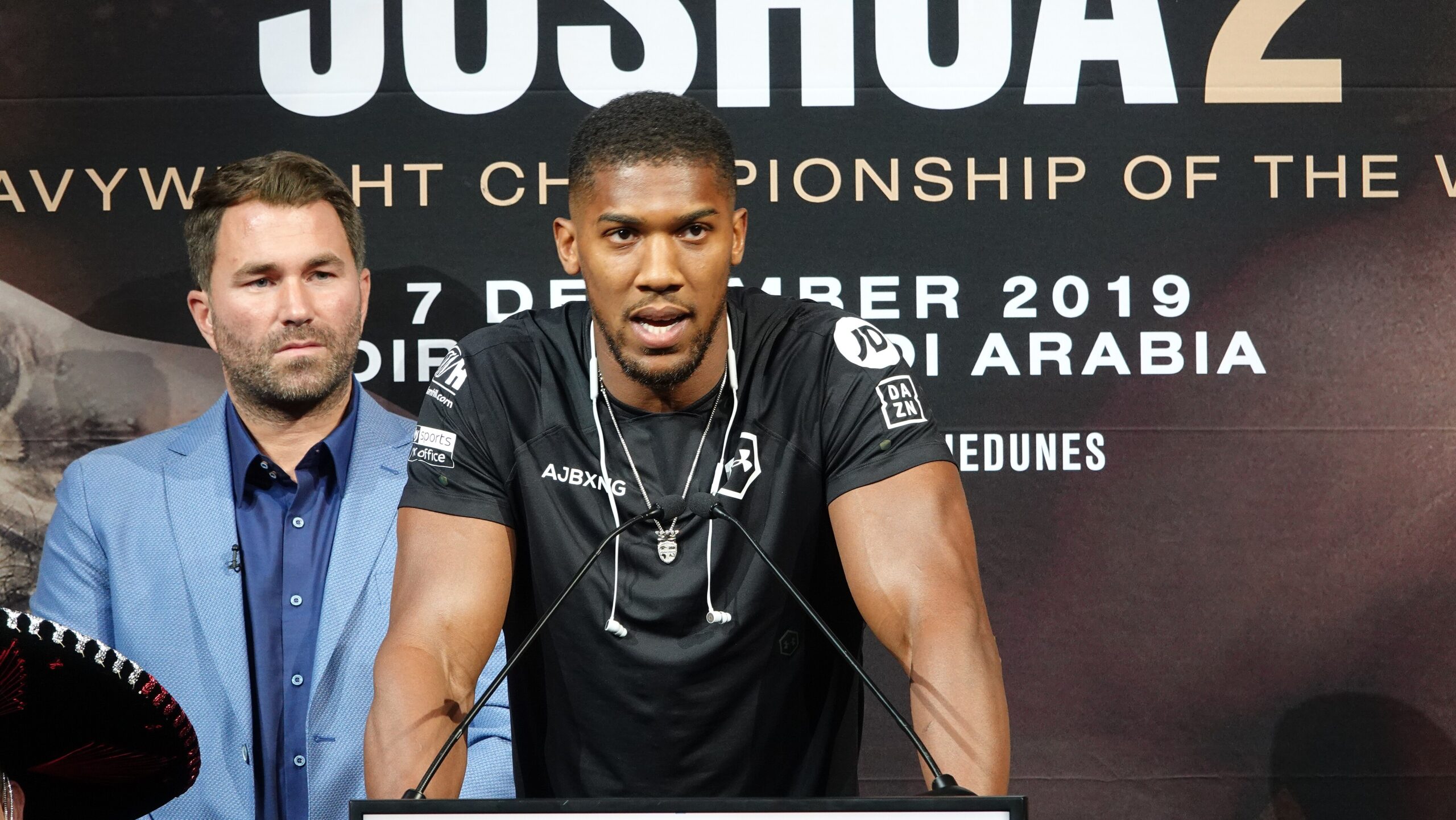
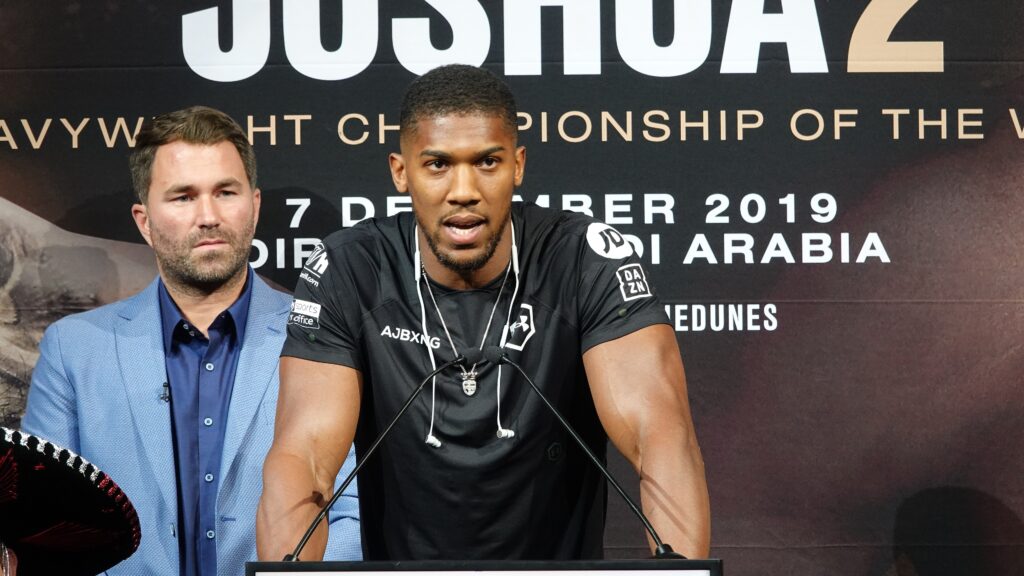
Anthony Joshua speaks at a press conference as promoter Eddie Hearn looks on behind him.Image: JazzyJoeyD / CC BY-SA 4.0 / Wikimedia Commons
Tyson Fury and Anthony Joshua are scheduled to headline one of British boxing’s biggest events on December 11 at Principality Stadium in Cardiff. Yet the supporting lineup for the Netflix event is already producing an argument that reaches beyond any single undercard fight.
Eddie Hearn has criticized the announced main card and questioned why Joe Cordina, a Welsh former two-time world champion, has been left off an event taking place in his home country. According to Boxing 247, Hearn believes the heavyweight matchup between unbeaten prospect Da’Mazion Vanhouter and Michael Essomba belongs on the preliminary portion of the show rather than the main broadcast.
The criticism raises a fair question about what a global main-card position should represent. Cordina offers championship credentials, local significance and an obvious connection to Cardiff. Vanhouter offers an unbeaten record, knockout potential and another heavyweight contest on a lineup built around boxing’s biggest division.
What the available reporting does not establish is that Vanhouter directly replaced Cordina.
That distinction matters. The real controversy is not a confirmed case of one fighter taking another fighter’s position. It is a dispute over matchmaking priorities—and whether a major event’s supporting card should be used to develop prospects or deliver the strongest and most relevant fights available.
Hearn’s Argument Starts With Cordina’s Cardiff Connection
The Independent reported that Hearn was disappointed by the announced main-card lineup and questioned Cordina’s absence. Hearn also said he was not involved in selecting the main supporting bouts, which means his criticism should not be confused with an internal disagreement over a card he personally assembled.
His strongest argument is straightforward.
If boxing is staging Fury–Joshua at Principality Stadium, a Welsh former two-time world champion would appear to be a natural candidate for the card. Cordina brings a connection to the location that cannot be manufactured through promotional language. His presence could give the event a meaningful Welsh component beneath a main event involving two English heavyweights.
Local representation is not merely ceremonial. Fighters with a genuine relationship to the host city or country can help create atmosphere, attract regional interest and give the audience another emotional investment before the headliners enter the ring.
That does not mean Cordina should receive a main-card position without an appropriate opponent. A recognizable name alone cannot guarantee a compelling contest. The matchup would still matter, and none of the available sources confirms who Cordina might have faced or whether negotiations for his involvement advanced far enough to produce a realistic bout.
Hearn’s complaint therefore identifies an omission without providing every detail required to judge the alternative.
Still, the central point is difficult to dismiss: if Cordina was available and a suitable matchup could have been made, his résumé and Welsh connection would have given viewers a clear reason to care.
The Official Card Gives Vanhouter a Premium Opportunity
Netflix’s official listing places Vanhouter against Essomba beneath Fury–Joshua on the December 11 card. That placement is confirmed. The reason organizers chose that particular fight for the main broadcast has not been publicly established in the cited reporting.
The selection does fit the event’s all-heavyweight presentation. Fury and Joshua are the attraction, and surrounding them with fighters from the same division creates a consistent theme. It also gives Vanhouter an enormous platform at an early stage of his career.
Boxing 247 listed Vanhouter at 14-0 with 11 knockouts, while Sky Sports independently reported his record as 14-0 when the Essomba fight was announced. Sky Sports also reported that Vanhouter entered the matchup following a first-round stoppage of Ivan Balaz on November 7.
Those numbers explain some of the intrigue. An unbeaten heavyweight with a strong knockout record will always attract attention, particularly on a card built around the division. Heavyweight prospects can become commercially important quickly, and exposure on a Fury–Joshua broadcast could accelerate Vanhouter’s development and public profile.
But an unbeaten record does not automatically settle whether a fight deserves premium placement.
A main-card bout must be evaluated by more than the promise of one participant. The competitive quality of the matchup, its relevance to the division and the audience’s reason to become invested all matter. The available research does not provide Essomba’s record, ranking or recent results, so those details should not be invented to strengthen either side of the argument.
That leaves the central question unresolved: does Vanhouter–Essomba offer enough competitive or narrative value to justify its position, or is the slot primarily valuable because it introduces an unbeaten heavyweight to a massive audience?
Prospect development is a legitimate purpose. It simply should not be treated as the only purpose of an undercard.
The Replacement Claim Goes Beyond the Confirmed Facts
Boxing 247 framed the controversy as Vanhouter taking a position that Hearn wanted for Cordina. That interpretation captures the contrast at the center of the debate, but it is not the same as proof that the two fighters were competing for one specific slot.
None of the available sources confirms that Cordina had been formally assigned a place on the event. There is no confirmed report that he was removed, that his proposed bout collapsed or that organizers selected Vanhouter–Essomba as a direct replacement.
The distinction protects both fighters from an unnecessarily personal narrative.
Vanhouter did not choose the card order, and there is no evidence that his opportunity came at Cordina’s direct expense. Cordina’s omission can be questioned without portraying Vanhouter as someone who seized a position belonging to another boxer.
The criticism is more accurately directed at the priorities behind the announced lineup.
Major boxing undercards frequently have to serve several interests at once. They are expected to entertain the audience, develop emerging fighters, satisfy business relationships, build future attractions and provide opponents or prospects with valuable exposure. Those purposes do not always produce the strongest possible matchups.
That tension becomes more visible when the event is enormous. A smaller show can use its supporting card primarily as a development platform without attracting widespread criticism. Fury–Joshua is different. It is a global Netflix event in a major stadium, and every main-card selection communicates something about what boxing believes deserves the audience’s attention.
Hearn’s complaint has intensified scrutiny of that choice, but it has not established a stolen position.
Vanhouter–Essomba Will Have to Justify the Placement
The most reliable answer will come when the fighters enter the ring.
If Vanhouter–Essomba produces competitive action, reveals a heavyweight worth following or creates a memorable moment on the broadcast, the decision to place it on the main card will become easier to defend. A prospect does not need an established international profile before earning an opportunity, and major events have often introduced fighters who later became significant names.
Vanhouter also cannot control the expectations created by his placement. His responsibility is to perform against the opponent selected for him. If he delivers, he will have taken advantage of a platform that many developing fighters never receive.
If the bout proves one-sided or inconsequential, however, Hearn’s criticism will carry more force. The question will not simply be whether Vanhouter is talented. It will be whether this particular matchup offered enough to justify occupying valuable broadcast time on one of the year’s most visible boxing events.
Cordina’s status remains another open issue. He could still be added elsewhere on the event, and the lineup could change before December 11. The available reporting does not confirm that the announced card is beyond revision.
There are also unanswered questions about whether Cordina was offered a specific position, whether his team discussed a particular opponent and what his next move will be if he does not appear in Cardiff. Until those details emerge, the strongest responsible conclusion is limited: Cordina is absent from the announced lineup, Hearn believes he belongs on it, and Vanhouter–Essomba currently holds a main-card position that Hearn considers better suited to the preliminaries.
Anything beyond that requires evidence that has not been reported.
Boxing’s Undercard Problem Is Bigger Than This Fight
The argument surrounding Vanhouter and Cordina reflects a recurring issue in boxing. The main event sells the show, but the supporting card often reveals what the promoters and organizers value beneath the headline attraction.
Sometimes that means competitive fights between established contenders. Sometimes it means showcasing prospects expected to become future attractions. Sometimes local fighters are used to strengthen the connection between an event and its host market.
The best cards combine those purposes.
A prospect can be developed in a meaningful matchup. A local favorite can face an opponent who creates genuine risk. A main-card position can advance a fighter’s career while also giving the audience stakes it can understand.
Problems emerge when exposure appears to become the primary objective and competitive urgency becomes secondary. Viewers are then asked to care because a fighter is unbeaten or considered promising, even when the matchup itself has not provided an obvious reason for investment.
That approach is especially risky on Netflix. Many people watching Fury–Joshua may not follow boxing every week. The supporting fights will help shape their impression of the sport before the main event begins.
For those viewers, an undercard is not an industry development program.
It is part of the product.
LET’S TALK ABOUT IT
Does Vanhouter–Essomba offer enough relevance for the Fury–Joshua main card, or should that position have gone to a stronger or more locally significant matchup?
Should Joe Cordina’s Welsh connection and championship résumé make him an automatic priority for a major Cardiff event?
Outlets cited in this story
- Boxing 247
- Sky Sports
Spot an error? Send a correction.
More on Eddie Hearn
All 9 Eddie Hearn stories →
Jaron “Boots” Ennis Could Eventually Face Canelo Alvarez — But First He Has a Division to Conquer
Jaron “Boots” Ennis against Canelo Alvarez is the kind of matchup that immediately creates attention. It places one of boxing’s most highly regarded unbeaten champions opposite the sport’s biggest available…
Shakur Stevenson’s Next Deal Faces Eddie Hearn’s Financial Line — But His Value Goes Beyond the Ring
Shakur Stevenson has already answered the competitive question. The unbeaten WBO junior-welterweight champion is 25-0 with 11 knockouts, according to BoxingScene, and his dominant victory over Teofimo Lopez reinforced his…
Eddie Hearn Holds Talks With Unnamed World Champion — But Matchroom’s American Rebuild Remains Unfinished
Eddie Hearn is attempting to strengthen Matchroom’s American roster, and at least some of those recruitment efforts may have moved beyond preliminary conversations. According to BoxingNews24, Hearn is discussing potential…
Raymond Ford’s Matchroom Contract Expires — But His Next Deal Must Deliver More Than Visibility
Raymond Ford is entering one of the most important stretches of his professional career without a confirmed promotional agreement. Eddie Hearn told iFL TV that Ford’s contract with Matchroom Boxing…