Amir Khan Sets Condition for Manny Pacquiao Fight — But a Standalone Event Must Prove Its Value
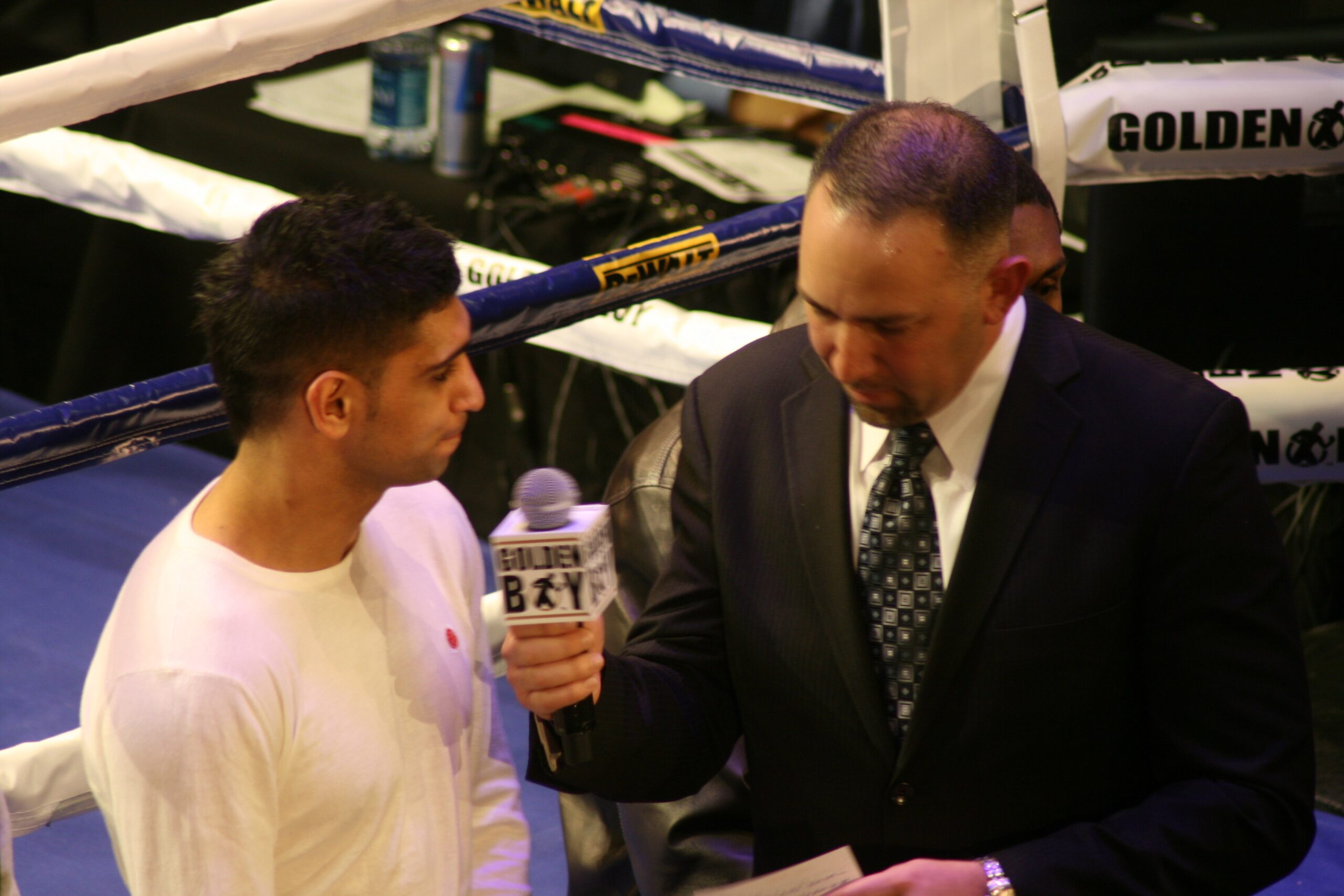
Boxer Amir Khan being interviewed at a boxing event in Los Angeles.Image: DEWALT POWER TOOLS FIGHT NIGHT CLUB 2010 / CC BY-SA 2.0 / Wikimedia Commons
Amir Khan is interested in fighting Manny Pacquiao, but he has drawn a clear line around how the proposed comeback bout should be presented.
Khan has rejected the rumored possibility of facing Pacquiao on the December 11 Tyson Fury–Anthony Joshua undercard. He says neither fighter has enough time to prepare for that date, and he believes a meeting between two former champions should be staged as a separate event rather than placed beneath another attraction.
That position gives the potential fight a clearer shape, but it does not make the matchup official. Khan has confirmed that discussions have taken place and says he has reviewed financial figures and a proposed location. There is still no publicly confirmed Khan signature, official date, venue, weight, purse, promoter, broadcaster, commission or sanctioning arrangement.
The central question is no longer simply whether Khan and Pacquiao are interested.
It is whether their names still carry enough commercial power to support the kind of standalone promotion Khan believes the fight deserves.
Khan Says a Promotional Company Brought Him the Proposal
According to Khan’s account to Hard Rock Bet, an unidentified promotional company approached him about facing Pacquiao. Khan said the company claimed it already possessed Pacquiao’s signature, but he stressed that he was not dealing directly with Pacquiao’s team.
That distinction matters.
Khan is relaying a claim made by the company presenting the proposal. Pacquiao and his authorized representatives have not publicly confirmed that he has signed an agreement for the fight, and no contract has been released or independently verified.
Khan said he forwarded the proposal to a lawyer for review. That indicates the discussions have moved beyond a completely casual expression of interest, but legal review is not the same as an executed agreement. Until Khan approves the terms and signs, his participation remains unconfirmed.
Global Boxing News reported on October 7 that January or February 2027 had been discussed, with the United States suggested as a possible location. Those details also came through Khan and have not been formally announced by Pacquiao’s side or an identified event organizer.
Two days later, Boxing News reported Khan’s comments to Metro that he had seen financial figures and a location he liked. Khan described both sides as interested, although he did not disclose the proposed purse or identify a confirmed venue.
The available information supports the existence of talks.
It does not yet support the conclusion that Khan–Pacquiao is a completed deal.
Rejecting the Undercard Changes the Commercial Question
The December 11 scenario became part of the story through reports linking Khan–Pacquiao to the Fury–Joshua undercard. Khan dismissed that possibility as a rumor, telling Metro that both he and Pacquiao had been traveling, neither was in training camp and the proposed date would not provide enough preparation time.
That alone would be a reasonable basis for refusing the date. A fight involving two returning veterans should not be assembled around a rushed camp simply because a major card already has an audience waiting.
Khan’s second objection is more revealing.
In comments reported by Boxing News and BoxingNews24, Khan said the Pacquiao fight should not take place on the Fury–Joshua card. He later told BoyleSports that he would consider facing Pacquiao, but not beneath the heavyweight event because Khan–Pacquiao should be staged separately.
That is more than a scheduling request. It is a statement about the matchup’s perceived value.
By rejecting undercard placement, Khan is effectively arguing that his fight with Pacquiao remains important enough to headline its own promotion. He does not see it as supporting nostalgia attached to a larger event. He sees it as the event.
The names make that argument understandable. Khan and Pacquiao are recognizable former champions whose careers created interest well beyond a single division or moment. A fight between them would revive a matchup that carries historical curiosity even without a current championship attached.
But recognition and commercial viability are not the same thing.
A position on the Fury–Joshua undercard would give Khan–Pacquiao the protection of an established headline attraction. The heavyweight fight would drive much of the attention, allowing the returning former champions to add value without being solely responsible for ticket sales, broadcast demand and the overall financial structure.
A standalone show would remove that protection.
If Khan–Pacquiao is going to headline, its organizers must demonstrate that public familiarity can become actual business.
The Talks Create Interest Without Establishing a Fight
Khan’s public comments have changed the status of the story in one meaningful way: the proposed matchup can no longer be dismissed as an idea created entirely outside the fighters’ knowledge.
Khan says he is interested. He says he has received a proposal, reviewed financial figures and responded favorably to the suggested location. He has also explained the timing and presentation he would require before accepting the fight.
Those are real developments.
They still leave nearly every operational detail unresolved.
No public announcement has identified the promotional company that approached Khan. No authorized representative for Pacquiao has independently confirmed the company’s claim that Pacquiao signed. Khan has not announced that he approved or executed his own agreement.
There is also no confirmed date. January or February 2027 has been discussed according to Khan, but neither month should be treated as settled. The United States has been mentioned as a possible destination, yet no city or venue has been officially named.
The competitive terms are equally unclear. There is no confirmed weight, and the reporting does not establish whether a commission or sanctioning body has been selected. The proposed purse remains undisclosed, while the promoter and broadcaster responsible for delivering the event have not been publicly identified.
Those omissions are not minor details to be filled in later. They determine whether the proposed fight can actually happen.
Boxing regularly produces stories in which recognizable fighters express interest, financial numbers circulate and tentative dates appear before the people responsible for staging the event have established a complete agreement. Some of those discussions become fights. Many do not.
Khan’s statements justify continued attention.
They do not justify presenting Khan–Pacquiao as official.
The Current Record Shows Discussion, Not Completion
The timeline is short and consistent with an active proposal still awaiting confirmation.
On October 7, Global Boxing News reported Khan’s disclosure that a promotional company had approached him. Khan said January or February 2027 and a possible United States location had been discussed. He also said he sent the proposal to a lawyer after the company claimed to possess Pacquiao’s signature.
On October 9, Boxing News reported Khan’s comments that he was satisfied with the financial figures and proposed location he had seen. That suggested the terms were attractive enough for the conversation to continue, but Khan did not announce that he had signed.
On October 10, Boxing News and BoxingNews24 carried Khan’s rejection of the rumored December 11 Fury–Joshua undercard scenario. His explanation combined two separate concerns: insufficient preparation time and his belief that Khan–Pacquiao belongs on its own event.
Nothing in that sequence confirms a completed bout agreement.
What it establishes is that Khan has received a proposal, considers the matchup possible and has set conditions under which he would be willing to proceed.
The next stage requires evidence from beyond Khan’s side of the conversation.
Pacquiao or an authorized representative would need to confirm the negotiations and clarify whether any agreement has actually been signed. Khan would need to complete his legal review and execute his own contract. A credible promoter would need to identify itself and announce the infrastructure surrounding the event.
An official date and venue would then have to be secured. The organizers would also need to confirm the weight, financial terms, broadcaster and relevant commission or sanctioning arrangements.
Until those pieces exist, the proposed fight remains an intriguing negotiation rather than a scheduled event.
A Standalone Promotion Would Be the Real Test
Khan’s condition raises expectations for everyone involved.
If the fight is too significant for the Fury–Joshua undercard, then it must be capable of carrying the responsibilities of a headline attraction. Its value cannot rest only on the familiarity of two names or the public’s memory of what those fighters once represented.
A standalone Khan–Pacquiao event would have no current title to create urgency and no immediate divisional consequence to establish sporting importance. Its appeal would come from celebrity, history and the unanswered question of what two retired champions might still produce against each other.
That could be enough to generate attention.
Whether it is enough to sustain a major promotion is a different question.
Organizers would need to sell the matchup as more than a reunion of famous names. They would have to convince an audience that the fight is competitive, properly prepared and professionally organized. Khan’s refusal to accept a rushed December date helps on that front because adequate training time would make the contest easier to treat seriously.
His demand for standalone status creates the opposite pressure. It places the commercial burden directly on Khan and Pacquiao.
If a credible promoter, broadcaster and venue eventually commit to the event, that would provide stronger evidence that the market agrees with Khan’s assessment. If negotiations stall once the fight must stand without Fury–Joshua, the undercard option may begin to look less like an insult and more like the safer business model.
Khan has defined what he wants.
The market still has to prove that it wants the same thing.
LET’S TALK ABOUT IT
Is Amir Khan right that a Manny Pacquiao fight is too big for the Fury–Joshua undercard, or would appearing beneath a major heavyweight event be the safer commercial move?
And without a title or current divisional stakes, do Khan and Pacquiao still have enough appeal to carry a standalone event?
Outlets cited in this story
- BoxingNews24
- Boxing News
Spot an error? Send a correction.
Keep reading
More Business of Boxing →
Senate Unanimously Passes Ali Boxing Revival Act — But Reform Could Concentrate Boxing’s Power
The United States Senate has unanimously passed the Muhammad Ali American Boxing Revival Act, advancing the most consequential federal boxing reform proposal in years while opening a larger debate about…
Tyson Fury Gets Tony Sims’ Vote Over Anthony Joshua — But the Prediction Exposes What Boxing Lost
Tyson Fury should enter his long-awaited fight with Anthony Joshua as the favorite, according to Joshua’s former trainer Tony Sims. That sounds like a clear prediction until Sims explains why…
Shakur Stevenson’s Mandatory Defense Heads Toward Purse Bids — But His Market Value Is the Bigger Fight
Shakur Stevenson became the WBO junior-welterweight champion by defeating Teofimo Lopez by 12-round unanimous decision on January 31, according to the WBO’s February 2026 divisional record. Now the business surrounding…
Shakur Stevenson’s Next Deal Faces Eddie Hearn’s Financial Line — But His Value Goes Beyond the Ring
Shakur Stevenson has already answered the competitive question. The unbeaten WBO junior-welterweight champion is 25-0 with 11 knockouts, according to BoxingScene, and his dominant victory over Teofimo Lopez reinforced his…