





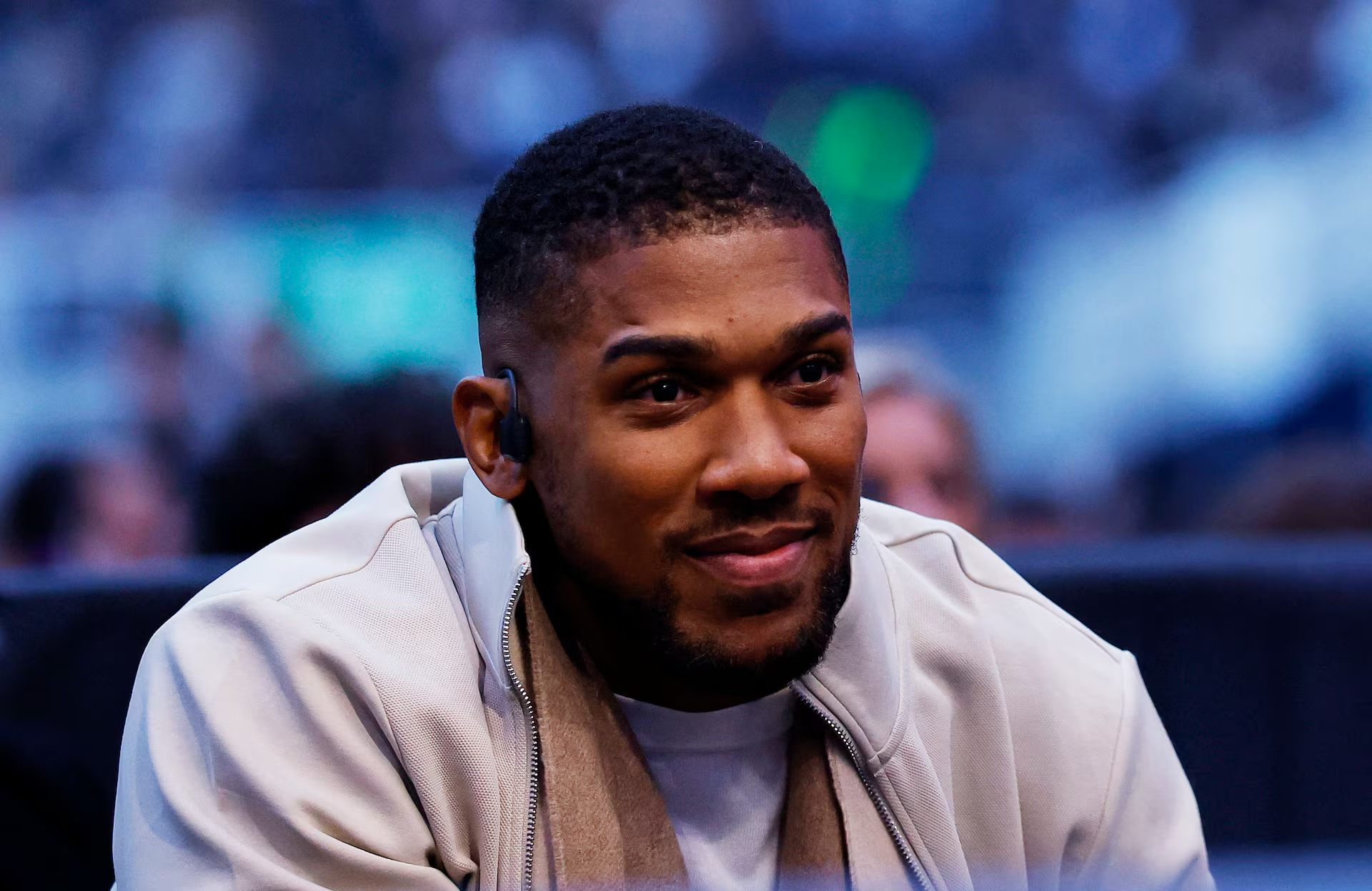
Anthony Joshua is turning to people with firsthand knowledge of Tyson Fury as he prepares for the biggest British heavyweight fight of his career. Joshua has confirmed that he has returned to Ben Davison for his December 11 meeting with Fury at Principality Stadium in Cardiff. He has also revealed that Peter Fury, Tyson’s uncle […]
Anthony Joshua is turning to people with firsthand knowledge of Tyson Fury as he prepares for the biggest British heavyweight fight of his career.
Joshua has confirmed that he has returned to Ben Davison for his December 11 meeting with Fury at Principality Stadium in Cardiff. He has also revealed that Peter Fury, Tyson’s uncle and former trainer, has offered ideas about training, strategy and areas Joshua could improve before the fight, which Netflix will stream live globally.
The distinction between those relationships is important. Davison’s involvement in Joshua’s preparation is confirmed. Peter has supplied advice, but The Ring reports that he will not formally join Joshua’s team.
No reviewed source identifies Peter as Joshua’s head trainer, places him inside the training camp or confirms that he will work the fight-night corner. Reports suggesting that he has joined Joshua’s team therefore overstate what has actually been established.
The real story is more measured but still significant. Joshua has two of Fury’s former trainers available as sources of information, including the man who guided Fury to his 2015 victory over Wladimir Klitschko and the coach who worked with him during his comeback and first fight against Deontay Wilder.
Their knowledge could help Joshua prepare for Fury’s habits, mentality and tactical adjustments.
It cannot make those adjustments for him.
Peter Fury Has Offered Advice, Not Joined Joshua’s Team
Joshua told The Ring that he speaks with Peter and values the trainer’s ability to identify technical details. According to Joshua, their contact developed through heavyweight Matty Harris, whom Peter trains.
Joshua said Peter has been willing to help and has offered ideas covering training, strategy and areas for improvement. He also indicated that their most recent conversation took place approximately one month before the interview.
That confirms communication between them. It does not confirm a formal coaching appointment.
The Ring specifically reported that Peter will not join Joshua’s team for the Fury fight. Nothing in the available reporting names him as the head trainer, assigns him a defined position within the camp or places him in Joshua’s corner on December 11.
The difference matters because informal advice can range from a brief technical observation to a detailed conversation about strategy. Without confirmation of Peter’s exact responsibilities or the frequency of their communication, it would be inaccurate to present him as one of the men directing Joshua’s preparation.
Joshua appears to understand that limitation. He told The Ring that he appreciates Davison and Peter because they can “pinpoint things,” but he also stressed the need to assess the information he receives and maintain control over his own performance.
That may be the most important part of his explanation.
A fighter preparing for a major contest will hear opinions from trainers, sparring partners and other experienced boxing figures. The value of those opinions depends on whether they fit the fighter’s abilities, whether they can be incorporated into a coherent plan and whether they remain useful when the opponent behaves differently from expected.
Peter’s connection to Fury makes his observations particularly interesting. It does not automatically make every observation suitable for Joshua.
Advice is not the same as authority.
Ben Davison’s Involvement Is Confirmed, but Joshua’s Corner Remains Unclear
Joshua’s relationship with Davison is more formal.
Joshua confirmed to The Ring that he has returned to Davison for the Fury fight. That follows a September 8 report from the same outlet stating that Joshua had resumed training at Davison’s gym in Essex while waiting for the matchup to be finalized. At that stage, the arrangement was described as a way for Joshua to remain active rather than a confirmed full-time reunion.
Joshua’s promoter, Eddie Hearn, later told Pro Boxing Fans that Davison would “definitely” participate in the camp and preparation process. Hearn said at the time that the final camp location and Davison’s precise position had not yet been determined.
The progression is clear. Joshua began working at Davison’s gym, Hearn confirmed that the trainer would participate in the preparation, and Joshua subsequently acknowledged returning to him for the fight.
What remains unresolved is the hierarchy.
The available reporting does not establish who will serve as Joshua’s official head trainer or who will hold final tactical authority in the corner. It also does not confirm Joshua’s complete fight-night team.
That uncertainty is more significant than the excitement surrounding Peter’s advice. Joshua can collect useful information from several experienced figures, but someone must eventually decide how that information becomes a practical strategy.
Multiple voices can be an advantage when their roles are defined. One trainer may notice technical habits, another may specialize in physical preparation, and another may understand the opponent’s psychology. The arrangement becomes less useful if competing opinions leave the fighter uncertain about which instructions to follow.
Against Fury, clarity will be essential.
Joshua will need a plan for the opening rounds, a method for controlling distance and a response if Fury changes his rhythm or approach. He will also need concise instructions between rounds when there is no time to debate several interpretations of what is happening.
Davison’s participation is no longer in doubt.
Whether Joshua’s team has a clear chain of command remains unanswered.
Their History With Fury Provides Insight, Not a Guaranteed Formula
Peter and Davison worked with Fury during important but different stages of his career.
According to Boxing News, Peter trained his nephew for the 2015 victory over Klitschko. That performance established Fury as a world heavyweight champion and demonstrated his ability to disrupt an accomplished opponent through movement, control of distance and tactical discipline.
Davison later trained Fury during his comeback and for his first fight with Wilder, also according to Boxing News. His experience covers another version of Fury: a fighter rebuilding his condition and confidence before navigating the danger of one of the division’s most destructive punchers.
That history could help Joshua.
Both trainers may recognize patterns in Fury’s positioning, preparation and decision-making that are less obvious from watching fight footage alone. They may understand what Fury prefers to establish early, how he responds when an opponent denies him space and what circumstances make him more likely to change tactics.
They may also understand how Fury thinks during camp and how he approaches the psychological side of major events.
None of that constitutes a secret blueprint.
Fighters evolve. The version of Fury who defeated Klitschko in 2015 is not identical to the one Davison trained during the Wilder comeback, and neither represents a frozen version of the man Joshua will face in Cardiff. Years of different trainers, opponents, victories, defeats and physical changes can alter how a fighter solves problems.
Even accurate information can have limited value if it describes habits Fury no longer relies upon.
There is also a difference between recognizing a tendency and exploiting it. Joshua may know when Fury is likely to change stance, vary his rhythm or alter the range, but he still has to respond without becoming hesitant. He must make decisions while absorbing punches, managing fatigue and processing instructions under pressure.
Fury can also adjust.
The Ring lists Joshua’s professional record at 30-4 with 27 knockouts and Fury’s at 36-2-1 with 25 knockouts. Those records reflect two former champions with extensive experience and proven finishing power. They also describe fighters who have spent years adapting to opponents at a high level.
Joshua’s challenge is therefore not simply to arrive with the correct opening plan. It is to maintain enough tactical flexibility to respond when Fury begins changing the problem.
Inside knowledge may help Joshua predict the first move.
It cannot guarantee the correct answer to the next one.
Tyson Fury’s Response Adds Intrigue Without Settling the Facts
Tyson has dismissed the reports surrounding Peter’s assistance.
According to Boxing News, Fury responded on Instagram by calling the story “the biggest BS” he had seen and adding, “No Fredo here guys.” Boxing 24/7 also reported that Fury jokingly called Davison a “dirty traitor” when the former trainer passed him at the launch event.
The tone surrounding Davison appeared playful, while the response to the Peter reports was more dismissive. Even so, Fury’s remarks do not clearly establish which part of the story he was disputing.
He could have been denying that Peter had formally joined Joshua’s team, which would be consistent with The Ring’s reporting. He could also have been rejecting the broader suggestion that meaningful strategic assistance had been provided.
The available comments do not resolve that ambiguity.
Joshua’s account confirms that conversations with Peter occurred and that advice was offered. The Ring simultaneously reports that Peter will not formally join the team. Those two facts can exist together without contradiction.
Fury’s reaction is useful promotional material because it introduces a family connection and allows the story to be framed as possible betrayal. It is not proof that Joshua has gained a decisive advantage or that Fury’s preparation has somehow been compromised.
If anything, the attention surrounding Peter could distract from the more substantial development: Joshua’s confirmed return to Davison.
Davison is expected to participate directly in the preparation process. Peter’s role, as currently reported, is advisory and informal. Treating those relationships as equivalent would create a more dramatic story but a less accurate one.
December 11 will provide the only meaningful test of whether either connection helped.
Joshua’s preparation should become visible in the structure of his performance. Does he begin with a coherent plan? Can he apply pressure without becoming predictable? Does he understand when to attack and when to reset? If Fury changes stance, rhythm or range, can Joshua adapt without waiting several rounds?
The corner will matter as well. Clear instructions and purposeful adjustments would support the idea that Joshua’s collection of experienced voices produced a unified strategy. Confusion between rounds or repeated tactical mistakes would raise harder questions about who controlled the preparation.
The value of the advice will not be measured by how familiar Joshua’s trainers are with Fury.
It will be measured by what Joshua does with it.
REAL TALK
Boxing loves the idea of inside information.
Whenever a former trainer begins helping an opponent, the story is presented as though years of secrets have changed sides. Habits, weaknesses and private observations become part of the promotion, and the former trainer is treated as someone carrying a hidden formula for victory.
The reality is rarely that simple.
Davison and Peter possess legitimate knowledge of Fury. They have watched him prepare, observed how he responds to pressure and helped guide him through important periods of his career. That experience could sharpen Joshua’s planning and prevent him from overlooking details that matter.
But their knowledge comes from earlier versions of Fury.
Joshua will not fight a memory from the Klitschko camp or the first Wilder fight. He will face the version of Fury who enters Principality Stadium on December 11, and that fighter will be capable of changing tactics once the opening strategy becomes clear.
Peter can offer ideas. Davison can build a plan. Joshua’s corner can identify adjustments.
Joshua still has to recognize the moment and act.
That is where this story moves beyond former trainers and supposed secrets. Joshua has never lacked access to experienced coaches or detailed preparation. The decisive question has often been whether he can remain assertive, adaptable and clear-minded when a difficult opponent disrupts the plan.
Information can shorten the search for an answer.
It cannot throw the punches.
LET’S TALK ABOUT IT
How much advantage can Ben Davison’s experience and Peter Fury’s informal advice realistically give Anthony Joshua against Tyson Fury?
And does Joshua benefit from consulting several experienced voices, or does he need one clearly defined trainer controlling the strategy on fight night?