




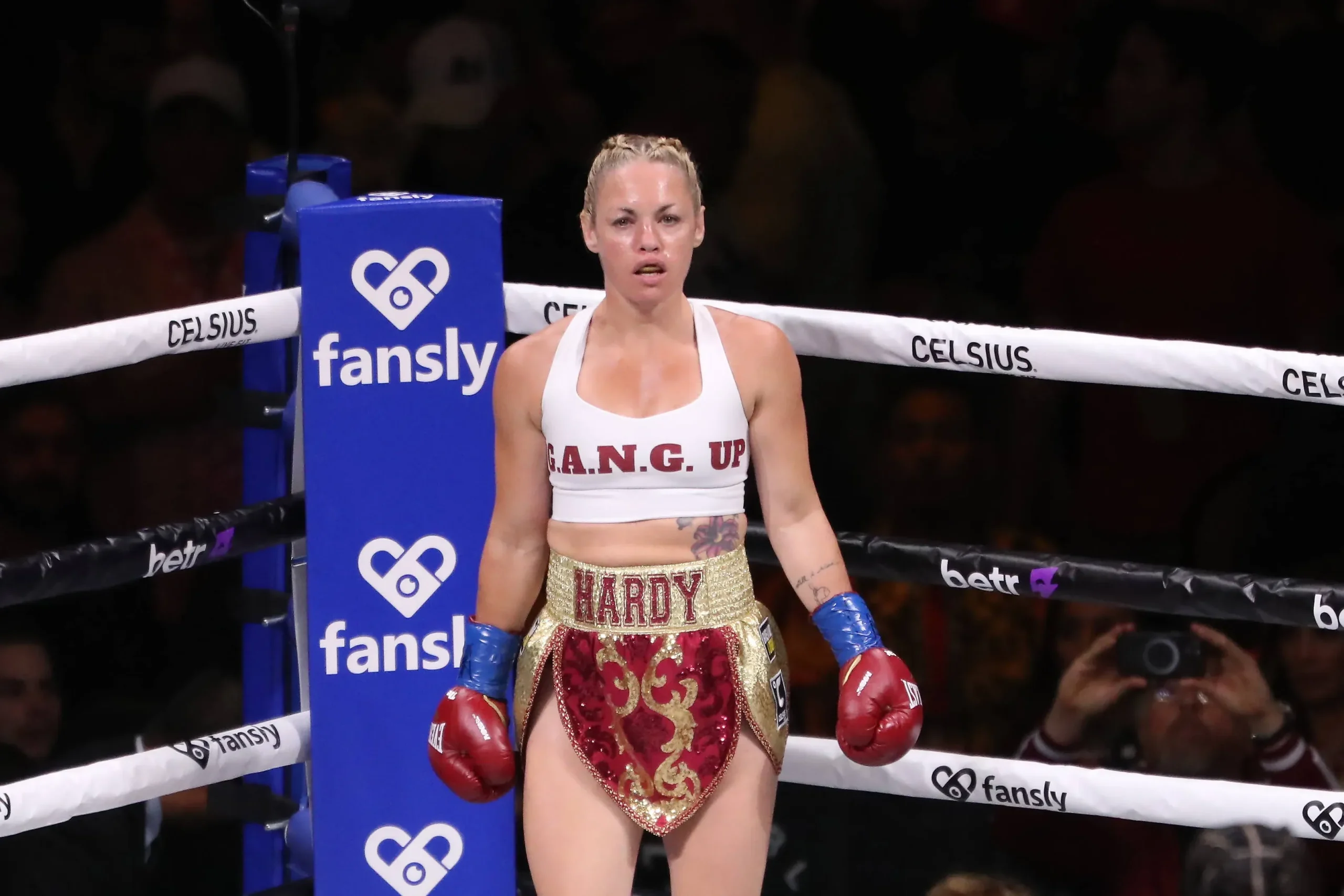
Heather Hardy’s fight with Amanda Serrano ended more than three years ago, but the most consequential fight connected to that night may now be taking place in a courtroom. Hardy has filed a federal lawsuit seeking more than $10 million against Jake Paul, Most Valuable Promotions and others connected to her August 2023 rematch with […]
Heather Hardy’s fight with Amanda Serrano ended more than three years ago, but the most consequential fight connected to that night may now be taking place in a courtroom.
Hardy has filed a federal lawsuit seeking more than $10 million against Jake Paul, Most Valuable Promotions and others connected to her August 2023 rematch with Serrano. The complaint alleges negligence and violations of the Muhammad Ali Boxing Reform Act, with Hardy claiming she suffered permanent neurological injuries as a result of the bout. The federal docket confirms the case was filed September 23 in the Northern District of Texas and names Jake Paul, Valuable Promotions LLC, Holden Boxing LLC and Bryce Holden as defendants.
Most Valuable Promotions has now responded, and its defense immediately raises one of the most uncomfortable questions in combat sports.
MVP says Hardy was medically cleared.
Hardy essentially argues that allowing the fight to happen was part of the problem.
Those positions could eventually require a court to examine something boxing has wrestled with forever: When everybody technically follows the rules, who is responsible if the fighter still shouldn’t have been fighting?
What Heather Hardy Is Actually Alleging
The first thing we need to do is separate an allegation from an established fact.
Hardy’s lawsuit does not mean MVP has been found responsible for her medical problems. The case is in its early stages, and the allegations haven’t been proven in court. The public federal docket confirms the lawsuit and jury demand; it does not establish liability.
Hardy’s allegations are nevertheless serious.
According to reporting on the complaint, she alleges that the 2023 Serrano rematch exposed her to an extraordinary and foreseeable risk of neurological injury and that the defendants moved forward with the bout despite warning signs and objections surrounding the matchup. Hardy claims she subsequently experienced problems including traumatic brain injury, memory issues, double vision, spatial confusion and problems with depth perception.
Hardy hasn’t fought professionally since.
The Serrano rematch took place August 5, 2023, on the Jake Paul-Nate Diaz card in Dallas. Serrano won a unanimous decision after ten rounds, four years after beating Hardy by decision in their first fight.
Hardy is now arguing that what happened wasn’t simply the ordinary consequence of losing a boxing match.
Her legal argument reaches into how the fight was made in the first place.
And that’s where things become complicated.
MVP Says the Fight Went Through the Proper Channels
MVP disputes Hardy’s allegations.
In its response, the company emphasized that Hardy’s participation was arranged through her promoter, Lou DiBella, that Hardy was medically cleared by the athletic commission overseeing the event and that the contest proceeded under the commission’s authority and medical requirements. MVP also says it remains committed to fighter safety and regulatory compliance.
That’s an important defense.
Athletic commissions exist partly because promoters aren’t supposed to unilaterally decide whether a fighter is medically fit to compete. Fighters undergo licensing requirements and medical examinations, and the regulatory body overseeing an event has authority over whether somebody is cleared.
If Hardy was properly examined and officially cleared, MVP can point to that regulatory process and argue that the organization responsible for making medical eligibility decisions allowed her to fight.
But Hardy’s lawsuit appears to be asking a different question.
Is medical clearance the end of a promoter’s responsibility?
That’s potentially where this story becomes much bigger than Heather Hardy versus MVP.
Being Cleared to Fight and Whether a Fight Should Be Made Aren’t Necessarily the Same Question
There’s an important distinction here.
A fighter can be legally licensed to box without every potential matchup automatically becoming a good idea.
That’s where matchmaking enters the conversation.
Promoters and matchmakers constantly evaluate age, experience, recent performances, inactivity, weight, opponent quality and the commercial value of a fight. They aren’t merely checking whether both fighters possess licenses.
They’re choosing who fights whom.
Hardy was 41 years old when she fought Serrano for the second time. She had already fought Serrano once, losing a unanimous decision in 2019. Serrano was one of the best women’s fighters in the sport and had established herself as a major attraction by the time of the rematch.
None of those facts alone proves the rematch was negligent.
Boxers in their forties compete. Former opponents have rematches. Underdogs receive championship opportunities.
But Hardy’s lawsuit reportedly argues that the total circumstances should have caused the people involved to recognize a danger that went beyond the normal risks associated with professional boxing.
MVP’s position is essentially that the appropriate protocols were followed.
That’s a significant disagreement because the two sides aren’t simply arguing about what happened after the fight.
They’re arguing about who was responsible before the opening bell ever rang.
Lou DiBella Could Become a Very Important Part of This Story
There’s another wrinkle that deserves attention.
MVP says Hardy’s participation was arranged through her longtime promoter Lou DiBella. Reporting on Hardy’s complaint, however, says Hardy alleges DiBella had concerns about the matchup and declined to facilitate it because of safety concerns.
Those accounts are obviously important, and they shouldn’t be casually reconciled when the parties appear to characterize DiBella’s role differently.
What exactly was communicated?
Who negotiated which portions of the deal?
What concerns, if any, were expressed?
Who possessed decision-making authority?
Those are factual questions that litigation may clarify through documents, testimony and discovery if the case progresses that far.
For now, we shouldn’t pretend we already know the answers.
But this illustrates why the lawsuit could become significant for boxing beyond the dollar amount attached to Hardy’s complaint.
Professional boxing doesn’t have one centralized organization controlling every major fighter.
A single bout can involve fighters, managers, separate promoters, event promoters, broadcasters, sanctioning organizations, athletic commissions, doctors, matchmakers and lawyers.
When everything goes right, everybody understands their role.
When something goes terribly wrong, determining where one person’s responsibility ended and somebody else’s began can become considerably more complicated.
This Is Bigger Than Jake Paul
Jake Paul’s name obviously makes this story bigger.
Put “$10 million lawsuit” and “Jake Paul” together and you’re guaranteed attention.
But reducing this to another Jake Paul controversy misses what could be the most important part of the case.
MVP has made women’s boxing central to its identity.
The company has heavily promoted Amanda Serrano, helped stage major women’s fights and publicly advocated for increased opportunities and compensation for female fighters.
That history doesn’t establish whether Hardy’s allegations are true or false.
But it does increase the significance of the lawsuit.
A promotional company that has positioned itself as an advocate for fighters — particularly women fighters — is now facing an allegation from a former women’s world champion claiming that commercial interests were placed ahead of her safety. MVP firmly denies wrongdoing and says the appropriate safety procedures were followed.
That’s not something responsible boxing coverage should decide based on which person has the better social-media argument.
Evidence matters.
Boxing Has Always Had an Uncomfortable Relationship With Fighter Choice
There’s another side of this conversation that can’t be ignored.
Fighters aren’t ordinary employees being unknowingly sent into dangerous situations.
They know boxing is dangerous.
Hardy was an experienced world champion. She understood what happens inside a boxing ring better than almost anybody watching from outside it.
And fighters frequently want opportunities that trainers, promoters, family members or fans might consider too risky.
That’s partly because professional boxing creates brutal financial incentives.
A fighter might spend years earning modest purses and suddenly receive an opportunity against a star that could pay considerably more than several ordinary fights combined.
What are they supposed to do?
Turn it down?
That’s easy for somebody else to say.
This is where the legal question and the boxing question begin moving in slightly different directions.
A court may eventually determine what legal duties existed and whether anybody violated them.
Boxing still has to ask whether its system gives fighters enough protection from decisions they may be financially motivated to make themselves.
REAL TALK
There’s a phrase people use constantly in sports: the fighter wanted the fight.
Sometimes that’s treated as the end of the conversation.
I’m not convinced it should be.
One of the qualities that makes somebody capable of becoming a professional fighter is precisely what can make protecting them complicated. Fighters are conditioned to believe they can overcome pain, age, injury, bad odds and almost anything else standing between them and an opportunity.
That’s part of why we admire them.
It may also be why the people surrounding them have responsibilities that can’t always end with asking, “Do you still want to fight?”
A fighter saying yes matters.
Medical clearance matters.
Commission approval matters.
So do matchmaking decisions, medical history, age, accumulated punishment and the financial circumstances surrounding the fighter.
None of that means Heather Hardy’s lawsuit is automatically correct. MVP deserves the same fairness Hardy does. Its defense — that the fight was properly arranged, medically cleared and conducted under commission supervision — deserves to be evaluated alongside Hardy’s allegations rather than dismissed because the injuries she describes are disturbing.
But this case exposes something boxing has never completely solved.
Everyone loves fighter freedom until a fighter gets seriously hurt.
Then everybody starts asking who should have stopped them.
The fighter?
The trainer?
The promoter?
The doctor?
The commission?
The manager?
Some combination of all of them?
Maybe that’s the uncomfortable truth underneath this lawsuit. Fighter safety doesn’t belong to one person because the decision to put somebody into a professional boxing ring isn’t made by one person.
There are multiple gates a fighter has to pass through before the bell rings.
If Hardy’s case proceeds far enough, the most important question may not simply be whether she receives $10 million.
It could be what responsibility each person standing at those gates actually has.
LET’S TALK ABOUT IT
If an athletic commission medically clears a fighter, should that largely satisfy a promoter’s responsibility — or should promoters still be accountable for deciding whether a particular matchup is too dangerous to make?
And when an experienced fighter knowingly accepts a dangerous fight for a major opportunity, where should personal choice end and the responsibility of the people around that fighter begin?